Notification and Control System for Cricket Culture with the Internet of Things
Keywords:
Internet of things, Control system, Notification system, CricketAbstract
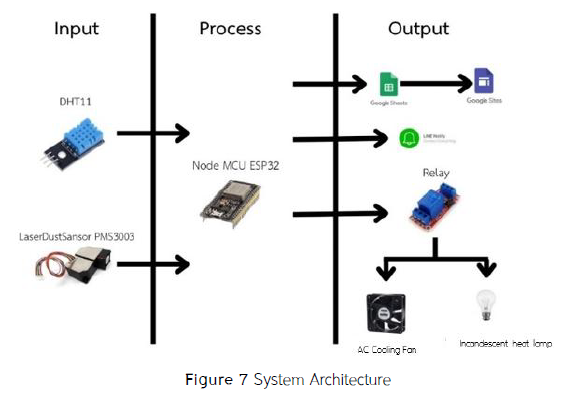
The Internet of Things technology has become essential in agriculture and livestock farming, offering automated environmental control solutions. Crickets, as an emerging economic livestock, have gained popularity among farmers due to their high nutritional value as an alternative protein source and their potential for high income generation. Applying IoT to cricket farming is a promising approach to enhancing efficiency and quality. This study aims to: 1) design and develop an IoT-based monitoring and control system for cricket farming, 2) evaluate the system's performance, and 3) assess the survival rate of crickets. The system monitors temperature, humidity, and PM2.5 dust levels, sending alerts for abnormal values to ensure optimal environmental conditions. The research involved five participants, including IoT experts and cricket farmers from Nakhon Ratchasima Province. Tools used included a system performance evaluation form, with data analyzed using mean and standard deviation. The findings revealed that the system accurately monitored and controlled the cricket farming environment and sent alerts via LINE Notify, resulting in improved farming efficiency, reduced risks, and lower farm maintenance costs. The performance evaluation showed high overall efficiency, with a mean score of 4.76 ± 0.42, while the cricket survival rate was significantly high at 94.56%.
References
Homkhiew, C & et al. (2023). Promoting the Use of Natural Fiber Hiding Materials to Produce High-Quality Crickets in Farms (Research Report). Rajamangala University of Technology Srivijaya. (In Thai)
Information and Statistical Data Group, Center for Information Technology and Communication, Department of Livestock Development. (2022). Livestock Statistics in Thailand 2022 (pp 162). (In Thai)
Jueachantuk, K & et al. (2025). Automated Rice Field Crab Farming System Using Internet of Things (IoT). Proceedings of the 2nd National and International Academic Conference, January 23–25, 2025. (In Thai)
Kanjanawanikul, K, Kaewsihawong, C, Uttaracha, W, & Yangyuen, S. (2020). Smart Cricket Farming Using Internet of Things. Journal of Farm Engineering and Automatic Control Technology, 6(2), 98–112. (In Thai)
Likhitpoonsap, T & Yuenyongwatthanakul, M. (2011). Car Comparison Web Application. (Bachelor of Science Thesis), Bangkok: Siam University. (In Thai)
Manwicha, C. (2016). Smart Farm Technology. Hat Yai Academic Journal, 14(2). (In Thai)
National Bureau of Agricultural and Food Standards. (2016). Promotion of Crickets as an Economic Insect.
Ngamwannakorn, C & Runraviwan, S. (2018). Development of Small-Scale Factory Equipment Control System Using Wireless Technology via Mobile Application under the Internet for Everything Concept. Yala Rajabhat University Research Report, pp 50. (In Thai)
Paengkoet, S & Duangsai, S. (2023). Automatic Aquarium Control System Using IoT. RMUT Bangkok Research Journal, 17(1), January–June 2023. (In Thai)
Prapagornkiat, S. (2021). Cricket Farming with Technology: Valuable Protein for the Future. from https://www.depa.or.th/th/article-view/cricket-future-technology. (In Thai)
Ratcharaksa, W, Boonchawna, P, & Awat, U. (2023). IoT Cricket House. Rajaprajanugroh 56 School, Nan Province, Office of Special Education Administration, Ministry of Education. (In Thai)
Soithongdee, N. and N. Nilapornkul. (2019). Cost and return of commercial cricket farming. MBA-KKU Journal, 12(1), 165-186. (in Thai)
Udomtanathira, K. (2019). System Development Cycle. from https://dol.dip.go.th/th/category/2019-02-08-08-57-30/2019-03-15-11-06-29. (In Thai)
Wangsinh, T, Semkan, J, & Racha, N. (2021). Smart Solar-Powered Incubator Using IoT Technology. Proceedings of the 1st National Student Academic Conference, February 22, 2021. Kamphaeng Phet: Kamphaeng Phet Rajabhat University. (In Thai)