
Design and Implementation of an Inertial Navigation System for Pedestrians Using Self-Correction Based on Zero Velocity Update Algorithms
Article Sidebar
Main Article Content
Abstract
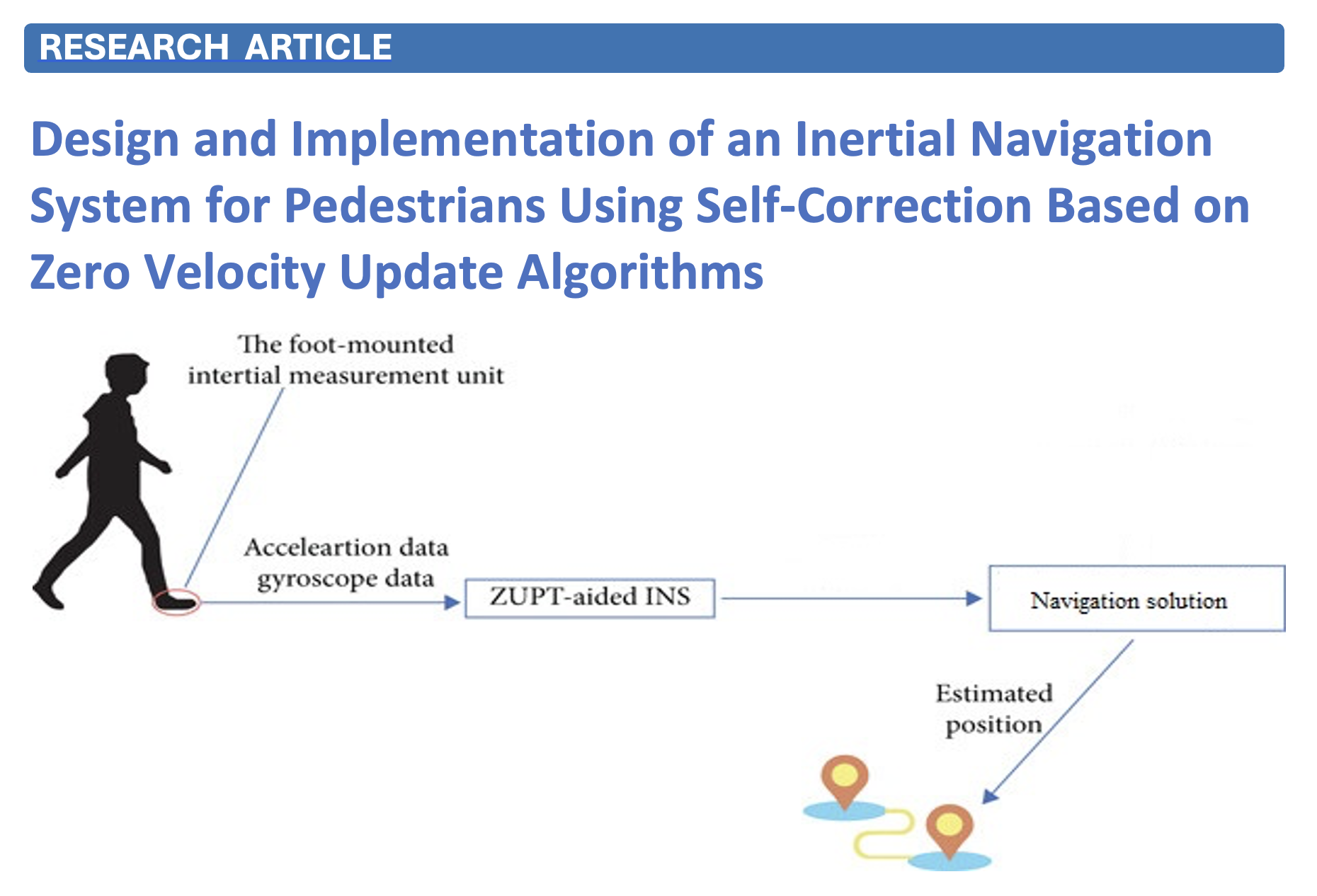
In pedestrian navigation systems, pedestrian positioning is typically computed using an inertial navigation algorithm. To mitigate cumulative drift errors inherent in the integration process of such systems, the zero-velocity update (ZUPT) technique is commonly employed. However, the effectiveness of ZUPT heavily depends on the accurate detection of zero-velocity intervals. This work evaluates and compares two distinct zero-velocity detection algorithms: an iterative model based on human gait phases and a sensor-based approach relying on inertial data during stationary periods. The detected zero-velocity information is subsequently utilized as a measurement vector within a Kalman filter framework to correct navigation errors during stance phases. Both algorithms were experimentally validated using four real pedestrian trajectories with durations of 6, 11, 16, and 22 minutes. The sensor-based method consistently outperformed the gait-model-based approach across all tested trajectories. Notably, during the longest 22-minute trial, the gait-model algorithm yielded a final positioning error of 3.6778 m, whereas the sensor-based algorithm achieved a lower error of 2.3798 m, representing a 35.3% improvement and the highest observed error reduction. On average, the proposed sensor-based method reduced positioning errors by approximately 30.4% compared to the iterative gait model. These findings demonstrate both the superior accuracy and robustness of the sensor-based zero-velocity detection method across varying walking durations, confirming its viability for real-time pedestrian navigation applications.
Article Details

This work is licensed under a Creative Commons Attribution-NonCommercial-NoDerivatives 4.0 International License.
All authors need to complete copyright transfer to Journal of Applied Informatics and Technology prior to publication. For more details click this link: https://ph01.tci-thaijo.org/index.php/jait/copyrightlicense
