
User-Centric Design Thinking Framework for Digital Transformation: Bridging the Digital Literacy Gap in Thai Manufacturing SMEs
Article Sidebar
Main Article Content
Abstract
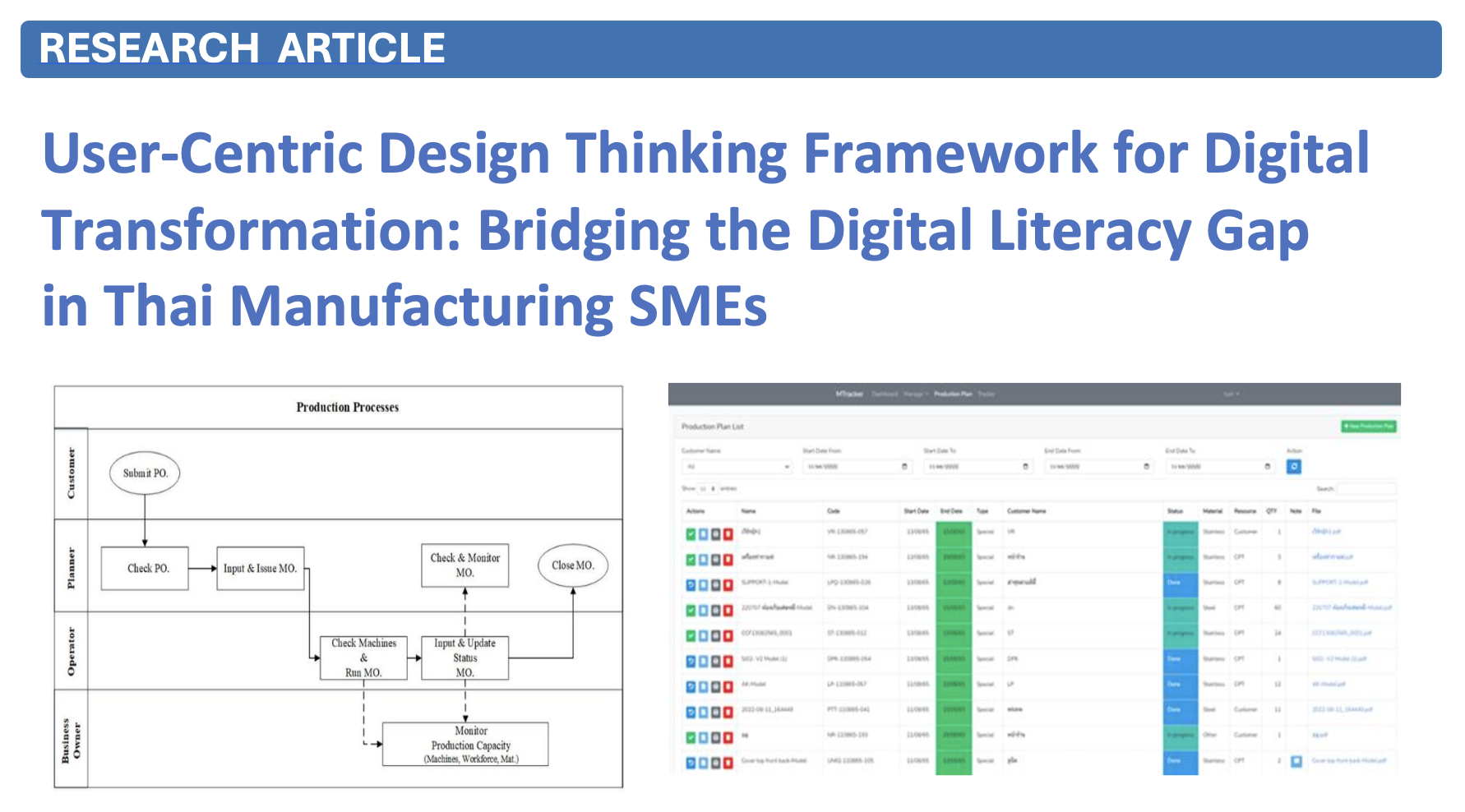
While digital transformation is essential for enhancing the competitiveness of Small and Medium-sized Enterprises (SMEs), a significant barrier remains in the form of low levels of employees' digital literacy. This study addresses this critical challenge by proposing and validating a User-Centric Design Thinking Framework for developing digital tools in environments characterized by varying levels of technological proficiency. Using a Thai manufacturing SME as a case study, the study employed a five-stage Design Thinking process involving 20 participants to develop a web-based production management system. The methodology emphasized empathy and iterative feedback to ensure the system was intuitive, accessible, and aligned with user needs. Post-implementation analyses revealed substantial operational improvements, including an 81.1% reduction in production monitoring time and an 80.7% decrease in reporting time, accompanied by significant cost savings. Usability testing, incorporating both qualitative feedback and quantitative assessment, demonstrated a high level of user satisfaction (mean score = 4.52 out of 5). The findings indicate that a user-centric approach is effective in not only bridging the digital literacy gap but also enhancing business performance. This study provides a practical and replicable framework for technology adoption in SMEs and contributes to the broader understanding of inclusive digital transformation in developing economies.
Article Details

This work is licensed under a Creative Commons Attribution-NonCommercial-NoDerivatives 4.0 International License.
All authors need to complete copyright transfer to Journal of Applied Informatics and Technology prior to publication. For more details click this link: https://ph01.tci-thaijo.org/index.php/jait/copyrightlicense
References
Benabderrazik, K., Lehner, M., Gwara, S., and Zondo, N. (2025). Growing critical minds and cultivating solutions: Design thinking as a useful toolkit and mindset for a project-based learning environment. ETH Learning and Teaching Journal, 5(1). DOI: 10.16906/lt-eth.v5i1.257.
Economic Research Institute for ASEAN and East Asia (ERIA) and Organisation for Economic Co-operation and Development (OECD) (2024). SME Policy Index: ASEAN 2024 – Enabling Sustainable Growth and Digitalisation. ERIA and OECD, Jakarta, Indonesia and Paris, France.
Faiz, F., Le, V., and Masli, E. K. (2024). Determinants of digital technology adoption in innovative SMEs. Journal of Innovation & Knowledge, 9(4):100610. DOI: 10.1016/j.jik.2024.100610.
Intaratat, K. (2022). Digital literacy and digital skills scenario of ASEAN marginal workers under and post COVID-19 pandemic. Open Journal of Business and Management, 10(1):118–133. DOI: 10.4236/ojbm.2022.101007.
International Organization for Standardization (1998). Ergonomic requirements for office work with visual display terminals (VDTs) – part 11: Guidance on usability (ISO 9241-11:1998).
R´acz-Szab´o, A., Ruppert, T., B´antay, L., L¨ocklin, A., Jakab, L., and Abonyi, J. (2020). Real-time locating system in production management. Sensors, 20(23).DOI: 10.3390/s20236766.
Rahman, M. A. and Jyoti, S. N. (2022). A systematic literature review of user-centric design in digital business systems: Enhancing accessibility, adoption, and organizational impact. Review of Applied Science and Technology, 1(4):1–25. DOI: 10.63125/ndjkpm77.
Reddy, P., Chaudhary, K., and Hussein, S. (2023). A digital literacy model to narrow the digital literacy skills gap. Heliyon, 9(4):e14878. DOI: 10.1016/j.heliyon.2023.e14878.
R¨osch, N., Tiberius, V., and Kraus, S. (2023). Design thinking for innovation: Context factors, process, and outcomes. European Journal of Innovation Management, 26(7):160–176. DOI: 10.1108/EJIM-03-2022-0164.
Vendraminelli, L., Macchion, L., Nosella, A., and Vinelli, A. (2023). Design thinking: Strategy for digital transformation. Journal of Business Strategy, 44(4):200–210. DOI: 10.1108/JBS-01-2022-0009.
