
Ubiquitous Collaborative Learning Applications: Driving Gender-Inclusive Success in Computer Education
Article Sidebar
Main Article Content
Abstract
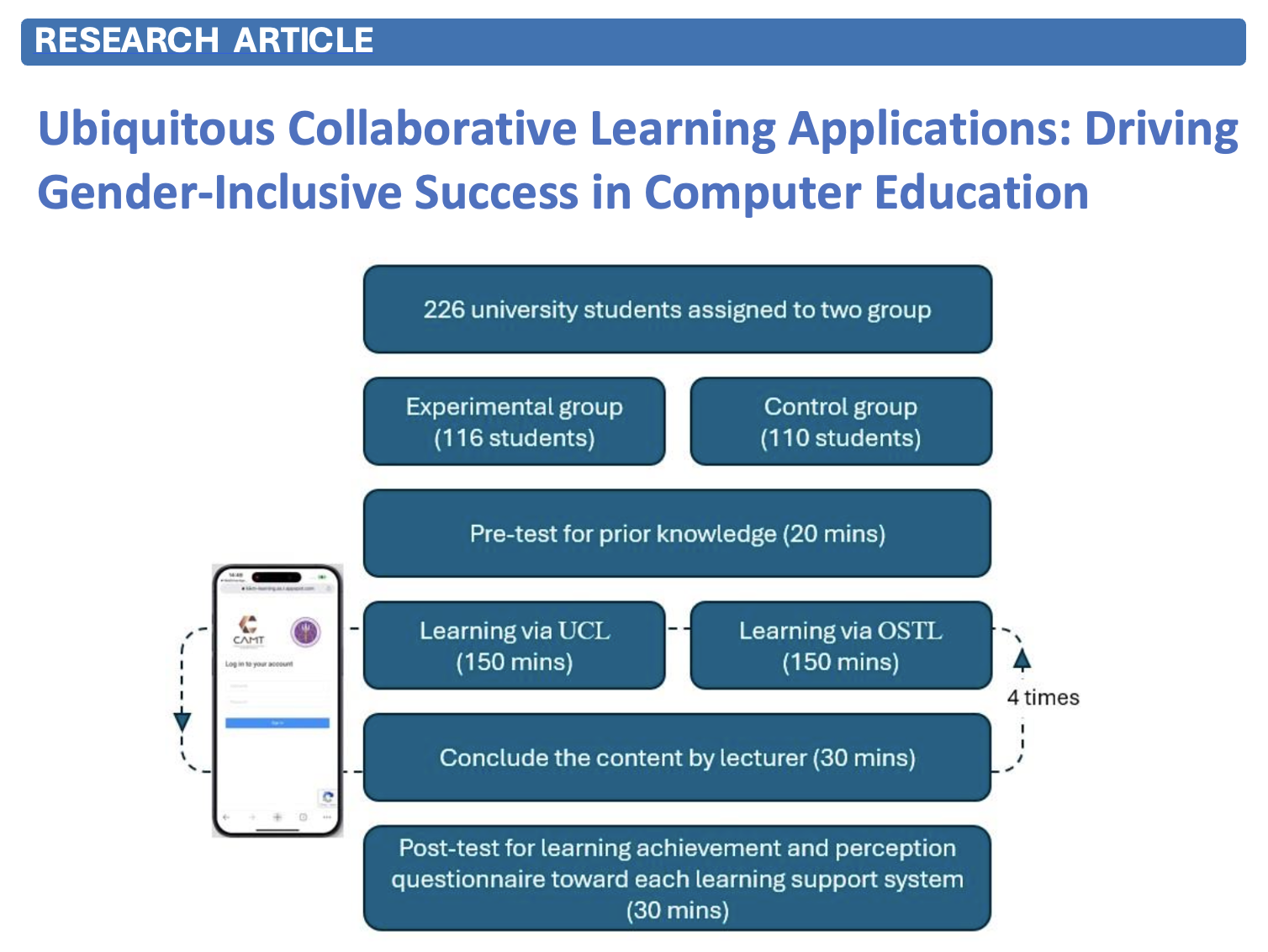
This study explores the transformative potential of ubiquitous collaborative learning applications in fostering gender-inclusive success in computer education. Persistent gender disparities in STEM fields, particularly in computing, highlight the need for innovative educational approaches that ensure equitable access and engagement. This research evaluates how these applications enhance learning achievement and perceptions equitably across genders, providing a promising pathway to address long-standing challenges in education. A mixed-methods approach was employed, involving 226 undergraduate computing students from northern Thailand. Data collected through pre- and post-tests and surveys revealed significant improvements in learning achievement for the experimental group, with no notable gender differences in outcomes. Additionally, students in the experimental group reported higher satisfaction with the application's user interface, perceived usefulness, ease of use, and overall learning experience than those in the control group. The findings underscore the capacity of ubiquitous collaborative learning applications to support inclusive and equitable education, addressing gender disparities while improving educational outcomes. The implications of this study are significant, highlighting the importance of leveraging innovative educational technologies to foster engagement, reduce inequities, and prepare students for the demands of the digital era.
Article Details

This work is licensed under a Creative Commons Attribution-NonCommercial-NoDerivatives 4.0 International License.
All authors need to complete copyright transfer to Journal of Applied Informatics and Technology prior to publication. For more details click this link: https://ph01.tci-thaijo.org/index.php/jait/copyrightlicense
References
Abdullah, W. D., Afikah, A., Apino, E., Supahar, and Jumadi (2024). Moderator effect of mobile learning on students’ achievement in physics: A meta-analysis. Journal of Baltic Science Education, 23(2):187–207. DOI: 10.33225/jbse/24.23.187.
Aithal, P. S. and Aithal, S. (2023). Stakeholders’ analysis of the effect of ubiquitous education technologies on higher education. International Journal of Applied Engineering and Management Letters, 7(2):102–133. DOI: 10.47992/IJAEML.2581.7000.0177.
Alamri, H. A., Watson, S., and Watson, W. (2021). Learning technology models that support personalization within blended learning environments in higher education. TechTrends, 65(1):62–78. DOI: 10.1007/s11528-020-00530-3.
Aljawarneh, S. A. (2020). Reviewing and exploring innovative ubiquitous learning tools in higher education. Journal of Computing in Higher Education, 32(1):57–73. DOI: 10.1007/s12528-019-09207-0.
Bairoh, S. (2023). The gender(ed) gap(s) in STEM: Explaining the persistent underrepresentation of women in STEM careers. PhD thesis, Hanken School of Economics. Doctoral thesis.
Barbosa, J. L. V., Barbosa, D. N. F., Rigo, S. J., de Oliveira, J. M., and Rabello, S. A. J. (2014). Integrating collaborative and decentralized models to support ubiquitous learning. International Journal of Information and Communication Technology Education, 10(3):77–86. DOI: 10.4018/ijicte.2014070106.
Borgonovi, F., Han, S. W., and Greiff, S. (2023). Gender differences in collaborative problem-solving skills and preferences. Journal of Educational Psychology, 115(5):747–766. DOI: 10.1037/edu0000788.
C´ardenas-Robledo, L. A. and Pe˜na-Ayala, A. (2018). Ubiquitous learning: A systematic review. Telematics and Informatics, 35(5):1097–1132. DOI: 10.1016/j.tele.2018.01.009.
Casta neda, L. and Williamson, B. (2021). Assembling new toolboxes of methods and theories for innovative critical research on educational technology. Journal of New Approaches in Educational Research, 10(1):1–14. DOI: 10.7821/naer.2021.1.703.
Chan, R. C. H. (2022). A social cognitive perspective on gender disparities in self-efficacy, interest, and aspirations in science, technology, engineering, and mathematics (STEM): The influence of cultural and gender norms. International Journal of STEM Education, 9:37. DOI: 10.1186/s40594-022-00352-0.
Chen, C.-C. and Huang, T.-C. (2012). Learning in a u-museum: Developing a context-aware ubiquitous learning environment. Computers & Education, 59(3):873–883. DOI: 10.1016/j.compedu.2012.04.003.
Chin, K.-Y., Lee, K.-F., and Chen, Y.-L. (2018). Using an interactive ubiquitous learning system to enhance authentic learning experi-
ences in a cultural heritage course. Interactive Learning Environments, 26(4):444–459. DOI: 10.1080/10494820.2017.1341939.
Costa, L. F. C., Nascimento, L. M. A., de Lima, Y. O., Santos, A. M., Barbosa, C. E., Xex’eo, G., and de Souza, J. M. (2024). Women’s journey in stem education in brazil: A rapid review on engineering and computer science. IEEE Access, 12:112576–112593. DOI: 10.1109/ACCESS.2024.3442879.
El-Hamamsy, L., Bruno, B., Audrin, C., Chevalier, M., Avry, S., Zufferey, J. D., and Mondada, F. (2023). How are primary school computer science curricular reforms contributing to equity? impact on student learning, perception of the discipline, and gender gaps. International Journal of STEM Education, 10:60. DOI: 10.1186/s40594-023-00438-3.
Elsafi, A. (2020). Augmented strategies for mobile and ubiquitous learning technologies. In Yu, S., Ally, M., and Tsinakos, A., editors, Emerging Technologies and Pedagogies in the Curriculum, pages 245–260. Springer Singapore. DOI: 10.1007/978-981-15-
-5 15.
Erkens, M. and Bodemer, D. (2019). Improving collaborative learning: Guiding knowledge exchange through the provision of information about learning partners and learning contents. Computers & Education, 128:452–472. DOI: 10.1016/j.compedu.2018.10.009.
Farhan, W., Razmak, J., Demers, S., and Laflamme, S. (2019). E-learning systems versus instructional communication tools: Developing and testing a new e-learning user interface from the perspectives of teachers and students. Technology in Society, 59:101192. DOI: 10.1016/j.techsoc.2019.101192.
Garlinska, M., Osial, M., Proniewska, K., and Pregowska, A. (2023). The influence of emerging technologies on distance education. Electronics, 12(7):1550. DOI: 10.3390/electronics12071550.
G´omez, S., Zervas, P., Sampson, D. G., and Fabregat, R. (2014). Context-aware adaptive and personalized mobile learning delivery supported by uolmp. Journal of King Saud University - Computer and Information Sciences, 26(1):47–61. DOI: 10.1016/j.jksuci.2013.06.002.
Grant, M. M. (2019). Difficulties in defining mobile learning: Analysis, design characteristics, and implications. Educational Technology Research and Development, 67:361–388. DOI: 10.1007/s11423-018-9630-y.
Haleem, A., Javaid, M., Qadri, M. A., and Suman, R. (2022). Understanding the role of digital technologies in education: A review. Sustainable Operations and Computers, 3:275–285. DOI: 10.1016/j.susoc.2022.05.006.
Ho, S.-C., Hsieh, S.-W., Sun, P.-C., and Chen, C.-M. (2017). To activate english learning: Listen and speak in real life context with an ar featured u-learning system. Educational Technology & Society, 20(2):176–187.
Hwang, G.-J. (2014). Definition, framework and research issues of smart learning environments: A context-aware ubiquitous learning perspective. Smart Learning Environments, 1(1):4. DOI: 10.1186/s40561-014-0002-7.
Jeong, H. and Hmelo-Silver, C. E. (2016). Seven affordances of computer-supported collaborative learning: How to support collaborative learning? how can technologies help? Educational Psychologist, 51(2):247–265. DOI: 10.1080/00461520.2016.1157929.
Karakaya, K. and Bozkurt, A. (2022). Mobile-assisted language learning (MALL) research trends and patterns through bibliometric analysis: Empowering language learners through ubiquitous educational technologies. System, 110:102925. DOI: 10.1016/j.system.2022.102925.
Kaur, M. (2018). Tools of ICT in open and distance learning for inclusive education in the developing world. In Technology for Efficient Learner Support Services in Distance Education: Experiences from Developing Countries, pages 23–41. IGI Global. DOI:
4018/978-1-5225-2978-7.ch002.
Liao, Y.-W., Huang, Y.-M., Chen, H.-C., and Huang, S.-H. (2015). Exploring the antecedents of collaborative learning performance over social networking sites in a ubiquitous learning context. Computers in Human Behavior, 43:313–323. DOI: 10.1016/j.chb.2014.11.025.
Liaw, S.-S. (2008). Investigating students’ perceived satisfaction, behavioral intention, and effectiveness of e-learning: A case study of the blackboard system. Computers & Education, 51(2):864–873. DOI: 10.1016/j.compedu.2007.09.005.
Lin, Y.-L. and Wang, W.-T. (2024). Enhancing students’ online collaborative pbl learning performance in the context of coauthoring-based technologies: A case of wiki technologies. Education and Information Technologies, 29(2):2303–2328. DOI: 10.1007/s10639-023-11907-1.
Loes, C. N. and Pascarella, E. T. (2017). Collaborative learning and critical thinking: Testing the link. The Journal of Higher Education, 88(5):726–753. DOI: 10.1080/00221546.2016.1267152.
Matthew, U. O., Kazaure, J. S., and Okafor, N. U. (2021). Contemporary development in e-learning education, cloud computing technology and internet of things. EAI Endorsed Transactions on Cloud Systems, 7(20):e3. DOI: 10.4108/eai.20-12-2021.170669.
McPeake, J., Hirshberg, E. L., Christie, L. M., Drumright, K., Haines, K., and Hough, C. L. (2019). Models of peer support to remediate post-intensive care syndrome: A report developed by the society of critical care medicine thrive international peer support collaborative. Critical Care Medicine, 47(1):e21–e27. DOI: 10.1097/CCM.0000000000003463.
MIT Professional Education (2023). The gender gap in stem: Still gaping in 2023. Accessed June 22, 2025.
Pardjono (2016). Active learning: The dewey, piaget, vygotsky, and constructivist theory perspectives. Jurnal Ilmu Pendidikan, 9(3). Metadata should be verified from the journal source before submission, DOI: 10.17977/jip.v9i3.7712.
Parthasarathy, P., Mittal, A., Aggarwal, A., Mantri, A., and Singh, N. (2024). The covid-19 fighter: An interactive learning platform. Information Discovery and Delivery. DOI: 10.1108/IDD-02-2024-0010.
Pavlov, V. (2024). Higher education policies for female retention in computer science. Delft University of Technology Repository. Accessed June 22, 2025.
Pimmer, C., Mateescu, M., and Gr”ohbiel, U. (2016). Mobile and ubiquitous learning in higher education settings: A systematic review of empirical studies. Computers in Human Behavior, 63:490–501. DOI: 10.1016/j.chb.2016.03.045.
Qurat-ul-Ain, Shahid, F., Aleem, M., Islam, M. A., Iqbal, M. A., and Yousaf, M. M. (2019). A review of technological tools in teaching and learning computer science. Eurasia Journal of Mathematics, Science and Technology Education, 15(11). DOI: 10.29333/ejmste/109611.
Rahman, L. (2024). Vygotsky’s zone of proximal development of teaching and learning in STEM education. International Journal of Engineering Research and Technology, 13(8):389–394. DOI: 10.17577/IJERTV13IS080389.
Saleem, A., Kausar, H., and Deeba, F. (2021). Social constructivism: A new paradigm in teaching and learning environment. Perennial Journal of History, 2(2):403–421. DOI: 10.53697/pjhs.v2i2.1159.
Schmid, R. and Petko, D. (2019). Does the use of educational technology in personalized learning environments correlate with self-reported digital skills and beliefs of secondary-school students? Computers and Education, 136:75–86. DOI: 10.1016/j.compedu.2019.03.006.
Silva, D. C., Salati, L. R., Villas-Bˆoas, A. P., Schwarz, K., Fontanari, A. M., Soll, B., Costa, A. B., Hirakata, V., Schneider, M., and Lobato, M. I. R. (2021). Factors associated with ruminative thinking in individuals with gender dysphoria. Frontiers in Psychiatry, 12:602293. DOI: 10.3389/fpsyt.2021.602293.
Srivastava, S., Varshney, A., Katyal, S., Kaur, R., and Gaur, V. (2021). A smart learning assistance tool for inclusive education. Journal of Intelligent and Fuzzy Systems, 40(6):11981–11994. DOI: 10.3233/JIFS-202970.
Tham, J. C. K. and Verhulsdonck, G. (2023). Smart education in smart cities: Layered implications for networked and ubiquitous learning. IEEE Transactions on Technology and Society, 4(1):87–95. DOI: 10.1109/TTS.2023.3239478.
Thongkoo, K., Panjaburee, P., and Daungcharone, K. (2019). A development of ubiquitous learning support system based on an enhanced inquiry-based learning approach. International Journal of Mobile Learning and Organisation, 13(2):129–151. DOI: 10.1504/IJMLO.2019.10019445.
Ullah, A. and Anwar, S. (2020). The effective use of information technology and interactive activities to improve learner engagement. Education Sciences, 10(12):349. DOI: 10.3390/educsci10120349.
Vallejo-Correa, P., Monsalve-Pulido, J., and Tabares-Betancur, M. (2021). A systematic mapping review of context-aware analysis and its approach to mobile learning and ubiquitous learning processes. Computer Science Review, 39:100335. DOI: 10.1016/j.cosrev.2020.100335.
Virtanen, M. A., Haavisto, E., Liikanen, E., and K¨a¨ari¨ainen, M. (2018). Ubiquitous learning environments in higher education: A scoping literature review. Education and Information Technologies, 23:985–998. DOI: 10.1007/s10639-017-9642-1.
Wu, S.-Y. (2020). Incorporation of collaborative problem solving and cognitive tools to improve higher cognitive processing in online discussion environments. Journal of Educational Computing Research, 58(1):249–272. DOI: 10.1177/0735633119888879.
Yates, J. and Plagnol, A. C. (2022). Female computer science students: A qualitative exploration of women’s experiences studying computer science at university in the uk. Education and Information Technologies, 27(3):3079–3105. DOI: 10.1007/s10639-021-10743-5.
Yousif, J. H. (2025). Artificial intelligence revolution for enhancing modern education using zone of proximal development approach. Applied Computing Journal, pages 386–398. DOI: 10.52098/acj.20255239.
Zabolotska, O., Zhyliak, N., Hevchuk, N., Petrenko, N., and Alieko, O. (2021). Digital competencies of teachers in the transformation of the educational environment. Journal of Optimization in Industrial Engineering, 14(Special Issue):25–32. DOI: 10.30495/JOIE.2021.1927702.1643.
Zajda, J. (2021). Constructivist learning theory and creating effective learning environments. In Zajda, J., editor, Globalisation and Education Reforms: Creating Effective Learning Environments, pages 35–50. Springer, Cham. DOI: 10.1007/978-3-030-71575-5_3.
