
A Comparative Study of Sea Lettuce Cultivation in Seawater and Scientific Saltwater using IoT Technology
Article Sidebar
Main Article Content
Abstract
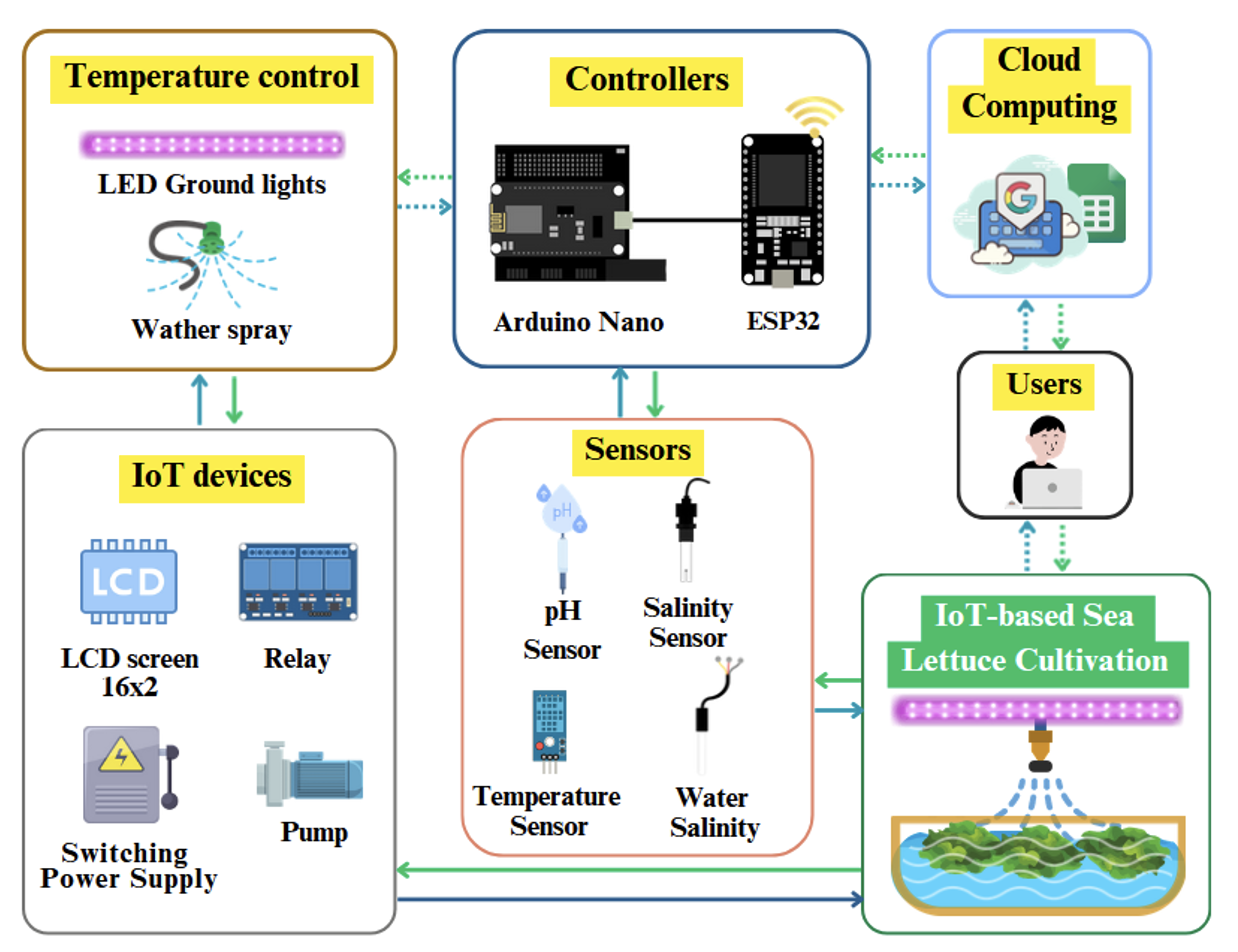
Ulva Rigida, known as sea lettuce, is a variety of marine algae that exhibits a high degree of cultivation feasibility. Sea lettuce offers numerous health benefits and is increasingly being considered as a future food source that could promote commercial cultivation. However, challenges arise in assessing the feasibility of utilizing seawater appropriately, which could be addressed by incorporating the Internet of Things (IoT) into this study. This research aims to investigate and compare the growth of sea lettuce between seawater and scientific saltwater using IoT based on temperature-controlling systems. The IoT-enabled sea lettuce cultivation system can record and display real-time data using Arduino Nano. The results show that the scientific saltwater closely approximates the properties of seawater during the 21-day cultivation period. Sea lettuce cultivated in seawater exhibited greater growth and weight gain compared to cultivation in scientific saltwater. The average weight gain per day was 3.27 grams for seawater cultivation and 2.83 grams for scientific saltwater cultivation, indicating a difference of 0.44 grams. These experimental results demonstrate the feasibility of using scientific saltwater, which exhibits properties resembling seawater. Cultivating with scientific saltwater facilitates ease of cultivation and eliminates the need for coastal locations. Additionally, it has the potential to reduce pollution in marine environments.
Article Details

This work is licensed under a Creative Commons Attribution-NonCommercial-NoDerivatives 4.0 International License.
All authors need to complete copyright transfer to Journal of Applied Informatics and Technology prior to publication. For more details click this link: https://ph01.tci-thaijo.org/index.php/jait/copyrightlicense




References
Bachtiar, M. I., Hidayat, R., & Anantama, R. (2022). Internet of things (IoT) based aquaculture monitoring system. MATEC Web of Conferences, 372, 04009. https://doi.org/10.1051/matecconf/202237204009
Boonlertvanit, T. (2020). A study to develop a technology roadmap for Thailand’s novel food industry based on public policy-making and academics’ perspectives [Master’s dissertation, Mahidol University]. https://archive.cm.mahidol.ac.th/handle/123456789/4243 [In Thai]
de Camargo, E. T., Spanhol, F. A., Slongo, J. S., da Silva, M. V. R., Pazinato, J., de Lima Lobo, A. V., Coutinho, F. R., Pfrimer, F. W. D., Lindino, C. A., Oyamada, M. S., & Martins, L. D. (2023). Low-cost water quality sensors for IoT: A systematic review. Sensors, 23(9), 4424. https://doi.org/10.3390/s23094424
Iskandar, Samuel, C. I., Favitri, D., Padlan, & Azizi. (2021). IoT-based of seaweed cultivation employing a low-cost autonomous experimental buoy. 2021 15th International Conference on Telecommunication Systems, Services, and Applications (TSSA), 1–5. https://doi.org/10.1109/tssa52866.2021.9768270
Jahanbakht, M., Xiang, W., Hanzo, L., & Rahimi Azghadi, M. (2021). Internet of underwater things and big marine data analytics—A comprehensive survey. IEEE Communications Surveys & Tutorials, 23(2), 904–956. https://doi.org/10.1109/comst.2021.3053118
Liang, Z., Wang, W., Liu, L., Li, G., & Xia, B. (2022). Influence of commercial-scale seaweed cultivation on water quality: A case study in a typical laver culture area of the Yellow Sea, North China. Journal of Marine Science and Engineering, 10(5), 681. https://doi.org/10.3390/jmse10050681
Mouritsen, O. G., Rhatigan, P., & Pérez-Lloréns, J. L. (2018). World cuisine of seaweeds: Science meets gastronomy. International Journal of Gastronomy and Food Science, 14, 55–65. https://doi.org/10.1016/j.ijgfs.2018.09.002
Nguyen, D. K., Nguyen, H. Q., Dang, H. T. T., Nguyen, V. Q., & Nguyen, L. (2022). A low-cost system for monitoring pH, dissolved oxygen and algal density in continuous culture of microalgae. HardwareX, 12, e00353. https://doi.org/10.1016/j.ohx.2022.e00353
Peres, C., Emam, M., Jafarzadeh, H., Belcastro, M., & O’Flynn, B. (2021). Development of a low-power underwater NFC-enabled sensor device for seaweed monitoring. Sensors, 21(14), 4649. https://doi.org/10.3390/s21144649
Purnamawati, Yahya, M., Jamaluddin, & Akil, M. (2021). Implementation of temperature monitoring system in seaweed drying room. International Journal on Advanced Science, Engineering and Information Technology, 11(5), 1912. https://doi.org/10.18517/ijaseit.11.5.13834
Rukhiran, M., & Netinant, P. (2020). Mobile application development of hydroponic smart farm using information flow diagram. 2020 5th International Conference on Information Technology (InCIT), 150–155. https://doi.org/10.1109/incit50588.2020.9310780
Rukhiran, M., Sutanthavibul, C., Boonsong, S., & Netinant, P. (2023). IoT-based mushroom cultivation system with solar renewable energy integration: Assessing the sustainable impact of the yield and quality. Sustainability, 15(18), 13968. https://doi.org/10.3390/su151813968
Siddiqui, M., Zaidi, A., & Abdullah, M. (2019). Performance evaluation of newly proposed seaweed enhancing index (SEI). Remote Sensing, 11(12), 1434. https://doi.org/10.3390/rs11121434
Somchun, C. (2023). Sea lettuce seaweed eating fresh and processed is very valuable. Retrieved 17 April 2023. Retrieved from https://www.thairath.co.th/news/local/2681306
Tanchaiha, A., Pichitkul, P., Wudtisin, I., & Tamtin, M. (2021). Effects of nitrogen fertilizers on growth and antioxidant activities of sea lettuce (Ulva rigida), Khon Kaen Agriculture Journal, 50(1), 100-111. https://li01.tci-thaijo.org/index.php/agkasetkaj/article/view/249532 [In Thai]
Vinil, K. (2023). Upgrading sea lettuce seaweed to food & cosmeceutical products. Retrieved 7 July 2023. Retrieved from https://www.thairath.co.th/news/local/east/2707495
