
The Flood Simulation System as a New Process for Public Participation of Local Administrative Organizations in Tha Wang Pha District, Nan Province
Article Sidebar
Main Article Content
Abstract
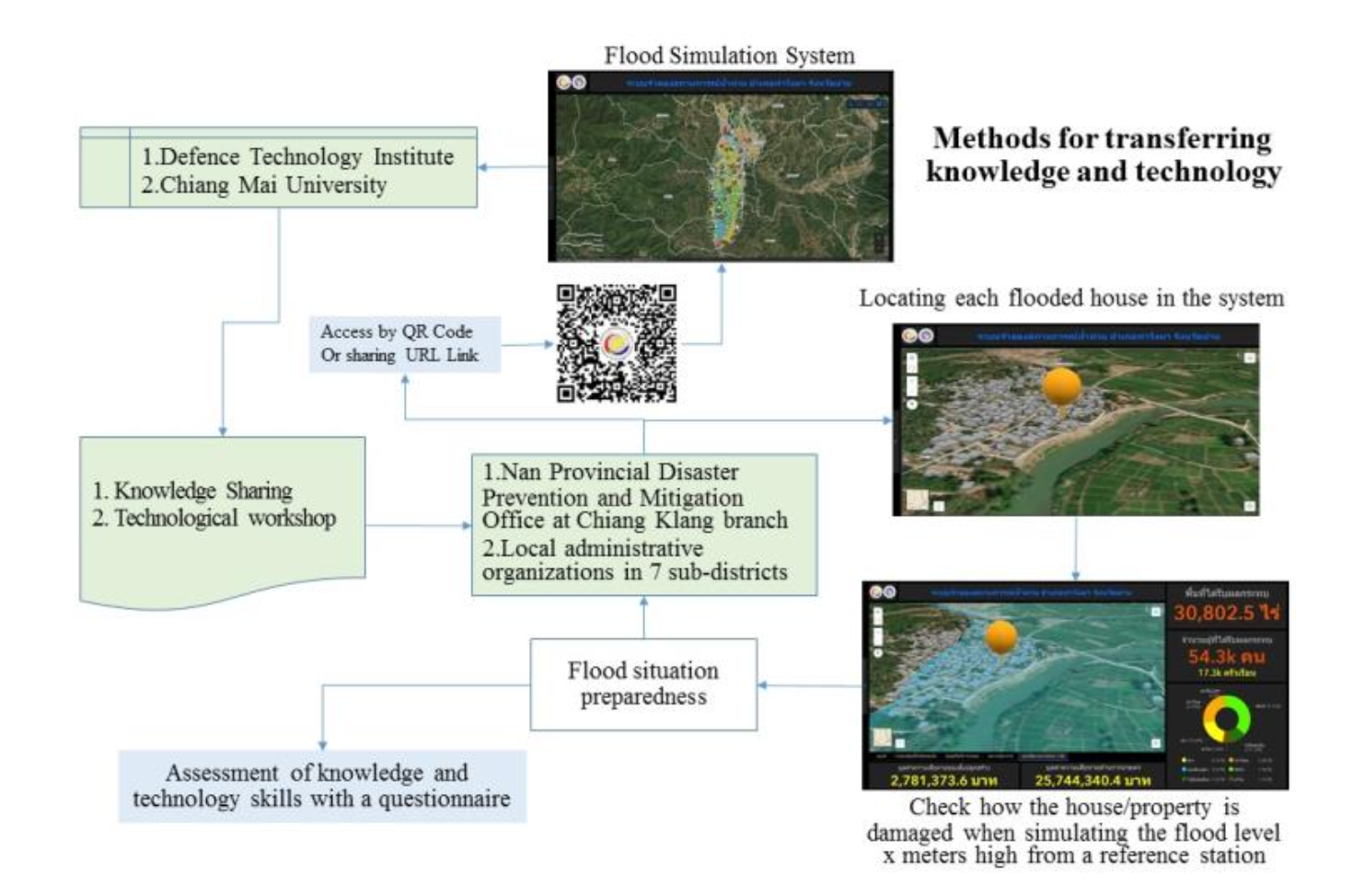
This research paper discusses the new process for public participation of 7 local administrative organizations in Tha Wang Pha District, Nan Province in preparedness for flooding situation. Activities for the knowledge and technology transfer of a flood simulation system were conducted and attended by 50 invited representatives, who were presented with 5 questionnaires to test their acquired knowledge and skills. The willingness to apply the knowledge and skills to flood situation preparedness of their workplace or missions was analyzed through sub-questions and illustrated in a series of tables. The results showed that the contents of the knowledge sharing were comprehended between 82-90%. Following the technological workshop, the participants planned to use the knowledge to flood preparedness at 100% with measured skills at 100%. The paper concluded that 100% of the respondents agreed with the use of the flood simulation system in terms of building cooperation upon the knowledge and technology exposure, collaboration with relevant agencies, and support for the implementation of the flood simulation system. The official coordination of agencies and institutes was the key for the successfully organized activities, thus be it the new process for the focus-group public participation of local administrative organizations.
Article Details

This work is licensed under a Creative Commons Attribution-NonCommercial-NoDerivatives 4.0 International License.
All authors need to complete copyright transfer to Journal of Applied Informatics and Technology prior to publication. For more details click this link: https://ph01.tci-thaijo.org/index.php/jait/copyrightlicense




References
Abdulkasan, A., Arguillas, D., Espinosa, F., & Pardillo, J. (2021). The extent of public participation in disaster risk reduction and management of Cotabato City, Mindanao, Philippines. International Journal of Humanities Social Sciences and Education (IJHSSE), 8(12), 8–22. https://doi.org/10.20431/2349-0381.0812002
Adams, R. M., Evans, C., Wolkin, A., Thomas, T., & Peek, L. (2022). Social vulnerability and disasters: Development and evaluation of a CONVERGE training module for researchers and practitioners. Disaster Prevention and Management: An International Journal, 31(6), 13–29. https://doi.org/10.1108/DPM-04-2021-0131
Balci, O. (1998). Verification, validation, and testing (Chapter 10, pp. 335–393). In J. Banks (Ed.), Handbook of simulation: Principles, methodology, advances, applications, and practice (pp. 335–393). New York: John Wiley & Sons, Inc.
Banks, J. (1998). Principles of simulation (Chapter 1, pp. 1–30). In J. Banks (Ed.), Handbook of simulation: Principles, methodology, advances, applications, and practice (pp. 1–30). New York: John Wiley & Sons, Inc.
Bibi, T., Nawaz, F., & Abdul, A. (2018). Flood risk assessment of River Kabul and Swat catchment area, District Charsadda, Pakistan. In A. A. Rahman & H. Karim (Eds.), Proceedings of the International Conference Geomatics & Geospatial Technology (GGT 2018), 4-5 September 2018, ParkRoyal Hotel, Kuala Lumpur, Malaysia (pp. 17–25).
Bryman, A. (2007). The research question in social research: What is its role? International Journal of Social Research Methodology, 10(1), 5–20. https://doi.org/10.1080/13645570600655282
Duan, R., Liu, J., Wang, C., & Wei, G. (2020). Influencing factors of public participation in meteorological disaster prevention and mitigation. Sustainability, 12(8), 3108. https://doi.org/10.3390/su12083108
Gultom, D. I. (2016). Community-based disaster communication: How does it become trustworthy? Disaster Prevention and Management, 25(4), 478–491. https://doi.org/10.1108/DPM-02-2016-0026
Hsu, C.-W. (2017). What should we do? The after-action review of village heads’ information seeking and decision making during the unprecedented Kaohsiung blast. Disaster Prevention and Management, 26(5), 582–596. https://doi.org/10.1108/DPM-03-2017-0059
Ismail, F. K. M., & Zubairi, A. M. B. (2022). Item objective congruence analysis for multidimensional items: Content validation of a reading test in Sri Lankan University. English Language Teaching, 15(1), 106-117. https://doi.org/10.5539/elt.v15n1p106
Kamarudin, K. H., Razak, K. A., Hasan, R. C., Wan Mohd Rani, W. N. M., Kamal, F., Omar Chong, N., & Sardi, F. (2018). Disaster risk reduction at community level: Action planning approach. In A. A. Rahman & H. Karim (Eds.), Proceedings of the International Conference Geomatics & Geospatial Technology (GGT 2018), September 4–5, 2018, ParkRoyal Hotel, Kuala Lumpur, Malaysia (pp. 259–263).
Khamutova, M. V., Rezchikov, A. F., Kushnikov, V. A., & Ivashchenko, V. A. (2021). Simulation model for determining the flood effects characteristics. IFAC-PapersOnLine, 54(13), 103–106. https://doi.org/10.1016/j.ifacol.2021.10.427
Lucett, E. (2002). Public participation in disaster mitigation in Cambria, CA (Master’s thesis). California Polytechnic State University. https://digitalcommons.calpoly.edu/cgi/viewcontent.cgi?article=1011&context=nres_rpt
Marchezini, V., Porto De Albuquerque, J., Pitidis, V., Rudorff, C., Lima-Silva, F., Klonner, C., & Martins, M. (2022). Flood risk governance in Brazil and the UK: Facilitating knowledge exchange through research gaps and the potential of citizen-generated data. Disaster Prevention and Management: An International Journal, 31(6), 30-44. https://doi.org/10.1108/DPM-01-2022-0016
Musselman, K. J. (1998). Guidelines for success (Chapter 22, pp. 721–740). In J. Banks (Ed.), Handbook of simulation: Principles, methodology, advances, applications, and practice (pp. 721–740). New York: John Wiley & Sons, Inc.
Samdaengchai, B., Sinnung, S., Meena, P., & Laos, T. (2022). An analysis on disasters caused by flood via data from SENTINEL-1 satellite. International Journal on Technical and Physical Problems of Engineering (IJTPE), 14(2), 22–26.
Tamang, S. L., Saikhom, V., Singh, N. R., & Bhutia, Z. T. (2014). 3D flood simulation system using RS & GIS. International Journal of Engineering Research & Technology (IJERT), 3(5), 2218–2222.
van den Bout, B., Jetten, V. G., van Westen, C. J., & Lombardo, L. (2023). A breakthrough in fast flood simulation. Environmental Modelling & Software, 168, 105787. https://doi.org/10.1016/j.envsoft.2023.105787
Yeo, J., & Comfort, L. K. (2017). An expected event, but unprecedented damage: Structure and gaps of large-scale response coordination of the 2011 Thailand floods. Disaster Prevention and Management: An International Journal, 26(4), 458–470. https://doi.org/10.1108/DPM-02-2017-0048
