
CFD-Guided design and experimental validation of a horizontal ribbon-blade mixer for commercial Leucaena leucocephala-based ruminant feed production
Article Sidebar
Main Article Content
Abstract
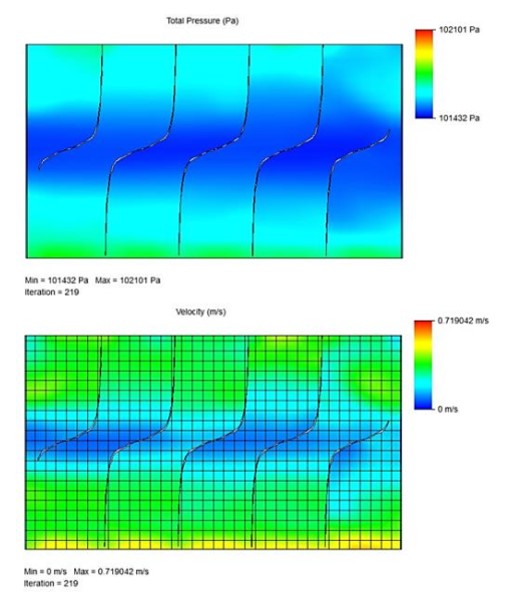
Homogeneous mixing of compound animal feed is a prerequisite for nutritional consistency, growth performance, and economic feasibility in commercial ruminant production. Acacia (Leucaena leucocephala) wood chips have emerged as a low-cost, locally available protein-rich roughage in tropical Southeast Asia, but their irregular particle geometry and density mismatch with conventional concentrates pose a persistent processing challenge. This study presents a coupled computational and experimental framework for the design and validation of a 1.5 m3 horizontal ribbon-blade mixer tailored for L. leucocephala-based feed production. Three blade geometries—screw, paddle, and double helical ribbon—were comparatively evaluated using a transient three-dimensional CFD model (Volume-of-Fluid multiphase coupled with a moving reference frame and the k–ε turbulence closure) at shaft speeds of 10, 20, and 50 rpm over a 20 min mixing cycle. The ribbon geometry consistently outperformed the screw and paddle blades, reducing the predicted Coefficient of Variation (CV) from 42.1 % to 11.7 % within 6 min. A full-scale prototype with a centerline ribbon diameter of 1.14 m, pitch of 0.51 m, and a 10 kW motor was subsequently fabricated. Experimental sampling at ten radial–axial locations and one discharge point yielded a minimum CV of 7.01 % and a Lacey mixing index of 0.987 at 10 rpm after 5 min, in close agreement with the CFD prediction (CV = 7.1 %; relative error = 1.3 %). The validated prototype achieved a throughput of 4.5 t h−1 at a specific energy consumption of 0.42 kWh t−1 and a simple payback period of 2.63 years. The combined numerical–experimental–economic evidence demonstrates that CFD-guided geometric selection can deliver a commercially deployable, energy-efficient mixer for heterogeneous lignocellulosic–protein feed mixtures.
Article Details

This work is licensed under a Creative Commons Attribution-NonCommercial-NoDerivatives 4.0 International License.

This work is licensed under a Creative Commons Attribution-NonCommercial-NoDerivatives 4.0 International License.
References
Barros-Rodríguez M, Sandoval-Castro CA, Solorio-Sánchez J, Sarmiento-Franco LA, Rojas Herrera R, Klieve AV. Leucaena leucocephala in ruminant nutrition. Trop Subtrop Agroecosystems. 2014;17:173-83. DOI: https://doi.org/10.56369/tsaes.2026
Halmemies-Beauchet-Filleau A, Rinne M, Lamminen M, Mapato C, Ampapon T, Wanapat M, et al. Review: Alternative and novel feeds for ruminants: nutritive value, product quality and environmental aspects. Animal. 2018;12:s295-309. DOI: https://doi.org/10.1017/S1751731118002252
Irawan F, Halliday MJ, Hegarty RS, Cowley FC. The effects and toxicological mechanisms of leucaena toxicity on ruminant reproduction: a review. Toxicon 2025;260:108367. DOI: https://doi.org/10.1016/j.toxicon.2025.108367
McSweeney CS, Halliday M, Mackie RI. Rumen Synergistota: new insights into their role in mimosine and fluoroacetate toxicity of ruminant livestock. Appl Environ Microbiol. 2025;91:e00380-25. DOI: https://doi.org/10.1128/aem.00380-25
Phesatcha K, Wanapat M. Improvement of nutritive value and in vitro ruminal fermentation of Leucaena silage by molasses and urea supplementation. Asian-Australas J Anim Sci. 2015;29(8):1136-44. DOI: https://doi.org/10.5713/ajas.15.0591
Giang NTT, Wanapat M, Phesatcha K, Kang S. Level of Leucaena leucocephala silage feeding on intake, rumen fermentation, and nutrient digestibility in dairy steers. Trop Anim Health Prod. 2016;48:1057-64. DOI: https://doi.org/10.1007/s11250-016-1060-3
Soltan YA, Morsy AS, Sallam SMA, Louvandini H, Abdalla AL. Comparative in vitro evaluation of forage legumes (prosopis, acacia, atriplex, and leucaena) on ruminal fermentation and methanogenesis. J Anim Feed Sci. 2012;21(4):759-72. DOI: https://doi.org/10.22358/jafs/66148/2012
Halliday MJ, Padmanabha J, McSweeney CS, Kerven G, Shelton HM. Leucaena toxicity: a new perspective on the most widely used forage tree legume. Trop Grassl-Forrajes Trop. 2013;1:1-11. DOI: https://doi.org/10.17138/TGFT(1)1-11
Mohamed M. Mixing: guidelines for quality feed production ensuring better animal performance [Internet]. 2020 [cited 2026 May 1]. Available from: https://en.engormix.com/feed-machinery/feed-pelletizing/mixing-guidelines-quality-feed_a45826/.
Basinskas G, Sakai M. Numerical study of the mixing efficiency of a ribbon mixer using the discrete element method. Powder Technol. 2016;287:380-94. DOI: https://doi.org/10.1016/j.powtec.2015.10.017
Cleary PW, Sinnott MD. Assessing mixing characteristics of particle-mixing and granulation devices. Particuology. 2008;6(6):419-44. DOI: https://doi.org/10.1016/j.partic.2008.07.014
Chandratilleke GR, Zhou YC, Yu AB, Bridgwater J. Effect of blade speed on granular flow and mixing in a cylindrical mixer. Ind Eng Chem Res. 2010;49(11):5467-78. DOI: https://doi.org/10.1021/ie901581t
Halidan M, Chandratilleke GR, Dong KJ, Yu AB. Mixing performance of ribbon mixers: effects of operational parameters. Powder Technol. 2018;325:92-106. DOI: https://doi.org/10.1016/j.powtec.2017.11.009
Gao W, Liu L, Liao Z, Chen S, Zang M, Tan Y. Discrete element analysis of the particle mixing performance in a ribbon mixer with a double U-shaped vessel. Granular Matter. 2019;21:12. DOI: https://doi.org/10.1007/s10035-018-0864-4
Cajindos JR. Design and fabrication of horizontal screw type mixer for livestock feed meal. JPAIR Multidisciplinary Research. 2014;15:82-100. DOI: https://doi.org/10.7719/jpair.v15i1.266
Bekele G, Gebiso T. Development of livestock feed mixer. Oromia Agricultural research institute workshop proceeding on Adaptation and Generation of Agricultural Technologies, vol. 3; 2019 Jun 26-29; Addis Ababa, Ethiopia. Addis Ababa: Oromia Agricultural Research Institute (IQQO); 2019. p. 316-26.
Bridgwater J. Mixing of powders and granular materials by mechanical means—a perspective. Particuology. 2012;10(4):397-427. DOI: https://doi.org/10.1016/j.partic.2012.06.002
Groesbeck CN, Goodband RD, Tokach MD, Dritz SS, Nelssen JL, DeRouchey JM. Diet mixing time affects nursery pig performance. J Anim Sci. 2007;85(7):1793-8. DOI: https://doi.org/10.2527/jas.2007-0019
Jin X, Chandratilleke GR, Wang S, Shen Y. DEM investigation of mixing indices in a ribbon mixer. Particuology. 2022;60:37-47. DOI: https://doi.org/10.1016/j.partic.2021.03.005
Xu W, Zhu J, Du X, Ma Y, Long J, Li X. CFD analysis of mixing homogeneity and mass transfer synergy in a three-blade planetary mixer. AIChE J. 2025;71(11):e70043. DOI: https://doi.org/10.1002/aic.70043
Fan C, Shi Y, Sun J, He R, Xu G, Li Y. DEM-CFD simulation of organic–inorganic fertiliser mixing-spreading: optimizing inorganic fertiliser placement for uniformity. Agriculture. 2025;15(21):2256. DOI: https://doi.org/10.3390/agriculture15212256
Jin X, Wang S, Shen Y. Effects of operating conditions and particle properties on mixing performance in an industrial-scale U-shape ribbon mixer. Powder Technol. 2022;411:117933. DOI: https://doi.org/10.1016/j.powtec.2022.117933
Berk Z. Food process engineering and technology. 3rd ed. New York: Academic press; 2018.
Tongtib A, Wichitkul P. Design and test of horizontal rice mixer with ribbon stirring blade. Academic Journal Uttaradit Rajabhat University Science and Technology. 2022;17(2):37-54. (In Thai)
Clark PM, Behnke KC, Poole DR. Effects of marker selection and mix time on the coefficient of variation (mix uniformity) of broiler feed. J Appl Poult Res. 2007;16(3):464-70. DOI: https://doi.org/10.1093/japr/16.3.464
Yeow ST, Shahar A, Abdul Aziz N, Anuar MS, Yusof YA, Taip FS. The influence of operational parameters and feed preparation in a convective batch ribbon powder mixer. Drug Des Devel Ther. 2011;5:465-9. DOI: https://doi.org/10.2147/DDDT.S25047
Herrman T, Behnke K. Testing mixer performance Manhattan: Kansas State University; 1994.
ASABE. ASAE EP496.3: Agricultural machinery management. St. Joseph: American Society of Agricultural and Biological Engineers; 2006.
