
HSEL: An adaptive rotational hybrid stacking ensemble with exponential accuracy weighting for real-time forest fire risk prediction
Article Sidebar
Main Article Content
Abstract
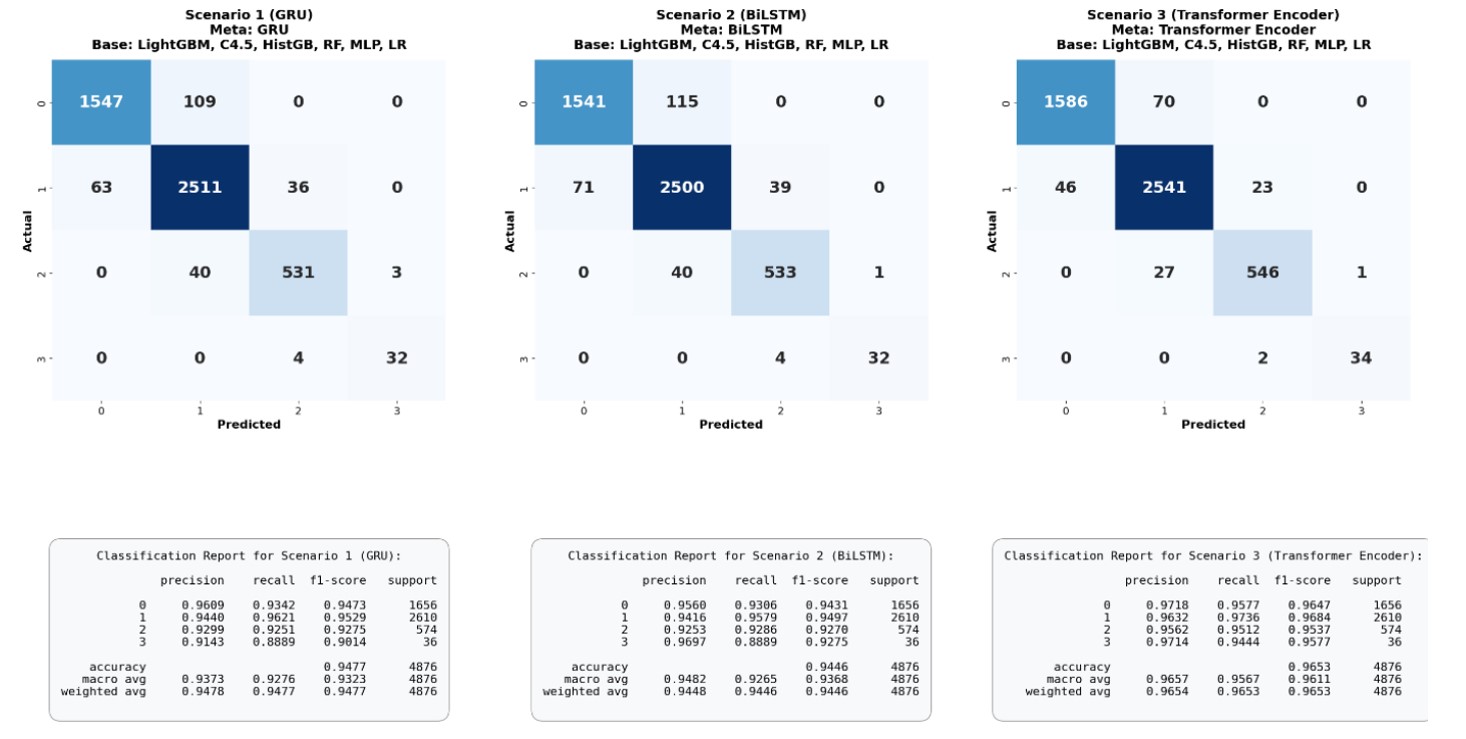
This study proposes the HSEL model to improve the accuracy of fire risk predictions based on meteorological data and real-time IoT integration. The main issues with individual models are their susceptibility to bias and overfitting, while conventional stacking methods have not been able to effectively optimize the contribution of each base model. HSEL addresses these issues through the application of exponential accuracy weighting with parameter α = 5 and hyperparameter optimization using Optuna. The results show that accuracy improved from 87.80%–88.26% in the base stacking to 92.55%–94.20% after applying weighting, and reached 96.53% after optimization. Additionally, the model demonstrates stable performance, is capable of handling data imbalance, and possesses good generalization ability. This model also successfully improves classification balance across classes and significantly reduces prediction errors in the minority class. SHAP-based Explainable AI (XAI) analysis shows that the model is capable of providing transparent interpretations of the main factors influencing predictions.
Article Details

This work is licensed under a Creative Commons Attribution-NonCommercial-NoDerivatives 4.0 International License.

This work is licensed under a Creative Commons Attribution-NonCommercial-NoDerivatives 4.0 International License.
References
Sengdara K, Sukendro A, Heridadi. The role of the Government of Riau provincial in dealing with forest and land fires. IOP Conf Ser Earth Environ Sci. 2023;1173:012063. DOI: https://doi.org/10.1088/1755-1315/1173/1/012063
Yuliani F, Zulkarnaini. Land and forest fire control strategy through inter- organizational network in efforts to implement disaster management in Riau province, Indonesia. IOP Conf Ser: Earth Environ Sci. 2024;1419:012072. DOI: https://doi.org/10.1088/1755-1315/1419/1/012072
Zaidi A. Predicting wildfires in Algerian forests using machine learning models. Heliyon. 2023;9(7):e18064. DOI: https://doi.org/10.1016/j.heliyon.2023.e18064
Manalu DR, Sitompul OS, Mawengkang H, Zarlis M. Model classification of fire weather index using the SVM-FF method on forest fire in North Sumatra, Indonesia. Int J Adv Comput Sci Appl. 2023;14(8):329-37. DOI: https://doi.org/10.14569/IJACSA.2023.0140836
Singh KR, Neethu KP, Madhurekaa K, Harita A, Mohan P. Parallel SVM model for forest fire prediction. Soft Comput Lett. 2021;3:100014. DOI: https://doi.org/10.1016/j.socl.2021.100014
Willem T, Shitov VA, Luecken MD, Kilbertus N, Bauer S, Piraud M, et al. Biases in machine-learning models of human single-cell data. Nat Cell Biol. 2025;27(3):384-92. DOI: https://doi.org/10.1038/s41556-025-01619-8
Mavrogiorgos K, Kiourtis A, Mavrogiorgou A, Menychtas A, Kyriazis D. Bias in machine learning: a literature review. Appl Sci. 2024;14(19):8860. DOI: https://doi.org/10.3390/app14198860
Ramampiandra EC, Scheidegger A, Wydler J, Schuwirth N. A comparison of machine learning and statistical species distribution models: quantifying overfitting supports model interpretation. Ecol Modell. 2023;481:110353. DOI: https://doi.org/10.1016/j.ecolmodel.2023.110353
Lubis A, Irawan Y, Junadhi, Defit S. Leveraging K-Nearest neighbors with SMOTE and boosting techniques for data imbalance and accuracy improvement. J Appl Data Sci. 2024;5(4):1625-38. DOI: https://doi.org/10.47738/jads.v5i4.343
Mujahid M, Kına E, Rustam F, Villar MG, Alvarado ES, De La Torre Diez I, et al. Data oversampling and imbalanced datasets: an investigation of performance for machine learning and feature engineering. J Big Data. 2024;11(1):87. DOI: https://doi.org/10.1186/s40537-024-00943-4
Song L, Zhao J, Li Y, Liu L, Duan J, He L, et al. Early detection of wheat powdery mildew: a multi-source in situ remote sensing approach enabled by stacked ensemble learning. Artif Intell Agric. 2026;16(1):124-38. DOI: https://doi.org/10.1016/j.aiia.2025.10.004
Li Y, Guo S, Chen P, Chen L, Mou J. A stacking-based ensemble learning model for intelligent ship trajectory interpolation. Reliab Eng Syst Saf. 2026;265:111615. DOI: https://doi.org/10.1016/j.ress.2025.111615
Putri AK, Suparwito H. Uji algoritma stacking ensemble classifier pada kemampuan adaptasi mahasiswa baru dalam pembelajaran online. KONSTELASI: Konvergensi Teknologi dan Sistem Informasi. 2023;3(1):1-12. (In Indonesian) DOI: https://doi.org/10.24002/konstelasi.v3i1.7009
Irawan Y, Defit S, Sovia R. Rotational stacking ensemble with accuracy-based weighting for real-time forest fire risk prediction. Int J Robot Control Syst. 2026;6(3):1713-36.
Devis Y, Muhamadiah, Yulanda, Irawan Y, Wahyuni R. Optimization of machine learning models for risk prediction of DHF spread to support management strategies in urban areas. J Appl Data Sci. 2025;6(4):2407-20. DOI: https://doi.org/10.47738/jads.v6i4.898
Herianto, Kurniawan B, Hartomi ZH, Irawan Y, Anam MK. Machine learning algorithm optimization using stacking technique for graduation prediction. J Appl Data Sci. 2024;5(3):1272-85. DOI: https://doi.org/10.47738/jads.v5i3.316
Daza A, Ponce Sánchez CF, Apaza-Perez G, Pinto J, Zavaleta Ramos K. Stacking ensemble approach to diagnosing the disease of diabetes. Inform Med. Unlocked. 2024;44:101427. DOI: https://doi.org/10.1016/j.imu.2023.101427
Irawan Y, Defit S, Sovia R. Optimizing stacking ensemble learning to enhance meta-model performance in forest fire risk level detection. 1st International Conference on Emerging Trends in Information Systems and Informatics (ICETISI); 2025 Dec 1-2; Jakarta, Indonesia. USA: IEEE; 2025. p. 1-6. DOI: https://doi.org/10.1109/ICETISI67983.2025.11406049
Reza MS, Amin R, Yasmin R, Kulsum W, Ruhi S. Improving diabetes disease patients classification using stacking ensemble method with PIMA and local healthcare data. Heliyon. 2024;10(2):e24536. DOI: https://doi.org/10.1016/j.heliyon.2024.e24536
Li C, Xu B, Chen Z, Huang X, He J, Xie X. A stacking model-based classification algorithm is used to predict social phobia. Appl Sci. 2024;14(1):433. DOI: https://doi.org/10.3390/app14010433
Lu M, Hou Q, Qin S, Zhou L, Hua D, Wang X, et al. A stacking ensemble model of various machine learning models for daily runoff forecasting. Water. 2023;15(7):1265. DOI: https://doi.org/10.3390/w15071265
Suresh J. Fire-Fighting Robot. 2017 International Conference on Computational Intelligence in Data Science (ICCIDS); 2017 Jun 2-3; Chennai, India. USA: IEEE; 2017. p. 1-4. DOI: https://doi.org/10.1109/ICCIDS.2017.8272649
Kurniawan B, Wahyuni R, Yulanda, Irawan Y, Yuhandri MH. Multimodal deep learning and iot sensor fusion for real-time beef freshness detection. J Appl Data Sci. 2025;6(4):2921-37. DOI: https://doi.org/10.47738/jads.v6i4.977
Muhaimin A, Edriyansyah, Wahyat, Irawan Y, Wahyuni R. Optimized IoT-based multimodal fusion for early forest fire detection and prediction. ECTI Trans Comput Inf Technol. 2025;19(4):569-82. DOI: https://doi.org/10.37936/ecti-cit.2025194.262839
Kharisma RS, Setiyansah A. Fire early warning system using fire sensors, microcontroller, and SMS gateway. J Robot Control. 2021;2(3):165-9. DOI: https://doi.org/10.18196/jrc.2372
Irawan Y, Muzawi R, Alamsyah A, Renaldi R, Elisawati, Nurhadi, et al. Realtime monitoring and analysis based on cloud computing internet of things (CC-IoT) technology in detecting forest and land fires in Riau province. Ilk J Ilm. 2023;15(3):445-54. DOI: https://doi.org/10.33096/ilkom.v15i3.1636.445-454
Irawan Y, Wahyuni R, Muhardi, Fonda H, Hamzah ML, Muzawi R. Real time system monitoring and analysis-based internet of things (IoT) technology in measuring outdoor air quality. Int J Interact Mob Technol. 2021;15(10):224-40. DOI: https://doi.org/10.3991/ijim.v15i10.20707
Stracqualursi L. A lightweight exponential-weighted ensemble for crop recommendation. J Agric Biol Environ Stat. 2025:1-17. DOI: https://doi.org/10.1007/s13253-025-00694-6
Boateng VA, Yang B. A global modeling pruning ensemble stacking with deep learning and neural network meta-learner for passenger train delay prediction. IEEE Access. 2023;11:62605-15. DOI: https://doi.org/10.1109/ACCESS.2023.3287975
Almohimeed A, Saad RMA, Mostafa S, El-Rashidy NM, Farrag S, Gaballah A, et al. Explainable artificial intelligence of multi-level stacking ensemble for detection of alzheimer’s disease based on particle swarm optimization and the sub-scores of cognitive biomarkers. IEEE Access. 2023;11:123173-93. DOI: https://doi.org/10.1109/ACCESS.2023.3328331
Alabdulhafith M, Saleh H, Elmannai H, Ali ZH, El-Sappagh S, Hu JW, et al. A clinical decision support system for edge/cloud ICU readmission model based on particle swarm optimization, ensemble machine learning, and explainable artificial intelligence. IEEE Access. 2023;11:100604-21. DOI: https://doi.org/10.1109/ACCESS.2023.3312343
Rezaei Melal S, Aminian M, Shekarian SM. A machine learning method based on stacking heterogeneous ensemble learning for prediction of indoor humidity of greenhouse. J Agric Food Res. 2024;16:101107. DOI: https://doi.org/10.1016/j.jafr.2024.101107
Mondal S, Ghosh S, Nag A. Brain stroke prediction model based on boosting and stacking ensemble approach. Int J Inf Technol. 2024;16(1):437-46. DOI: https://doi.org/10.1007/s41870-023-01418-0
Rahim MA, Hossain MA, Hossain MN, Shin J, Yun KS. Stacked ensemble-based type-2 diabetes prediction using machine learning techniques. Ann Emerg Technol Comput. 2023;7(1):30-9. DOI: https://doi.org/10.33166/AETiC.2023.01.003
Kalabarige LR, Rao RS, Pais AR, Gabralla LA. A boosting-based hybrid feature selection and multi-layer stacked ensemble learning model to detect phishing websites. IEEE Access. 2023;11:71180-93. DOI: https://doi.org/10.1109/ACCESS.2023.3293649
Kaleem W, Tewari S, Fogat M, Martyushev DA. A hybrid machine learning approach based study of production forecasting and factors influencing the multiphase flow through surface chokes. Petroleum. 2023;10(2):354-71. DOI: https://doi.org/10.1016/j.petlm.2023.06.001
Al Shamsi AA, Abdallah S. Ensemble stacking model for sentiment analysis of Emirati and Arabic dialects. J King Saud Univ - Comput Inf Sci. 2023;35(8):101691. DOI: https://doi.org/10.1016/j.jksuci.2023.101691
Daza A, Arroyo-Paz, Bobadilla J, Apaza O, Pinto J. Stacking ensemble learning model for predict anxiety level in university students using balancing methods. Inform Med Unlocked. 2023;42:101340. DOI: https://doi.org/10.1016/j.imu.2023.101340
Zhao N, Li X, Ma Y, Wang H, Lee SJ, Wang J. Improved stacked ensemble with genetic algorithm for automatic ECG diagnosis of children living in high-altitude areas. Biomed Signal Process Control. 2024;87:105506. DOI: https://doi.org/10.1016/j.bspc.2023.105506
Om Kumar CU, Singh I, Suguna M. Optimizing patient recruitment for clinical trials : a hybrid classification model and game-theoretic approach for strategic interaction. IEEE Access. 2024;12:10254-80. DOI: https://doi.org/10.1109/ACCESS.2024.3351688
Niyogisubizo J, Liao L, Nziyumva E, Murwanashyaka E, Claver P. Predicting student’s dropout in university classes using two-layer ensemble machine learning approach: a novel stacked generalization. Comput Educ Artif Intell. 2021;3:100066. DOI: https://doi.org/10.1016/j.caeai.2022.100066
Serrano-Guerrero J, Alshouha B, Bani-Doumi M, Chiclana F, Romero FP, Olivas JA. Combining machine learning algorithms for personality trait prediction. Egypt Inform J. 2024;25:100439. DOI: https://doi.org/10.1016/j.eij.2024.100439
