
Software selection and requirement specification for technology licensing fee management system using AHP and QFD approach
Article Sidebar
Main Article Content
Abstract
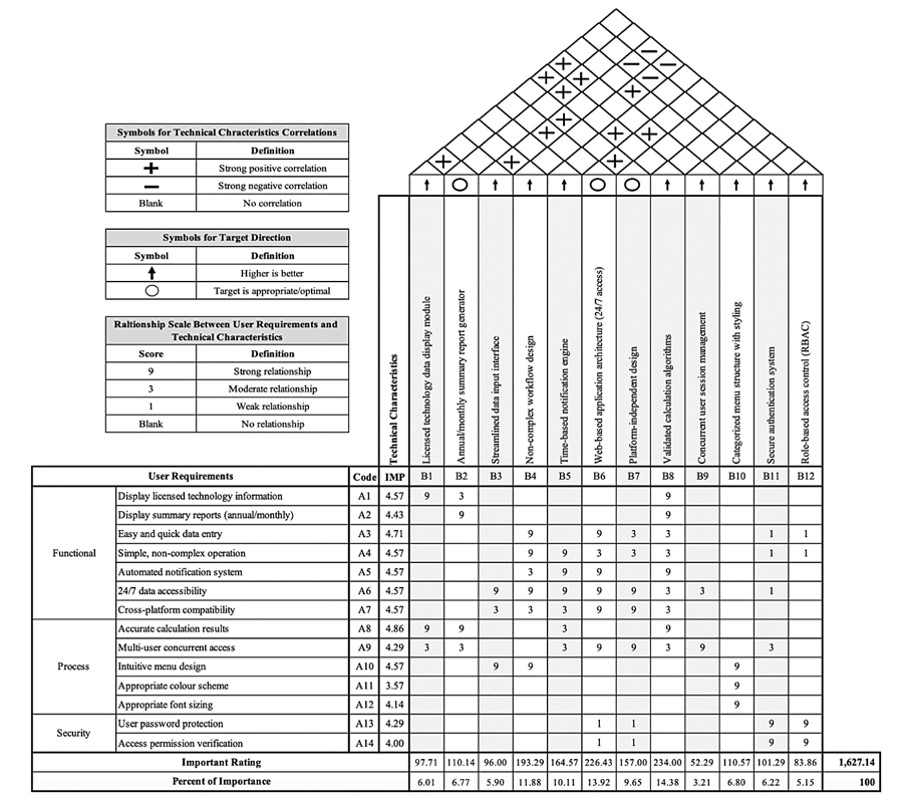
Technology licensing fee management in university science and technology parks faces critical challenges including data loss, inefficient royalty tracking, and revenue leakage from spreadsheet-based systems lacking automated notifications and centralized data management. This study develops an integrated framework combining Analytic Hierarchy Process (AHP) with Quality Function Deployment (QFD) for systematic software selection and requirement specification in technology licensing contexts. Conducted at a science and technology park, Chiang Mai University in Thailand, five technology transfer experts validated fourteen initial selection criteria through Index of Item-Objective Congruence (IOC), retaining nine criteria for evaluating three alternatives through AHP pairwise comparisons: customized Booked ME solution, commercial CRM system, and Google Workspace integration. Subsequently, seven end-users and three technical consultants conducted QFD analysis to translate fourteen validated user requirements into twelve technical specifications via House of Quality framework. AHP analysis prioritized security (0.21) and initial cost (0.20) as dominant factors, identifying the customized Booked ME solution as optimal (0.43) over commercial CRM (0.28) and Google-based solutions (0.29). QFD analysis revealed validated calculation algorithms (14.38%), web-based architecture (13.92%), and workflow simplification (11.88%) as highest-priority technical characteristics. The research contributes by: (1) extending AHP-QFD to technology licensing fee management, a novel domain combining financial, legal, and IP management; (2) providing empirical evidence from an emerging economy that platform customization outperforms commercial solutions when security and cost dominate; and (3) developing a replicable integrated framework bridging strategic platform selection with tactical requirement specification.
Article Details

This work is licensed under a Creative Commons Attribution-NonCommercial-NoDerivatives 4.0 International License.

This work is licensed under a Creative Commons Attribution-NonCommercial-NoDerivatives 4.0 International License.
References
Siegel DS, Waldman D, Link A. Assessing the impact of organizational practices on the relative productivity of university technology transfer offices: an exploratory study. Res Policy. 2003;32(1):27-48. DOI: https://doi.org/10.1016/S0048-7333(01)00196-2
Yeo KT. Critical failure factors in information system projects. Int J Proj Manag. 2002;20(3):241-6. DOI: https://doi.org/10.1016/S0263-7863(01)00075-8
Saaty TL. The analytic hierarchy process. New York: McGraw-Hill; 1980. DOI: https://doi.org/10.21236/ADA214804
Soner O, Celik E, Akyuz E. Application of AHP and VIKOR methods under interval type‑2 fuzzy environment in maritime transportation. Ocean Eng. 2017;129:107-16. DOI: https://doi.org/10.1016/j.oceaneng.2016.11.010
Al Jafa H. A case study for the CRM software selection process in a transportation company using an integrated AHP and QFD approach. SEA Pract Appl Sci. 2020;8(24):337-51.
Akao Y. Quality function deployment: integrating customer requirements into product design. Cambridge, MA: Productivity Press; 1990.
Haag S, Raja MK, Schkade LL. Quality function deployment usage in software development. Commun ACM. 1996;39(1):41-9. DOI: https://doi.org/10.1145/234173.234178
Zheng X, Pulli P. Improving mobile services design: A QFD approach. Comput Inform. 2007;26(4):369-81.
Chan LK, Wu ML. A systematic approach to quality function deployment with a full illustrative example. Omega. 2005;33(2):119-39. DOI: https://doi.org/10.1016/j.omega.2004.03.010
Karmaker CL, Halder P, Ahmed ST. Customer driven quality improvement of a specific product through AHP and entropy based QFD: a case study. Int J Anal Hierarchy Process. 2019;11(3):389-414. DOI: https://doi.org/10.13033/ijahp.v11i3.606
Kilic HS, Zaim S, Delen D. Selecting 'The Best' ERP system for SMEs using a combination of ANP and PROMETHEE methods. Expert Syst Appl. 2015;42(5):2343-52. DOI: https://doi.org/10.1016/j.eswa.2014.10.034
Turner RC, Carlson L. Indexes of item-objective congruence for multidimensional items. Int J Test. 2003;3(2):163-71. DOI: https://doi.org/10.1207/S15327574IJT0302_5
Rovinelli RJ, Hambleton RK. On the use of content specialists in the assessment of criterion-referenced test item validity. Tijdschrift voor Hoger Onderwijs. 1977;2:49-60
Karsak EE, Sozer S, Alptekin SE. Product planning in quality function deployment using a combined analytic network process and goal programming approach. Comput Ind Eng. 2003;44(1):171-90. DOI: https://doi.org/10.1016/S0360-8352(02)00191-2
