
Hybrid RSM-CCD and ANN-GA optimization of mechanical properties in permanent-backing-plate-assisted GMAW dissimilar welding of AISI 304L and SS400 steels
Article Sidebar
Main Article Content
Abstract
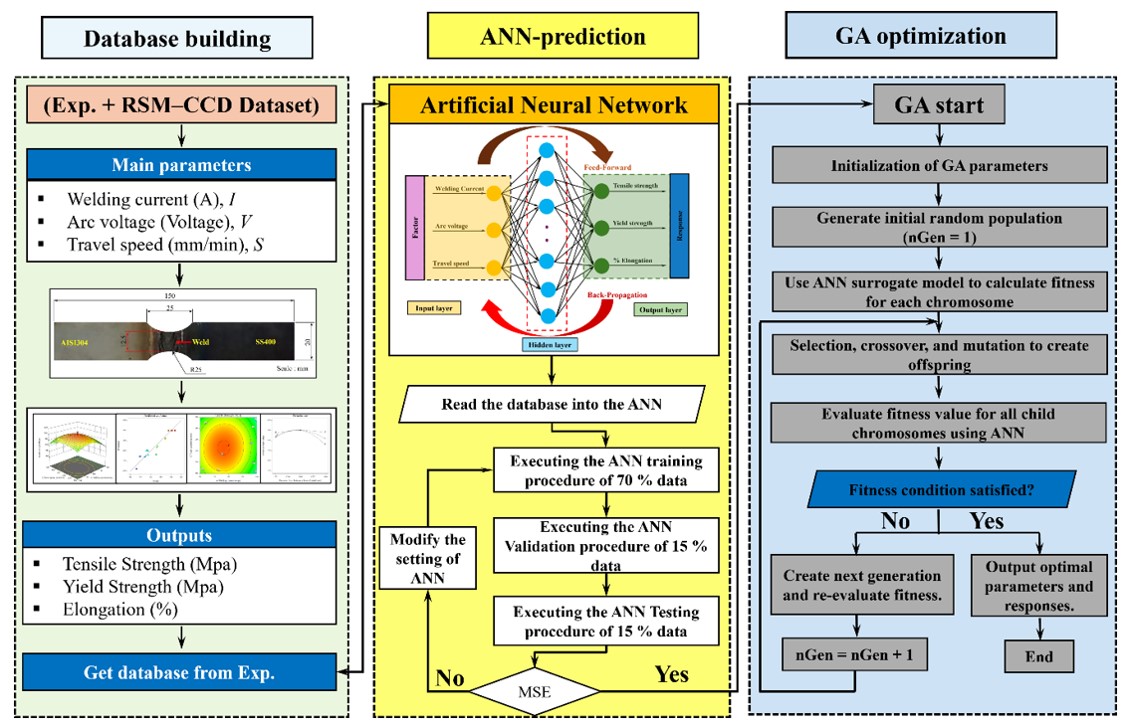
Dissimilar welding between AISI 304L stainless steel and SS400 carbon steel is widely applied in structural and industrial systems, yet differences in thermal and metallurgical properties often lead to heterogeneous microstructures and unstable mechanical performance. This study investigates the mechanical behavior and fracture characteristics of dissimilar AISI 304L–SS400 joints produced by Gas Metal Arc Welding (GMAW) with a permanent backing plate using a hybrid RSM–CCD + ANN–GA modeling and optimization framework. Welding current, arc voltage, and travel speed were selected as the key process parameters and optimized with respect to tensile strength, yield strength, and elongation. Statistical analysis revealed that welding current is the dominant factor controlling mechanical responses through its influence on heat input and weld penetration. The permanent SS400 backing plate introduces a tri-material heat conduction path (304L–SS400–SS400), modifying heat flow and thermal gradients within the weld region. Although the RSM–CCD quadratic models captured the general response trends, the Artificial Neural Network (ANN) provided superior predictive accuracy with lower RMSE, MAE, and MAPE values. Integration of ANN with a Genetic Algorithm enabled efficient multi-response optimization, identifying an optimal welding condition of approximately 170 A, 22.5 V, and 170 mm/min, which was experimentally validated. SEM fractography confirmed ductile micro-void coalescence under the optimized condition and mixed-mode fracture under detrimental parameters. The proposed hybrid framework provides a reliable approach for predicting and optimizing welding parameters in dissimilar GMAW systems with permanent backing plates.
Article Details

This work is licensed under a Creative Commons Attribution-NonCommercial-NoDerivatives 4.0 International License.

This work is licensed under a Creative Commons Attribution-NonCommercial-NoDerivatives 4.0 International License.
References
Huang CH, Hou CH, Hsieh TS, Tsai L, Chiang CC. Investigation of distinct welding parameters on mechanical and corrosion properties of dissimilar welded joints between stainless steel and low carbon steel. Sci Prog. 2022;105(4):1-18. DOI: https://doi.org/10.1177/00368504221126795
Scutelnicu E, Iordachescu M, Rusu CC, Mihailescu D, Ocaña J. Metallurgical and mechanical characterization of low carbon steel–stainless steel dissimilar joints made by laser autogenous welding. Metals. 2021;11(5):810. DOI: https://doi.org/10.3390/met11050810
Alcantar-Modragón N, García-García V, Reyes-Calderón F, Villalobos-Brito JC, Vergara-Hernández HJ. Study of cracking susceptibility in similar and dissimilar welds between carbon steel and austenitic stainless steel through finger test and FE numerical model. Int J Adv Manuf Technol. 2021;116:2661-86. DOI: https://doi.org/10.1007/s00170-021-07596-0
Baskutis S, Baskutiene J, Bendikiene R, Ciuplys A, Dutkus K. Comparative research of microstructure and mechanical properties of stainless and structural steel dissimilar welds. Materials. 2021;14(20):6180. DOI: https://doi.org/10.3390/ma14206180
Roshan R, Naik AK, Saxena KK, Arora KS, Shajan N, Msomi V, et al. Effect of welding speed and wire feed rate on arc characteristics, weld bead and microstructure in standard and pulsed gas metal arc welding. J Adhes Sci Technol. 2023;37(23):3297-314. DOI: https://doi.org/10.1080/01694243.2023.2192314
Chen C, Sun G, Du W, Li Y, Fan C, Zhang H. Influence of heat input on the appearance, microstructure and microhardness of pulsed gas metal arc welded Al alloy weldment. J Mater Res Technol. 2022;21:121-30. DOI: https://doi.org/10.1016/j.jmrt.2022.09.028
Yu Y, Wang X, Wu Y, Ma M, Gao G. The impact of backplate support conditions on ceramic fracture and energy absorption in the penetration resistance process of ceramic/metal composite armor. Ceram Int. 2024;50(7):10325-39. DOI: https://doi.org/10.1016/j.ceramint.2023.12.344
Aloraier A, Albannai A, Abdulsalam M, Al-Wakaa B. Effect of using different backing plate materials in autogenous TIG welding on bead geometry, microhardness, tensile strength, and fracture of 1020 low carbon steel. J Mech Behav Mater. 2025;34(1):20250057. DOI: https://doi.org/10.1515/jmbm-2025-0057
Ogbonna OS, Akinlabi SA, Madushele N, Fatoba OS, Akinlabi ET. Grey-based Taguchi method for multi-weld quality optimization of gas metal arc dissimilar joining of mild steel and 316 stainless steel. Results Eng. 2023;17:100963. DOI: https://doi.org/10.1016/j.rineng.2023.100963
Pramanik D, Roy N, Sen A, Biswas S, Ghosh N. Experimental evaluation of key welding process parameters on the performance of MIG welded mild steel. Int J Eng Inf Manag. 2025;1(3):34-43. DOI: https://doi.org/10.52756/ijeim.2025.v01.i03.003
Ranjan R, Kumar M, Rathore S, Goyal A. Enhancing shielded metal arc welding performance through process parameter optimization with low-frequency vibration assistance. Sci Rep. 2025;15:40016. DOI: https://doi.org/10.1038/s41598-025-23749-7
Ranjan R, Cep R, Kumar A, Srivastava M, Altarazi F, Dogra N, et al. Comprehensive review of vibration-assisted welding processes: mechanisms, applications, and future directions. Front Mech Eng. 2025;11:1550928. DOI: https://doi.org/10.3389/fmech.2025.1550928
Ranjan R, Kumar M, Goyal A. Tensile strength enhancement in vibration assisted butt welding using response surface optimization. Discov Appl Sci. 2025;7:861. DOI: https://doi.org/10.1007/s42452-025-07525-w
Guo Q, Yang Z, Xu J, Jiang Y, Wang W, Liu Z, et al. Progress, challenges and trends on vision sensing technologies in automatic intelligent robotic welding: state-of-the-art review. Robot Comput Integr Manuf. 2024;89:102767. DOI: https://doi.org/10.1016/j.rcim.2024.102767
Zhu M, Lei Q, Weng J, Shi Y. Intelligent monitoring and fuzzy control of MIG welding seam tracking based on passive visual sensing [Internet]. Research square [Preprint]. 2025 [2025 Dec 16]. Available from: https://doi.org/10.21203/rs.3.rs-5304510/v1. DOI: https://doi.org/10.21203/rs.3.rs-5304510/v1
Singh PK, Kumar SD, Patel D, Prasad SB. Optimization of vibratory welding process parameters using response surface methodology. J Mech Sci Technol. 2017;31(5):2487-95. DOI: https://doi.org/10.1007/s12206-017-0446-0
Mehta A, Vasudev H. Advances in welding sensing information processing and modelling technology: an overview. J Adhes Sci Technol. 2026;40(3):586-630. DOI: https://doi.org/10.1080/01694243.2024.2388141
Gunawan, Sudarsono, Arifin A, Nukman, Pratiwi DK, Isti N, et al. Investigating dissimilar welding quality of AISI 4340 and ST36 carbon steels via shielded metal arc welding for structural applications. J Adv Res Appl Mech. 2025;134(1):166-75. DOI: https://doi.org/10.37934/aram.134.1.166175
Upadhyay P, Reynolds A. Effect of backing plate thermal property on friction stir welding of 25-mm-thick AA6061. Metall Mater Trans A. 2014;45:2091-100. DOI: https://doi.org/10.1007/s11661-013-2121-0
Joseph Leon SL, Alfred Franklin V, Ravi R, Geetha B. Numerical thermal modeling on tool and backing plate diffusivity in friction stir welding using non-circular tool pin. Mater Today Proc. 2022;51:374-80. DOI: https://doi.org/10.1016/j.matpr.2021.05.469
Sri ND, Kottapalli R, Pavani A, Ganteda C, Gouthami E, Abd-Elmonem A, et al. Comparison between response surface methodology and Taguchi method for dyeing process parameters optimization in fabric manufacturing by empirical planning. Sci Rep. 2025;15:10209. DOI: https://doi.org/10.1038/s41598-025-94919-w
Phung TC, Nhat HH. Comparison of Taguchi method and response surface methodology in determining optimal parameters for welding two metal plates. VNUHCM J Eng Technol. 2023;5(4):1737-50.
Rocha VR, Lobato FS, De Assis PAQ, Ribeiro CR, da Cunha SS, Vilarinho LO, et al. Parametric optimization of artificial neural networks and machine learning techniques applied to small welding datasets. Processes. 2025;13(9):2711. DOI: https://doi.org/10.3390/pr13092711
Acherjee B, Mondal S, Tudu B, Misra D. Application of artificial neural network for predicting weld quality in laser transmission welding of thermoplastics. Appl Soft Comput. 2011;11(2):2548-55. DOI: https://doi.org/10.1016/j.asoc.2010.10.005
Saeed MM, Al Sarraf ZS. Using artificial neural networks to predict the effect of input parameters on weld bead geometry for SAW process. J Eur Syst Autom. 2021;54(2):309-15. DOI: https://doi.org/10.18280/jesa.540213
Dey U, Duggirala A, Paul S, Mitra S. Prediction of weld geometry in laser welding by numerical simulation and artificial neural networking. Adv Mater Process Technol. 2023;10(3):2233-50. DOI: https://doi.org/10.1080/2374068X.2023.2210931
Park SH, Joo YH, Kang M. Effect of backing plate materials in micro-friction stir butt welding of dissimilar AA6061-T6 and AA5052-H32 aluminum alloys. Metals. 2020;10(7):933. DOI: https://doi.org/10.3390/met10070933
Widyantono YE, Bintoro SR, Putri EDWS, Triyono T, Muhayat N. The impact of backing plate thermal conductivity on mechanical properties of friction stir spot welded AA5052-H32 joints. Arch Mater Sci Eng. 2024;130(1):23-30. DOI: https://doi.org/10.5604/01.3001.0054.9709
Daniyan IA, Mpofu K, Adeodu AO. Optimization of welding parameters using Taguchi and response surface methodology for rail car bracket assembly. Int J Adv Manuf Technol. 2019;100:2221-8. DOI: https://doi.org/10.1007/s00170-018-2878-9
Ahmad A, Alam S. Integration of RSM with grey-based Taguchi method for optimization of pulsed TIG welding process parameters. Mater Today Proc. 2019;18:5114-27. DOI: https://doi.org/10.1016/j.matpr.2019.07.508
Purnama D, Oktadinata H. Effect of shielding gas and filler metal to microstructure of dissimilar welded joint between austenitic stainless steel and low carbon steel. IOP Conf Ser: Mater Sci Eng. 2019;547:012003. DOI: https://doi.org/10.1088/1757-899X/547/1/012003
Bikić F, Kasapović D. Investigation of general corrosion of austenitic stainless steel types 304L and 317L from the aspect of their chemical composition. Zastita Materijala. 2025;66:611-7. DOI: https://doi.org/10.62638/ZasMat1165
Tasalloti H, Kah P, Martikainen J. Effects of welding wire and torch weaving on GMAW of S355MC and AISI 304L dissimilar welds. Int J Adv Manuf Technol. 2014;71:197-205. DOI: https://doi.org/10.1007/s00170-013-5484-x
Başyiğit AB, Murat MG. The effects of TIG welding rod compositions on microstructural and mechanical properties of dissimilar AISI 304L and 420 stainless steel welds. Metals. 2018;8(11):972. DOI: https://doi.org/10.3390/met8110972
Zhao W, Jin H, Du X, Chen J, Wei Y. A 3D arc-droplet-molten pool integrated model of Al alloy GMAW process: heat transfer, fluid flow and the effect of external magnetic field. Vacuum. 2022;202:111129. DOI: https://doi.org/10.1016/j.vacuum.2022.111129
Wordofa TN, Ramulu PJ. Gas metal arc welding input parameters impacts on weld quality characteristics of steel materials: a comprehensive exploration. Manuf Technol. 2023;23(3):366-79. DOI: https://doi.org/10.21062/mft.2023.046
Hussein NIS, Jmmani NANM, Ayof MN, Rahim TA, Abidin MZZ, Yusof F, et al. Simulation of wire and arc additive manufacturing of 308L stainless steel with cold arc gas metal arc welding. J Appl Eng Des Simul. 2021;1(1):88-96. DOI: https://doi.org/10.24191/jaeds.v1i1.35
Machfuroh T, Witono K, Riskitasari S, Puspitasari E. Influence of MIG welding process parameters on the strength of bimetal joints: study of gas flow rate and macrofractures. Logic J Rancang Bangun Teknol. 2024;24(3):141-9. DOI: https://doi.org/10.31940/logic.v24i3.141-149
Khrais S, Al Hmoud H, Abdel Al A, Darabseh T. Impact of gas metal arc welding parameters on bead geometry and material distortion of AISI 316L. J Manuf Mater Process. 2023;7(4):123. DOI: https://doi.org/10.3390/jmmp7040123
Amraei M, Ahola A, Afkhami S, Björk T, Heidarpour A, Zhao XL. Effects of heat input on the mechanical properties of butt-welded high and ultra-high strength steels. Eng Struct. 2019;198:109460. DOI: https://doi.org/10.1016/j.engstruct.2019.109460
Riswanda R, Akhyar A, Kadir H, Sugianto S, Saragih AD. The effect of heat input on tensile strength, Vickers hardness and microstructure on DMW of AISI 1015 and 304L SS through the GMAW process. J Achiev Mater Manuf Eng. 2024;123(1):5-16. DOI: https://doi.org/10.5604/01.3001.0054.4920
Ramdan RD, Koswara AL, Surasno, Wirawan R, Faturohman F, Widyanto B, et al. Metallurgy and mechanical properties variation with heat input during dissimilar metal welding between stainless and carbon steel. IOP Conf Ser: Mater Sci Eng. 2018;307:012056. DOI: https://doi.org/10.1088/1757-899X/307/1/012056
Otimeyin AW, Achebo JI, Frank U. Advanced modeling and optimization of weldment responses using statistical and metaheuristic techniques. Am J Mech Mater Eng. 2025;9(1):25-36. DOI: https://doi.org/10.11648/j.ajmme.20250901.13
Pramanik D, Roy N, Das RK, Das S, Das S. Optimisation of metal active gas welding on mild steel using response surface methodology. Int J Eng Inf Manag. 2025;1(3):55-66. DOI: https://doi.org/10.52756/ijeim.2025.v01.i03.005
Ofoeyeno B, Ajayi JI, Ozigagun A. Development of mathematical models to optimize weld penetration area of mild steel in gas tungsten arc welding. Int J Innov Sci Res Technol. 2020;5(7):885-91. DOI: https://doi.org/10.38124/IJISRT20JUL536
Nakowong K, Suwannasopa D, Kaewchalun A, Lamwong J, Pookamnerd Y. A genetic-neural optimization approach for friction stir spot welding of semi-solid metal aluminum alloy 5083. Eng Appl Sci Res. 2025;52(5):541-50.
Prasomthong S, Phatungthane T, Chomchalao C. Optimization of aluminum matrix composite production in a friction stir process with MgO nanoparticle reinforcement using ANN-GRA modeling. Eng Appl Sci Res. 2025;52(3):282-95.
Igbinake AO. Comparison of response surface methodology (RSM) and artificial neural networks (ANN) in optimisation of the thermal diffusivity of mild steel TIG welding. Am J Mech Mater Eng. 2025;9(2):43-9. DOI: https://doi.org/10.11648/j.ajmme.20250902.11
Lalwani V, Sharma P, Pruncu CI, Unune DR. Response surface methodology and artificial neural network-based models for predicting performance of wire electrical discharge machining of Inconel 718 alloy. J Manuf Mater Process. 2020;4(2):44. DOI: https://doi.org/10.3390/jmmp4020044
Bilal H, Shah RA, Ahmad H, Jan A, Radwan T. An intelligent framework for modeling nonlinear irreversible biochemical reactions using artificial neural networks. Sci Rep. 2025;15:28458. DOI: https://doi.org/10.1038/s41598-025-13146-5
Mayai A, Prasomthong S, Pookamnerd Y. Development of hybrid ANN-GA and RSM models for optimizing mechanical properties in SS400-SUS304 welds. EUREKA Phys Eng. 2025;3:152-65. DOI: https://doi.org/10.21303/2461-4262.2025.003606
Tomaz IDVT, Colaço FHG, Sarfraz S, Pimenov DY, Gupta M, Pintaude G. Investigations on quality characteristics in gas tungsten arc welding process using artificial neural network integrated with genetic algorithm. Int J Adv Manuf Technol. 2021;113:3569-83. DOI: https://doi.org/10.1007/s00170-021-06846-5
Van Huong H, Nguyen TT, Nguyen VT, Nguyen VTT. Material strength optimization of dissimilar MIG welding between carbon and stainless steels. Metals. 2024;14(9):1011. DOI: https://doi.org/10.3390/met14091011
Ai Y, Sun N, Han S, Zhang Y, Lei C. Investigation of the effects of laser welding process parameters on weld forming quality based on orthogonal experimental design and image processing. Materials. 2025;18(15):3627. DOI: https://doi.org/10.3390/ma18153627
Kellai A, Kahla S, Dehimi S, Kaba L, Boutaghou Z. Effect of post weld heat treatment on the microstructure and mechanical properties of a gas-tungsten-arc-welded 304 stainless steel. Int J Adv Manuf Technol. 2022;121:8171-86. DOI: https://doi.org/10.1007/s00170-022-09896-5
Pasang T, Kirchner A, Jehring U, Aziziderouei M, Tao Y, Jiang CP, et al. Microstructure and mechanical properties of welded additively manufactured stainless steels SS316L. Metals Mater Int. 2019;25:1278-86. DOI: https://doi.org/10.1007/s12540-019-00264-9
Kotari S, Punna E, Gangadhar SM, Cheepu M, Sarkar P, Venukumar S. Dissimilar metals TIG welding-brazing of AZ31 magnesium alloy to 304 stainless steel. Mater Today Proc. 2021;39:1549-52. DOI: https://doi.org/10.1016/j.matpr.2020.05.553
Zhang Z, Jing H, Xu L, Han Y, Zhao L. Investigation on microstructure evolution and properties of duplex stainless steel joint multi-pass welded by using different methods. Mater Des. 2016;109:670-85. DOI: https://doi.org/10.1016/j.matdes.2016.07.110
Chitturi V, Pedapati S, Awang M. Investigation of weld zone and fracture surface of friction stir lap welded 5052 aluminum alloy and 304 stainless steel joints. Coatings. 2020;10(11):1062. DOI: https://doi.org/10.3390/coatings10111062
Ma H, Qin G, Geng P, Li F, Fu B, Meng X. Microstructure characterization and properties of carbon steel to stainless steel dissimilar metal joint made by friction welding. Mater Des. 2015;86:587-97. DOI: https://doi.org/10.1016/j.matdes.2015.07.068
Nellikode S, Manladan SM, Jo I, Jung SJ, Kim IC, Park H, et al. Effect of microstructural heterogeneities on variability in low-temperature impact toughness in multi-pass weld metal of 420 MPa offshore engineering steel. Weld World. 2023;67:1679-93. DOI: https://doi.org/10.1007/s40194-023-01521-7
