
Banana peel-derived carbon for supercapacitor electrodes: Carbonization temperature-dependent structural and electrochemical properties
Article Sidebar
Main Article Content
Abstract
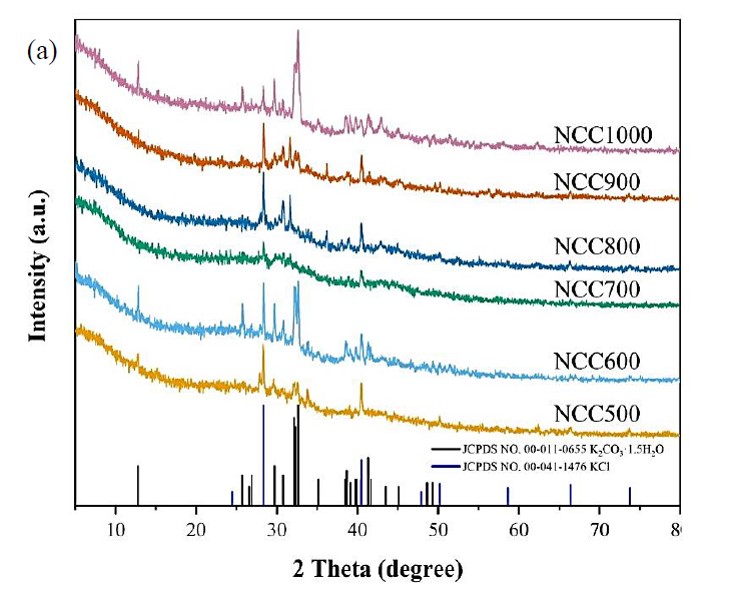
Banana peels (Musa ABB, Namwa cultivar) were utilized as sustainable precursors for the production of carbonaceous materials for supercapacitor electrodes. Carbonization was performed at temperatures ranging from 500 to 1000 °C. During carbonization, CO2 and H2O were released, promoting physical self-activation and pore development. X-ray diffraction confirmed the presence of KCl and K2CO3 phases, which were removed after washing with HCl and deionized water, leaving only amorphous carbon. Iodine adsorption analysis revealed that increasing carbonization temperature enhanced porosity, with iodine adsorption values of -10.42, 194.20, 150.04, 485.80, 471.44, and 325.09 mg·g-1 at 500, 600, 700, 800, 900, and 1000 °C, respectively. This trend is in agreement with the change in surface area with carbonization temperature, which increased from 500 to 800 °C (382.403–800.846 m2·g-1) and decreased at 900 and 1000 °C (684.595 and 156.881 m2·g-1, respectively). The carbon obtained at 800 °C (CC800) delivered the highest specific capacitance, 169 F·g-1 at 0.5 A·g-1 in a 1 M H2SO4 electrolyte, owing to its highest specific surface area (800.846 m2·g-1). Additionally, the redox peaks associated with surface functional groups formed during carbonization would further enhance the capacitance of all carbons. These results demonstrate that banana peel-derived carbon, synthesized via carbonization, exhibits a high surface area and excellent charge storage capability.
Article Details

This work is licensed under a Creative Commons Attribution-NonCommercial-NoDerivatives 4.0 International License.

This work is licensed under a Creative Commons Attribution-NonCommercial-NoDerivatives 4.0 International License.
References
Zhou C, Wang Y. Recent progress in the conversion of biomass wastes into functional materials for value-added applications. Sci Technol Adv Mater. 2020;21(1):787-804. DOI: https://doi.org/10.1080/14686996.2020.1848213
Phakkhawan A, Sakulkalavek A, Chanlek N, Nijpanich S, Ngernyen Y, Buranurak S, et al. Self-activation of carbons derived from bio-waste cabbage for a green supercapacitor based on seawater electrolyte. Sustain Mater Technol. 2024;42:e01143. DOI: https://doi.org/10.1016/j.susmat.2024.e01143
Yi H, Nakabayashi K, Yoon SH, Miyawaki J. Pressurized physical activation: a simple production method for activated carbon with a highly developed pore structure. Carbon. 2021;183:735-42. DOI: https://doi.org/10.1016/j.carbon.2021.07.061
Hsiao CH, Gupta S, Lee CY, Tai NH. Effects of physical and chemical activations on the performance of biochar applied in supercapacitors. Appl Surf Sci. 2023;610:155560. DOI: https://doi.org/10.1016/j.apsusc.2022.155560
Tomczyk A, Sokołowska Z, Boguta P. Biochar physicochemical properties: pyrolysis temperature and feedstock kind effects. Rev Environ Sci Biotechnol. 2020;19:191-215. DOI: https://doi.org/10.1007/s11157-020-09523-3
Gao F, Geng C, Xiao N, Qu J, Qiu J. Hierarchical porous carbon sheets derived from biomass containing an activation agent and in-built template for lithium ion batteries. Carbon. 2018;139:1085-92. DOI: https://doi.org/10.1016/j.carbon.2018.08.010
Niu J, Shao R, Liang J, Dou M, Li Z, Huang Y, et al. Biomass-derived mesopore-dominant porous carbons with large specific surface area and high defect density as high performance electrode materials for Li-ion batteries and supercapacitors. Nano Energy. 2017;36:322-30. DOI: https://doi.org/10.1016/j.nanoen.2017.04.042
Li J, Chen K, Li W, Qi S, Yang M, Ma X, et al. Self-activation strategy toward walnut shell-based porous carbon for supercapacitors. Diam Relat Mater. 2025;155:112290. DOI: https://doi.org/10.1016/j.diamond.2025.112290
Wongwaiwech D, Kamchonemenukool S, Ho CT, Li S, Thongsook T, Majai N, et al. Nutraceutical difference between two popular Thai Namwa cultivars used for sun dried banana products. Molecules. 2022;27(17):5675. DOI: https://doi.org/10.3390/molecules27175675
Bhat VS, Krishnan SG, Jayeoye TJ, Rujiralai T, Sirimahachai U, Viswanatha R, et al. Self-activated ‘green’ carbon nanoparticles for symmetric solid-state supercapacitors. J Mater Sci. 2021;56:13271-90. DOI: https://doi.org/10.1007/s10853-021-06154-z
Emrooz HBM, Hosseini Naghavi MS, Mohammadi S, Mousavi-Khoshdel SM. One-step green synthesis of meso-microporous carbons by self-activation of lemon wastes for high-performance supercapacitors. J Energy Storage. 2022;56:105989. DOI: https://doi.org/10.1016/j.est.2022.105989
Selvarajoo A, Muhammad D, Arumugasamy SK. An experimental and modelling approach to produce biochar from banana peels through pyrolysis as potential renewable energy resources. Model Earth Syst Environ. 2020;6:115-28. DOI: https://doi.org/10.1007/s40808-019-00663-2
Yang H, Yan R, Chen H, Lee DH, Zheng C. Characteristics of hemicellulose, cellulose and lignin pyrolysis. Fuel. 2007;86(12-13):1781-8. DOI: https://doi.org/10.1016/j.fuel.2006.12.013
Kumar M, Shukla SK, Upadhyay SN, Mishra PK. Analysis of thermal degradation of banana (Musa balbisiana) trunk biomass waste using iso-conversional models. Bioresour Technol. 2020;310:123393. DOI: https://doi.org/10.1016/j.biortech.2020.123393
Pardo RNC, Rojas GMA, Florez LM. Thermal analysis of the physicochemical properties of organic waste to application in the compost process. Biomass Convers Biorefin. 2023;13:7097-109. DOI: https://doi.org/10.1007/s13399-021-01786-2
Soares Dias AP, Pedra I, Salvador É, Rijo B, Costa Pereira MF, Serralha F, et al. Biodiesel production over banana peel biochar as a sustainable catalyst. Catalysts. 2024;14(4):266. DOI: https://doi.org/10.3390/catal14040266
Phakkhawan A, Horprathum M, Chanlek N, Nakajima H, Nijpanich S, Kumnorkaew P, et al. Activated carbons derived from sugarcane bagasse for high-capacitance electrical double layer capacitors. J Mater Sci: Mater Electron. 2022;33:663-74. DOI: https://doi.org/10.1007/s10854-021-07334-y
Tolkou AK, Tsoutsa EK, Kyzas GZ, Katsoyiannis IA. Sustainable use of low-cost adsorbents prepared from waste fruit peels for the removal of selected reactive and basic dyes found in wastewaters. Environ Sci Pollut Res. 2024;31:14662-89. DOI: https://doi.org/10.1007/s11356-024-31868-3
Mehrez M, Chaari I, Medhioub M. Biosorption of a leather dye (Dycem TTO) onto banana peel: characterization, isotherm, kinetic, thermodynamic, and mechanism studies. Water Air Soil Pollut. 2024;235:119. DOI: https://doi.org/10.1007/s11270-024-06905-z
Zheng H, Wang L. Banana peel carbon that containing functional groups applied to the selective adsorption of Au(III) from waste printed circuit boards. Soft Nanosci Lett. 2013;3(2):29-36. DOI: https://doi.org/10.4236/snl.2013.32006
Kamsonlian S, Suresh S, Majumder CB, Chand S. Characterization of banana and orange peels: biosorption mechanism. Int J Sci Technol Manag. 2011;2(4):1-7. DOI: https://doi.org/10.26634/jfet.7.1.1711
Malakar B, Das D, Mohanty K. Evaluation of banana peel hydrolysate as alternate and cheaper growth medium for growth of microalgae Chlorella sorokiniana. Biomass Convers Biorefin. 2024;14:10361-71. DOI: https://doi.org/10.1007/s13399-022-03106-8
Ma Q, Dutta S, Wu KCW, Kimura T. Analytical understanding of the materials design with well‐described shrinkages in multiscale. Chem Eur J. 2017;24:6886-904. DOI: https://doi.org/10.1002/chem.201704198
Zhang M, Yang H, Liu Y, Sun X, Zhang D, Xue D. First identification of primary nanoparticles in the aggregation of HMF. Nanoscale Res Lett. 2012;7:38. DOI: https://doi.org/10.1186/1556-276X-7-38
Wu H, Dong Z, Sun J, Ding K. Boosting the adsorption capacity of activated carbon prepared from Amygdalus communis shells using physicochemical co-activation method. Biomass Convers Biorefin. 2024;18121-31. DOI: https://doi.org/10.1007/s13399-023-04093-0
Guo Y, Wang Q. Fabrication and characterization of activated carbon from Phyllostachys edulis Using single-step KOH activation with different temperatures. Processes. 2022;10(9):1712. DOI: https://doi.org/10.3390/pr10091712
Chafidz A, Astuti W, Augustia V, Novira DT, Rofiah N. Removal of methyl violet dye via adsorption using activated carbon prepared from Randu sawdust (Ceiba pentandra). IOP Conf Ser: Earth Environ Sci. 2018;167:012013. DOI: https://doi.org/10.1088/1755-1315/167/1/012013
Anca-Couce A, Sommersacher P, Hochenauer C, Scharler R. Multi-stage model for the release of potassium in single particle biomass combustion. Fuel. 2020;280:118569. DOI: https://doi.org/10.1016/j.fuel.2020.118569
Paluch D, Bazan-Wozniak A, Pietrzak R. Microwave-Assisted chemical activation of caraway seeds with potassium carbonate for activated carbon production: physicochemical characterization and adsorption study. Molecules. 2025;30(18):3804. DOI: https://doi.org/10.3390/molecules30183804
Schlumberger C, Thommes M. Characterization of hierarchically ordered porous materials by physisorption and mercury porosimetry—a tutorial review. Adv Mater Interfaces. 2021;8(4):2002181. DOI: https://doi.org/10.1002/admi.202002181
Shahcheragh SK, Bagheri Mohagheghi MM, Shirpay A. Effect of physical and chemical activation methods on the structure, optical absorbance, band gap and urbach energy of porous activated carbon. SN Appl Sci. 2023;5:313. DOI: https://doi.org/10.1007/s42452-023-05559-6
Zhai X, Song Y, Liu J, Li P, Zhong M, Ma C, et al. In-Situ preparation of boron-doped carbons with ordered mesopores and enhanced electrochemical properties in supercapacitors. J Electrochem Soc. 2012;159:E177-82. DOI: https://doi.org/10.1149/2.047212jes
Zhang W, Liu D, Lin H, Lu H, Xu J, Liu D. On the cycling stability of the supercapacitive performance of activated carbon in KOH and H2SO4 electrolytes. Colloids Surf A: Physicochem Eng Asp. 2016;511:294-302. DOI: https://doi.org/10.1016/j.colsurfa.2016.10.009
Andreas HA, Conway BE. Examination of the double-layer capacitance of an high specific-area C-cloth electrode as titrated from acidic to alkaline pHs. Electrochim Acta. 2006;51(28):6510-20. DOI: https://doi.org/10.1016/j.electacta.2006.04.045
Brahma S, Ramanujam K. Combination of redox-active natural indigo dye and bio-derived carbon from ridge gourd fruit for high-performance asymmetric supercapacitors. Ionics. 2022;28:1427-40. DOI: https://doi.org/10.1007/s11581-021-04433-y
Han C, Ye Y, Wang G, Hong W, Feng C. Selective electro-oxidation of phenol to benzoquinone/hydroquinone on polyaniline enhances capacitance and cycling stability of polyaniline electrodes. Chem Eng J. 2018;347:648-59. DOI: https://doi.org/10.1016/j.cej.2018.04.109
Chen CM, Huang JQ, Zhang Q, Gong WZ, Yang QH, Wang MZ, et al. Annealing a graphene oxide film to produce a free standing high conductive graphene film. Carbon. 2012;50(2):659-67. DOI: https://doi.org/10.1016/j.carbon.2011.09.022
Sigiro M. Natural biowaste of banana peel-derived porous carbon for in-vitro antibacterial activity toward Escherichia coli. Ain Shams Eng J. 2021;12(4):4157-65. DOI: https://doi.org/10.1016/j.asej.2021.03.021
Razdyakonova GI, Kokhanovskaya OA, Likholobov VA. Influence of environmental conditions on carbon black oxidation by reactive oxygen intermediates. Procedia Eng. 2015;113:43-50. DOI: https://doi.org/10.1016/j.proeng.2015.07.287
Xie J, Yang P, Wang Y, Qi T, Lei Y, Li CM. Puzzles and confusions in supercapacitor and battery: theory and solutions. J Power Sources. 2018;401:213-23. DOI: https://doi.org/10.1016/j.jpowsour.2018.08.090
Mathis TS, Kurra N, Wang X, Pinto D, Simon P, Gogotsi Y. Energy storage data reporting in perspective—guidelines for interpreting the performance of electrochemical energy storage systems. Adv Energy Mater. 2019;9(39):1902007. DOI: https://doi.org/10.1002/aenm.201902007
Zhang Y, Cai Y, Li T, Wang M, Chen X, Xu Y. Synthesis and electrochemical performance of biomass-derived porous carbon materials for supercapacitors. J Mater Sci: Mater Electron. 2024;35:116. DOI: https://doi.org/10.1007/s10854-024-11944-7
Barakat NAM, Mahmoud MS, Moustafa HM. Comparing specific capacitance in rice husk-derived activated carbon through phosphoric acid and potassium hydroxide activation order variations. Sci Rep. 2024;14:1460. DOI: https://doi.org/10.1038/s41598-023-49675-0
Veerakumar P, Maiyalagan T, Raj BGS, Guruprasad K, Jiang Z, Lin KC. Paper flower-derived porous carbons with high-capacitance by chemical and physical activation for sustainable applications. Arab J Chem. 2020;13:2995-3007. DOI: https://doi.org/10.1016/j.arabjc.2018.08.009
Huarote-Garcia E, Cardenas-Riojas AA, Monje IE, López EO, Arias-Pinedo OM, Planes GA, et al. Activated carbon electrodes for supercapacitors from purple corncob (Zea mays L.). ACS Environ Au. 2024;4(2):80-8. DOI: https://doi.org/10.1021/acsenvironau.3c00048
