
Optimizing layering configurations for enhanced flexural and impact performance in perforated Al foil/glass fiber/epoxy hybrid laminates
Article Sidebar
Main Article Content
Abstract
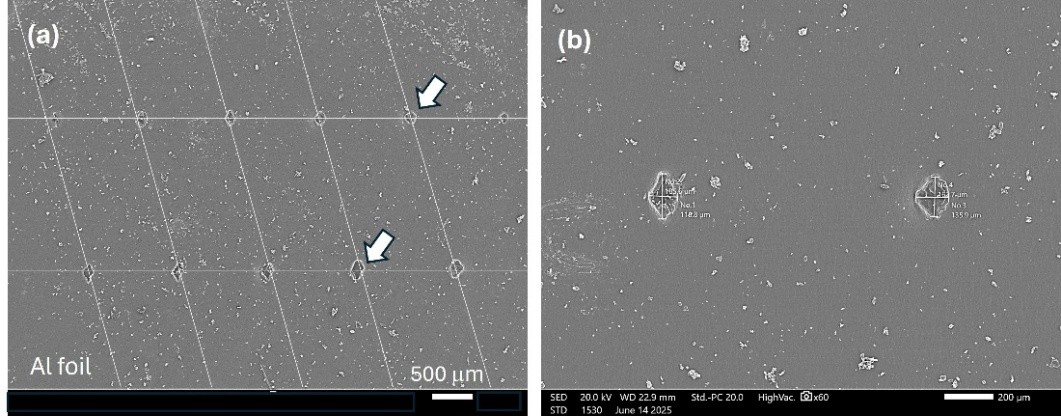
Lightweight panels for aircraft, vehicles, and protective structures need to absorb damage without a large weight penalty. In practice, many fiber metal laminates (FMLs) still struggle with shaping or curvature and can delaminate early, largely because the metal plies are relatively thick and the metal/polymer interface is prone to separation. An alternative hybrid laminate was developed using thin perforated Al foil (A) (~0.1 mm; perforations ~150 μm) combined with woven glass fiber (G)/epoxy, and the influence of stacking sequence on flexural and impact behavior was examined. Five configurations were manufactured by hand lay-up and evaluated using three-point bending (ASTM D790) and unnotched Charpy impact (ASTM D6110). Fracture surfaces and interfacial features were examined by optical microscopy and SEM. The laminates showed a clear, design-driven performance balance between bending strength and impact resistance. The symmetric, staggered lay-up V4 (GGGAAAGAAAGGG) delivered the highest flexural strength (229.74 MPa), whereas the metal-rich core V3 (GGGAAAAAAGGGG) produced the highest impact resistance (123 kJ/m²). Microstructural characterization indicates that resin flow through the perforations forms mechanical “anchors” at the Al foil/epoxy interface, limiting adhesive-type separation and promoting more progressive damage through cohesive cracking and controlled delamination. The results suggest that perforated Al foil/glass/epoxy hybrids offer a practical route to tune stiffness and toughness for lightweight skins/panels and protective components requiring high bending performance with moderate-to-high impact resistance.
Article Details

This work is licensed under a Creative Commons Attribution-NonCommercial-NoDerivatives 4.0 International License.

This work is licensed under a Creative Commons Attribution-NonCommercial-NoDerivatives 4.0 International License.
References
Kadhum AM, Faris ST, Al-Katawy AA. Development and properties of fiber metal laminate used in aircraft wing by using epoxy-novolac. IOP Conf Ser: Mater Sci Eng. 2019;518(3):032034. DOI: https://doi.org/10.1088/1757-899X/518/3/032034
Muniyan V, Kumar VV, Suyambulingam I, Priyadharshini S, Divakaran D, Rangappa SM, et al. A review of recent advancements in the impact response of fiber metal laminates. Heliyon. 2025;11(2):e41756. DOI: https://doi.org/10.1016/j.heliyon.2025.e41756
Vogelesang LB, Vlot A. Development of fibre metal laminates for advanced aerospace structures. J Mater Process Technol. 2000;103(1):1-5. DOI: https://doi.org/10.1016/S0924-0136(00)00411-8
Awi M, Abdullah AS. A review on mechanical properties and response of fibre metal laminate under impact loading (experiment). Evergreen. 2023;10(1):111-29. DOI: https://doi.org/10.5109/6781057
Khan ZI, Mohamad Z, Rahmat AR, Habib U. Synthesis and characterization of composite materials with enhanced thermo-mechanical properties for unmanned aerial vehicles (UAVs) and aerospace technologies. Pertanika J Sci Technol. 2021;29(3):2003-15. DOI: https://doi.org/10.47836/pjst.29.3.15
Khalili SMR, Daghigh V, Eslami Farsani R. Mechanical behavior of basalt fiber-reinforced and basalt fiber metal laminate composites under tensile and bending loads. J Reinf Plast Compos. 2011;30(8):647-59. DOI: https://doi.org/10.1177/0731684411398535
Zareei N, Geranmayeh A, Eslami-Farsani R. The effect of different configurations on the bending and impact properties of the laminated composites of aluminum-hybrid basalt and jute fibers-epoxy. Fibers Polym. 2019;20(5):1054-60. DOI: https://doi.org/10.1007/s12221-019-1148-2
Dhanaraj R, Venkateshwaran N, Chenthil M, Natarajan MS, Santhanam V, Baskar S. Experimental investigation on the mechanical properties of glass fiber with perforated aluminum sheet reinforced epoxy composite. Mater Today: Proc. 2020;37(2):1880-3. DOI: https://doi.org/10.1016/j.matpr.2020.07.456
Mahesh V, Joladarashi S, Kulkarni SM. A comprehensive review on material selection for polymer matrix composites subjected to impact load. Def Technol. 2021;17(1): 257-77. DOI: https://doi.org/10.1016/j.dt.2020.04.002
El-Sagheer I, Abd-Elhady AA, Sallam HEDM. Quasistatic tensile and flexural behaviors of fiber metal laminates after subjecting to uniaxial tensile impact loading. Sci Rep. 2025;15:16051. DOI: https://doi.org/10.1038/s41598-025-99159-6
Mousa S, Sallam HEDM, Kim GY, Abd-Elhady AA. Investigation on integrity assessment test of WRB metal-polymer-metal composites. Arch Civ Mech Eng. 2021;21:60. DOI: https://doi.org/10.1007/s43452-021-00216-4
Mousa S, Sallam HEDM, Abd-Elhady AA. Mechanical properties of Al/PU/Perforated CU/Al sandwich composites. Mater Res. 2021;24(5):e20210104. DOI: https://doi.org/10.1590/1980-5373-mr-2021-0104
Karapepas C, Trautmann M, Todt A, Al-Obaidi A, Nendel S, Kräusel V, et al. Development of tailored hybrid laminates: manufacturing of basalt fibre reinforced thermoplastic orthoses with aluminum thin sheets. Key Eng Mater. 2019;809:245-52. DOI: https://doi.org/10.4028/www.scientific.net/KEM.809.245
Giridharan D, Rakham B. Experimental analysis of fibre metal laminates. 2nd International Conference on Advancements in Aeromechanical Materials for Manufacturing; 2018 Jul 13-14; Telangana, India. UK: IOP Science; 2018. p. 1-15.
El-Sagheer I, Abd-Elhady AA, Sallam HEDM. Fracture behaviour of Al/GFRP/Al sandwich panel under uniaxial static and impact tensile loadings. J Sandw Struct Mater. 2025;27(7):1377-403. DOI: https://doi.org/10.1177/10996362251338900
Rajamurugan G, Sanjay AP, Krishnasamy P, Muralidharan B, Jain S. Drilling and mechanical performance analysis on flax-sisal hybrid composite embedded with perforated aluminum foil. J Reinf Plast Compos. 2020;39(23-24):902-17. DOI: https://doi.org/10.1177/0731684420937070
Hussain M, Zaki W, Umer R. Flexural performance of shape memory alloy/CF-PEKK fiber metal laminates for aircraft morphing under varied temperature conditions. Sci Rep. 2025;15:14093. DOI: https://doi.org/10.1038/s41598-025-99123-4
Ng LF, Yahya MY, Muthukumar C, Woo XJ, Muhaimin AH, Majid RA. Mechanical characterization of aluminum sandwich structures with woven-ply pineapple leaf/glass fiber-reinforced hybrid composite core. J Nat Fibers. 2023;20(1):2160404. DOI: https://doi.org/10.1080/15440478.2022.2160404
Sosiati H, Pamasti A, Adi RK, Kusuma AZ, Darmawan PD, Suwanda T. Mechanical characterization of epoxy-HA hybrid composites reinforced with woven carbon fiber and nylon fiber mesh for external fixator. Mater Res Express. 2025;12(8):085601. DOI: https://doi.org/10.1088/2053-1591/adf176
Karthick L, Sivakumar S, Sasikumar A, Prabhu A, Senthil Kumar J, Vadivukarasi L. A comparison and analysis of mechanical properties of glass fiber and banana fiber composite. Mater Today Proc. 2022;52(3):398-402. DOI: https://doi.org/10.1016/j.matpr.2021.09.073
Carrillo JG, Cantwell WJ. Mechanical properties of a novel fiber-metal laminate based on a polypropylene composite. Mech Mater. 2009;41(7):828-38. DOI: https://doi.org/10.1016/j.mechmat.2009.03.002
Botelho EC, Silva RA, Pardini LC, Rezende MC. A review on the development and properties of continuous fiber/epoxy/aluminum hybrid composites for aircraft structures. Mater Res. 2006;9(3):247-56. DOI: https://doi.org/10.1590/S1516-14392006000300002
Caggiano M, Saffioti MR, Rotella G. Fiber metal laminates: the role of the metal surface and sustainability aspects. J Compos Sci. 2025;9(1):35-55. DOI: https://doi.org/10.3390/jcs9010035
Patil DS, Bhoomkar MM, Sunheriya N, Giri J, Kulkarni A, Patil LN, et al. Qualitative evaluation of kerf taper angle of conventionally drilled hole in glass fiber epoxy composite. Front Mech Eng. 2025;11:1513269. DOI: https://doi.org/10.3389/fmech.2025.1513269
Sathish T, Varadhan B. Enhancing drilling performance in hybrid basalt/E-glass fiber epoxy modified with MWCNTs + SiO2 nanocomposites. Int J Adv Manuf Technol. 2025;136:325-28. DOI: https://doi.org/10.1007/s00170-024-14049-x
Hariharan C, Parthiban A, Thanikodi S. Investigating indispensable characteristic of Boehmeria nivea and Agave sisalana fiber reinforced epoxy hybrid composites for particles board applications. Int J Adv Manuf Technol. 2025;136:211-20. DOI: https://doi.org/10.1007/s00170-024-14001-z
Thanikodi S, Arunachalam SJ, Saravanan R, Giri J, Azizi M, Hourani AO, et al. Characterization of mechanical, morphological, and dynamic mechanical properties of jute/kenaf/glass fiber/epoxy modified with various nanofiller hybridized nanocomposites. Eng Rep. 2025;7:e70026. DOI: https://doi.org/10.1002/eng2.70026
Trindade D, Habiba R, Fernandes C, Costa AA, Silva R, Alves N, et al. Material performance evaluation for customized orthoses: compression, flexural, and tensile tests combined with finite element analysis. Polymers. 2024;16(18):2553. DOI: https://doi.org/10.3390/polym16182553
Habiba R, Amaro A, Trindade D, Moura C, Silva R, Antão A, et al. Comparative analysis of impact strength among various polymeric materials for orthotic production. Polymers. 2024;16(13):1843. DOI: https://doi.org/10.3390/polym16131843
Türk DA, Einarsson H, Lecomte C, Mebodt M. Design and manufacturing of high-performance prostheses with additive manufacturing and fiber-reinforced polymers. Prod Eng. 2018;12:203-13. DOI: https://doi.org/10.1007/s11740-018-0799-y
