
Modification of sulfur spring bitumen with Gilsonite: A step towards exploiting natural bitumen in flexible pavement production
Article Sidebar
Main Article Content
Abstract
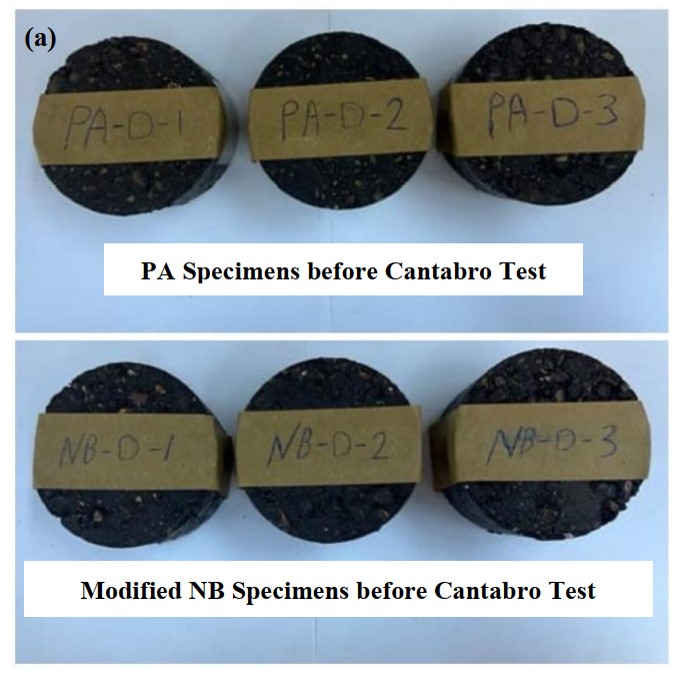
In recent years, there has been increasing interest in employing Natural bitumen (NB) as a modifier or bitumen in road construction due to its exceptional properties. This study investigates the ability to produce new asphalt binders by mixing two types of NB. In this work, NB from deposits in the western region of Iraq is selected. It consisted of two types, including the sulfur spring bitumen (NB-SS) and Gilsonite bitumen (NB-G). NB-SS modified with NB-G in percentages of 40, 50, and 60% by the weight of NB-SS. Conventional asphalt tests were conducted to examine the physical properties of bitumen. Furthermore, chemical tests, including Scanning Electron Microscopy (SEM), Energy Dispersive X-ray (EDX), and Fourier Transform Infrared spectroscopy (FTIR), were performed to examine the morphology and the chemical composition of bitumen. To examine the behavior of the asphalt mixture, the Marshall test was conducted to evaluate the mechanical and volumetric properties. In addition, the Cantabro test was performed in dry and wet conditions to assess the durability of PA and modified NB mixtures. The results reveal that NB-G can effectively harden NB-SS and improve its overall properties. Based on chemical tests, the microstructure of NB-SS and refinery asphalt is mostly flat, but it is more complex for NB-G. Moreover, NB-G has a high content of trace elements, and new functional chemical groups are produced in modified NB samples. Additionally, 50% of NB-G is the optimal blend content. Compared to a conventional mixture, modified NB-50% has a stiffness 34% higher with lower resistance to raveling, especially in dry conditions. However, the modified NB-50% mixture is more resistant to raveling in a moisture condition by approximately 52%. In summary, using NB-G as a modifier is an effective way to enhance the properties of NB-SS and make it more appropriate to use in asphalt pavement.
Article Details

This work is licensed under a Creative Commons Attribution-NonCommercial-NoDerivatives 4.0 International License.

This work is licensed under a Creative Commons Attribution-NonCommercial-NoDerivatives 4.0 International License.
References
Anupam A, Akinmade D, Kasbergen C, Erkens S, Adebiyi F. A state-of-the-art review of natural bitumen in pavement: underlining challenges and the way forward. J Clean Prod. 2023;382:134957. DOI: https://doi.org/10.1016/j.jclepro.2022.134957
Rondón-Quintana HA, Ruge-Cárdenas JC, Zafra-Mejía CA. Natural asphalts in pavements: review. Sustainability. 2023;15(3):2098. DOI: https://doi.org/10.3390/su15032098
Soleiman-Beigi M, Kohzadi H, Toolabi S. Natural asphalt: a novel bitumen modifier and asphalt filler. In: Tahmoorian F, editor. Asphalt Materials - recent developments and new perspective. UK: IntechOpen; 2024. p. 1-29 DOI: https://doi.org/10.5772/intechopen.1004297
Ma X, Diao W, Xu J, Wang D, Hou Y. Research on the aging characteristics of simulated asphalt within pavement structures in natural environments. Materials. 2025;18(2):434. DOI: https://doi.org/10.3390/ma18020434
Cardinal KM, Khalafalla M, Rueda-Benavides J. Protocol to assess the impact of crude oil price fluctuations on future asphalt prices. Transp Res Rec. 2021;2675(6):294-305. DOI: https://doi.org/10.1177/0361198121992072
Lee SY, Yang SL, Le THM. Assessment on the applicability of heavy oil advanced refining byproducts for bituminous road pavements. Case Stud Constr Mater. 2023;18:e01788. DOI: https://doi.org/10.1016/j.cscm.2022.e01788
Kazemi F, Bahrami A, Sharif, JA. Mineral processing plant site selection using integrated fuzzy cognitive map and fuzzy analytical hierarchy process approach: a case study of gilsonite mines in Iran. Miner Eng. 2020;147:106143. DOI: https://doi.org/10.1016/j.mineng.2019.106143
Jahanian HR, Shafabakhsh G, Divandari H. Performance evaluation of hot mix asphalt (HMA) containing bitumen modified with Gilsonite. Constr Build Mater. 2017;131:156-64. DOI: https://doi.org/10.1016/j.conbuildmat.2016.11.069
Ameli A, Babagoli R, Asadi S, Norouzi N. Investigation of the performance properties of asphalt binders and mixtures modified by crumb rubber and Gilsonite. Constr Build Mater. 2021;279:122424. DOI: https://doi.org/10.1016/j.conbuildmat.2021.122424
Al-Hawesah H, Sadique M, Harris C, Al-Nageim H, Stopp K, Pearl H, et al. A review on improving asphalt pavement service life using gilsonite-modified bitumen. Sustainability. 2021;13(12):6634. DOI: https://doi.org/10.3390/su13126634
Erkuş Y, Kök BV, Yilmaz M. Comparison of the conventional-rheological properties of Iraq Gilsonite and SBS modified bitumen. Sigma J Eng Nat Sci. 2023;41(6):1096-105.
Erkuş Y, Kök BV, Yilmaz M. The effects of Iraq natural asphalt on mechanical properties of bituminous hot mixtures. Teknik Dergi. 2022;33(2):11641-60. DOI: https://doi.org/10.18400/tekderg.664187
Farhan MM, Rabeea MA, Muslim RF, Zidan TA. Chemical composition (saturate fraction) of western Iraq natural bitumen. Mater Today: Proc. 2021;42:2527-33. DOI: https://doi.org/10.1016/j.matpr.2020.12.574
Mohsin HK, Latief RH. Properties evaluation of natural bitumen-filler mastic mixture. Eng Appl Sci Res. 2025;52(1):66-80.
Albayati AH, Al-Kheetan MJ, Mohammed AM, Al-ani AF, Moudhafar MM. Performance assessment of eco-friendly asphalt binders using natural asphalt and waste engine oil. Infrastructures. 2024;9(12):224. DOI: https://doi.org/10.3390/infrastructures9120224
Albayati AH, Mohammed AM, Al-Kheetan MJ, Al-ani AF, Oukaili NK, Moudhafar MM, et al. Performance enhancement of natural asphalt using waste-derived modifiers: sugarcane molasses and waste engine oil. Clean Waste Syst. 2025;11:100261. DOI: https://doi.org/10.1016/j.clwas.2025.100261
Ahmed F, Latief RH, Albayati A. Effect of natural bitumen on the performance of hot asphalt mixture. Gazi Univ J Sci. 2024;37(3):1154-70. DOI: https://doi.org/10.35378/gujs.1282239
Khusnutdinov I, Goncharova I, Safiulina A. Extractive deasphalting as a method of obtaining asphalt binders and low-viscosity deasphalted hydrocarbon feedstock from natural bitumen. Egypt J Pet. 2021;30(2):69-73. DOI: https://doi.org/10.1016/j.ejpe.2021.03.002
Connan J, Elezi G, Engel MH, Zumberge A. Natural asphalt on Late Neolithic (5000–4500 BCE) potsherds from southeastern Albania: a geochemical study. J Archaeol Sci Rep. 2024;53:104343. DOI: https://doi.org/10.1016/j.jasrep.2023.104343
State Corporation for Roads and Bridges. General specification for roads and bridges (SORB/R9)—hot mix asphaltic concrete pavement. Iraq: Department of Planning and Studies, Republic of Iraq, Ministry of Housing and Construction; 2003.
Altameemi AA, Al-Jumaili MA, Mohammed AJ, Abdul karim A. Studying the possibility of utilizing the vast deposits of natural asphalt in Iraq in specific uses using as little as possible manufacturing treatment. Iraqi J Mech Mater Eng. 2016;C:462-88. (In Arabic)
Mohsin HK, Latief RH. Natural bitumen in hot asphalt mixture: suitability of using treated natural bitumen instead of petroleum asphalt binder. IIUM Eng J. 2025;26(2):27-50. DOI: https://doi.org/10.31436/iiumej.v26i2.3452
Wang M, Xing C. Evaluation of microstructural features of buton rock asphalt components and rheological properties of pure natural asphalt modified asphalt. Constr Build Mater. 2021;267:121132. DOI: https://doi.org/10.1016/j.conbuildmat.2020.121132
Babagoli R, Hasaninia M, Mohammad Namazi N. Laboratory evaluation of the effect of Gilsonite on the performance of stone matrix asphalt mixtures. Road Mater Pavement Des. 2015;16(4):889-906. DOI: https://doi.org/10.1080/14680629.2015.1042016
Khanghahi SH, Tortum A. Examination of the possibility of using gilsonite in hot mix asphalt concrete. Jordan J Civ Eng. 2019;13(1):136-48.
Akinmade D, Anupam K, Kasbergen C, Erkens S, Samson D. Marco P. Performance of natural asphalt as a paving material: a laboratory and field evaluation. Case Stud Constr Mater. 2024;21:e03823. DOI: https://doi.org/10.1016/j.cscm.2024.e03823
Basheet SH, Latief RH. Assessment of the properties of asphalt mixtures modified with LDPE and HDPE polymers. Int J Appl Sci Eng. 2024;21(5):2024265. DOI: https://doi.org/10.6703/IJASE.202412_21(5).007
Saboo N, Sukhija M. Evaluating the suitability of nanoclay-modified asphalt binders from 10°C to 70°C. J Mater Civ Eng. 2020;32(12):04020393. DOI: https://doi.org/10.1061/(ASCE)MT.1943-5533.0003386
Saboo N, Sukhija M, Singh G. Effect of nanoclay on physical and rheological properties of waste cooking oil–modified asphalt binder. J Mater Civ Eng. 2021;33(3):04020490. DOI: https://doi.org/10.1061/(ASCE)MT.1943-5533.0003598
Li K, Vasiliu M, McAlpin CR, Yang Y, Dixon DA, Voorhees KJ, et al. Further insights into the structure and chemistry of the Gilsonite asphaltene from a combined theoretical and experimental approach. Fuel. 2015;157:16-20. DOI: https://doi.org/10.1016/j.fuel.2015.04.029
Soleiman-Beigi M, Noroozian Z, Sarai R, Kohzadi H, Naghipour A. Palladium and zirconium nanoparticles immobilized on functionalized natural asphalt sulfonate as magnetically and recoverable nanocatalysts for the synthesis of symmetrical and unsymmetrical disulfides. Reac Kinet Mech Cat. 2023:136:2465-80. DOI: https://doi.org/10.1007/s11144-023-02487-9
Zhou J, Li J, Liu G, Yang T, Zhao Y. Recycling aged asphalt using hard asphalt binder for hot-mixing recycled asphalt mixture. Appl Sci. 2021;11(12):5698. DOI: https://doi.org/10.3390/app11125698
Xu S, Huang W, Cai F, Huang H, Hu C. Evaluation of properties of Trinidad lake asphalt and SBS-modified petroleum asphalt. Pet Sci Technol. 2019;37(2):234-41. DOI: https://doi.org/10.1080/10916466.2018.1536714
Wang J, Yuan J, Kim KW, Xiao F. Chemical, thermal and rheological characteristics of composite polymerized asphalts. Fuel. 2018;227:289-99. DOI: https://doi.org/10.1016/j.fuel.2018.04.100
Basheet SH, Latief RH. Impact of using polyethylene polymer on the properties of hot asphalt mixture by conducting semi-wet and dry mixing process. Int J Eng. 2025;38(5):1108-19. DOI: https://doi.org/10.5829/ije.2025.38.05b.13
Gupta A, Castro-Fresno D, Lastra-Gonzalez P, Rodriguez-Hernandez J. Selection of fibers to improve porous asphalt mixtures using multi-criteria analysis. Constr Build Mater. 2021;266:121198. DOI: https://doi.org/10.1016/j.conbuildmat.2020.121198
Lin P, Liu X, Ren S, Xu J, Li Y, Li M. Effects of bitumen thickness on the aging behavior of high-content polymer-modified asphalt mixture. Polymers. 2023;15(10):2325. DOI: https://doi.org/10.3390/polym15102325
Andrés-Valeri VC, Muñoz-Cáceres O, Raposeiras AC, Castro-Fresno D, Lagos-Varas M, Movilla-Quesada D. Laboratory evaluation of porous asphalt mixtures with cellulose ash or combustion soot as a filler replacement. Sustainability. 2023;15(21):15509. DOI: https://doi.org/10.3390/su152115509
