
The role of citronella oil as a bio-additive on laminar burning characteristics of iso-octane
Article Sidebar
Main Article Content
Abstract
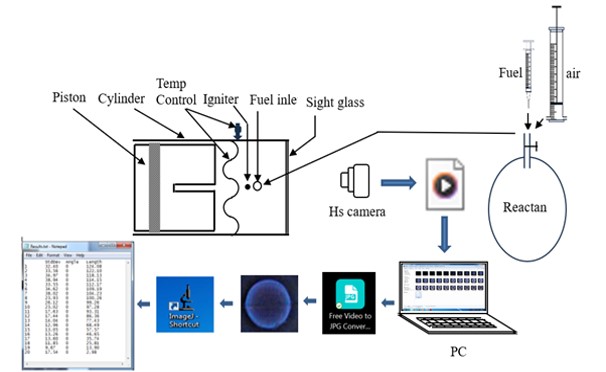
This study focuses on the laminar burning velocity of iso-octane fuel with a citronella additive. The main objective is to investigate and synthesize the composition of citronella bio-additive in iso-octane fuel and how it affects laminar burning velocity. Laminar burning velocity testing was conducted in a cylindrical explosion combustion chamber at constant pressure with six compositions (IC-0 to IC-5) at equivalence ratios (ɸ) of 0.8 to 1.2. Functional groups were examined by Fourier Transform InfraRed (FTIR) and volatility was characterized by Thermogravimetric Analysis (TGA). The IC-2 mixture increased the Research Octane Number from 92.0 to 92.3; whereas, the smallest decrease in laminar burning velocity was 4.8% compared to IC-0. TGA testing showed an increase in volatility in IC-2. Overall, the addition of low dose citronella bio-additives, especially IC-2, provided a moderate octane increase with a minimal reduction in laminar burning velocity and improved evaporation, supporting its potential as a practical bio-additive for spark ignition fuels.
Article Details

This work is licensed under a Creative Commons Attribution-NonCommercial-NoDerivatives 4.0 International License.

This work is licensed under a Creative Commons Attribution-NonCommercial-NoDerivatives 4.0 International License.
References
Su CW, Song XY, Dou J, Qin M. Fossil fuels or renewable energy? The dilemma of climate policy choices. Renewable Energy. 2025;238:121950. DOI: https://doi.org/10.1016/j.renene.2024.121950
Tissaoui K, Zaghdoudi T. Against a background of energy uncertainty and climate change, is there a substitution effect between fossil fuels in OECD countries?. Energy. 2025;320:135271. DOI: https://doi.org/10.1016/j.energy.2025.135271
Chavda P, Mehta D. Assessing the impact of fossil fuel subsidies and environmental tax on renewable energy consumption of OECD countries: a panel quantile approach. Next Energy. 2025;8:100313. DOI: https://doi.org/10.1016/j.nxener.2025.100313
Majidpour M. Policy lessons from the execution of fuel dual-pricing: Insights for fuel-subsidizing economies. Energy. 2022;247:123480. DOI: https://doi.org/10.1016/j.energy.2022.123480
Lindstad E, Ask TØ, Cariou P, Eskeland GS, Rialland A. Wise use of renewable energy in transport. Transp Res D Trans Environ. 2023;119: 103713. DOI: https://doi.org/10.1016/j.trd.2023.103713
Ha S, Jeong B, Jang H, Park C, Ku B. A framework for determining the life cycle GHG emissions of fossil marine fuels in countries reliant on imported energy through maritime transportation: a case study of South Korea. Sci Total Environt. 2023;897:165366. DOI: https://doi.org/10.1016/j.scitotenv.2023.165366
Miao Y, Ather Bukhari AA, Ather Bukhari WA, Ahmad S, Hayat N. Why fossil fuels stifle green economic growth? An environmental management perspective in assessing the spatial spillover impact of energy consumption in South Asia. J Environ Manage. 2025;373:123471. DOI: https://doi.org/10.1016/j.jenvman.2024.123471
Umair M, Yousuf MU, Cheema AR, Ul-Haq J. Assessing the environmental consequences of fossil fuel consumption in newly industrialized countries. Int J Energy Sect Manage. 2025;19(4):1027-44. DOI: https://doi.org/10.1108/IJESM-08-2024-0036
Khan AA, Rehman S, Waheed MA, Alam SS, Nafis MS. Experimental investigation on combustion and performance characteristics of DI diesel engine using waste cooking oil biodiesel blends. 1st International Conference on Heat Transfer and Fluid Dynamics (AHTFD 22); 2022 Dec 1-3; Aligarh, India. Singapore: Springer; 2024. p. 317-34. DOI: https://doi.org/10.1007/978-981-99-7213-5_25
Dey P, Ray S, Newar A. Defining a waste vegetable oil-biodiesel based diesel substitute blend fuel by response surface optimization of density and calorific value. Fuel. 2021;283:118978. DOI: https://doi.org/10.1016/j.fuel.2020.118978
Razzak SA, Hossain SMZ, Ahmed U, Hossain MM. Cleaner biodiesel production from waste oils (cooking/vegetable/frying): advances in catalytic strategies. Fuel. 2025;393:134901. DOI: https://doi.org/10.1016/j.fuel.2025.134901
Rachmaditasari R, Darojat MI, Mahfud M. Production of biodiesel (isopropyl ester) from coconut oil by microwave assisted transesterification: parametric study and optimization. Int J Renewable Energy Dev. 2024;13(4):662-72. DOI: https://doi.org/10.61435/ijred.2024.60174
Sileghem L, Alekseev VA, Vancoillie J, Van Geem KM, Nilsson EJK, Verhelst S, et al. Laminar burning velocity of gasoline and the gasoline surrogate components iso-octane, n-heptane and toluene. Fuel. 2013;112:355-65. DOI: https://doi.org/10.1016/j.fuel.2013.05.049
Isobe K, Yoshimura K, Kobayashi T, Sok R, Kusaka J. Impacts of low-temperature heat release on unstretched laminar burning velocity in advanced flex-fuel gasoline-ethanol engines. Appl Therm Eng. 2025;258:124826. DOI: https://doi.org/10.1016/j.applthermaleng.2024.124826
Xue Z, Deng H, Wen X, Song J, Wang F, Chen G, et al. The temperature dependence of laminar burning velocity and superadiabatic flame temperature phenomena in ammonia-hydrogen-air and ammonia oxy-fuel premixed flames. Int J Hydrogen Energy. 2025;117:158-67. DOI: https://doi.org/10.1016/j.ijhydene.2025.03.177
Huang L, Huang S, Wang X, Zhao X, Li H, Zhu Q. Similarity in laminar burning velocity and scaling of turbulent flame speed of real fuel/air expanding flames: RP-3 kerosene with complex compositions. Combust Flame. 2025;277:114209. DOI: https://doi.org/10.1016/j.combustflame.2025.114209
Xie Y, Li J, Yang J, Cracknell R. Laminar burning velocity blending laws using particle imaging velocimetry. Appl Energy Combust Sci. 2023;13:100114. DOI: https://doi.org/10.1016/j.jaecs.2023.100114
Wang Q, Luo Z, Xu C, Yu C. Laminar burning velocity and explosion characteristics of a lignocellulose-derived bio-jet fuel at elevated pressures and temperatures. Fuel. 2025;383:133834. DOI: https://doi.org/10.1016/j.fuel.2024.133834
Ramalingam K, Balasubramanian D, Chellakumar PJTJS, Padmanaban J, Murugesan P, Xuan T. An assessment on production and engine characterization of a novel environment-friendly fuel. Fuel. 2020;279:118558. DOI: https://doi.org/10.1016/j.fuel.2020.118558
Erdiwansyah, Zaki M, Mahidin, Mamat R, Yusop AF, Susanto H, et al. The effects of using diesel-citronella fuel blend on the emission and fuel consumption for single-cylinder diesel engine. J Adv Res Fluid Mech Therm Sci. 2020;74(2):1-15. DOI: https://doi.org/10.37934/arfmts.74.2.115
Prahmana RA. Effects of bioadditives and commercial additive on the performance and exhaust emissions of a gasoline engine. International Conference on Science, Infrastructure Technology and Regional Development; 2020 Oct 23-25; South Lampung, Indonesia. UK: IOP Science; 2021. p.1-9. DOI: https://doi.org/10.1088/1755-1315/830/1/012077
Fitri N, Riza R, Akbari MK, Khonitah N, Fahmi RL, Fatimah I. Identification of citronella oil fractions as efficient bio-additive for diesel engine fuel. Designs. 2022;6(1);15. DOI: https://doi.org/10.3390/designs6010015
Mofijur M, Ahmed SF, Ahmed B, Mehnaz T, Mehejabin F, Shome S, et al. Impact of nanoparticle-based fuel additives on biodiesel combustion: an analysis of fuel properties, engine performance, emissions, and combustion characteristics. Energy Convers Manage: X. 2024;21:100515. DOI: https://doi.org/10.1016/j.ecmx.2023.100515
Karami R, Hoseinpoor M, Doosti A, Rasul M, Hassan N. Effects of nanoadditives in compression ignition diesel engines fueled with biodiesel. Biomass Convers Nanomater. 2025:185-219. DOI: https://doi.org/10.1016/B978-0-443-24748-4.00010-6
Gupta P, Protim Das P, Mubarak M, Shaija A. Performance and emission analysis of single cylinder SI engine using bioethanol-gasoline blend produced from Salvinia Molesta. International Conference on Mechanical Engineering (TSME-ICoME 2017); 2017 Dec 12-15; Bangkok, Thailand. UK: IOP Science; 2017.
Senthil J, Prabhahar M, Singh S, Poudel R, Vivek Kumar Achari V. Performance and emission characteristics of citronella oil as an alternative fuel. International Conference on Mechanical, Electronics and Computer Engineering 2020; 2020 Apr 22; Kancheepuram, India. UK: IOP Science; 2020. DOI: https://doi.org/10.1088/1757-899X/993/1/012026
Waluyo B, Wardana ING, Yuliati L, Sasongko MN, Setiyo M. The role of polar ethanol induction in various iso-octane ethanol fuel blend during single droplet combustion. FPT. 2020;199:106275. DOI: https://doi.org/10.1016/j.fuproc.2019.106275
PubChem. 2,2,4-Trimethylpentane [Internet]. 2024 [cited 2025 Jul 20]. Available from: https://pubchem.ncbi.nlm.nih.gov/
compound/2_2_4-Trimethylpentane.
PubChem. Citronella [Internet]. 2024 [cited 2025 July 26]. Available from: https://pubchem.ncbi.nlm.nih.gov/compound/2_2_4-Trimethylpentane#section=Flash-Point.
Suarta IM, Wardana ING, Hamidi N, Wijayanti W. The role of molecule clustering by hydrogen bond in hydrous ethanol on laminar burning velocity. J Combust. 2016;2016:5127682. DOI: https://doi.org/10.1155/2016/5127682
Suarta IM, Wardana ING, Hamidi N, Wijayanti W. The role of hydrogen bonding on laminar burning velocity of hydrous and anhydrous ethanol fuel with small addition of n-heptane. J Combust. 2016;2016:9093428. DOI: https://doi.org/10.1155/2016/9093428
Ming Z, Liu H, Cui Y, Wen M, Zhang X, Yao M. Optical diagnosis study of fuel volatility on combustion characteristics of spray flame and wall-impinging flame. Fuel Process Technol. 2023;250:107880. DOI: https://doi.org/10.1016/j.fuproc.2023.107880
Wang J, Li J, Shen Y, Shi S, Xiang F, Xu Y. Experimental investigation on evaporation, puffing and vapor jetting of multi-component fuel droplets with high-volatility difference. Appl Therm Eng. 2024;239:122151. DOI: https://doi.org/10.1016/j.applthermaleng.2023.122151
Yang X, Xie J, Li Y, Xu X, Hao L, Ran Q, et al. Amphiphilic polyurethane-assisted uniform dispersion of TiO2/carbon dots hybrids in amidoximed polyarylene ether membranes for enhanced oil/water separation and photocatalytic organic dye degradation. Chem Eng J. 2025;516:163841. DOI: https://doi.org/10.1016/j.cej.2025.163841
Kadarohman A, Hernani, Rohman I, Kusrini R, Astuti RM. Combustion characteristics of diesel fuel on one cylinder diesel engine using clove oil, eugenol, and eugenyl acetate as fuel bio-additives. Fuel. 2012;98:73-9. DOI: https://doi.org/10.1016/j.fuel.2012.03.037
