
Life cycle assessment and management of carbon emission from reinforce concrete construction projects in Thailand
Article Sidebar
Main Article Content
Abstract
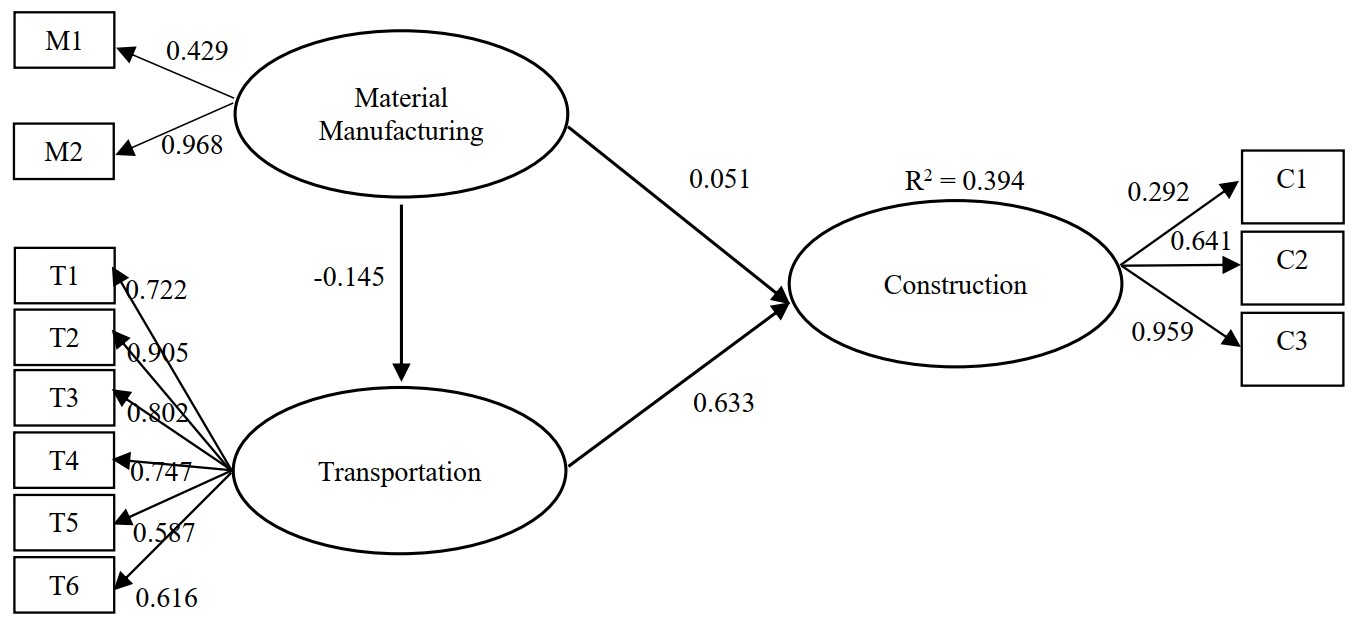
This study presented the comprehensive analysis and management to reduce carbon emissions in Thailand's reinforced concrete building construction projects using Structural Equation Modelling (SEM). Data were collected via questionnaires from experts certified by the Thailand Green Building Institute. The SEM analysis, which demonstrated good model fit, identified three main components: Material Manufacturing, Transportation, and Construction Processes. Structural work exhibited the highest factor loading, whilst electricity uses in construction showed the lowest. Notably, the study revealed the negative relationship between material manufacturing and transportation processes, challenging conventional assumptions. These findings provide crucial insights for designers and industry professionals in developing targeted strategies to reduce carbon emissions. The study's limitations include its focus on the Thai context and a specific set of variables. Future research should explore additional factors, such as renewable energy integration, and conduct longitudinal studies to refine our understanding of emission drivers in the construction sector.
Article Details

This work is licensed under a Creative Commons Attribution-NonCommercial-NoDerivatives 4.0 International License.

This work is licensed under a Creative Commons Attribution-NonCommercial-NoDerivatives 4.0 International License.
References
International Energy Agency. Tracking clean energy progress. Paris: IEA; 2023.
Intergovernmental Panel on Climate Change. Global warming of 1.5° C. An IPCC special report on the impacts of global warming of 1.5° C above pre‐industrial levels and related global greenhouse gas emission pathways, in the context of strengthening the global response to the threat of climate change, sustainable development, and efforts to eradicate poverty. UK: Cambridge University Press; 2018.
International Energy Agency. Global status report for buildings and construction 2019. Paris: IEA; 2019.
Thailand Greenhouse Gas Management Organization (Public Organization). Local performance assessment: LPA. Bangkok: Amarin Group; 2018. (In Thai)
United Nations Environment Programme. Emissions gap report 2023: broken record – temperatures hit new highs, yet world fails to cut emissions (again). Nairobi: United Nations Environment Programme; 2023.
United Nations Environment Programme. 2022 Global status report for buildings and construction: towards a zero‑emission, efficient and resilient buildings and construction sector. Nairobi: United Nations Environment Programme; 2022.
Toufani P, Kucukvar M, Onat NC. Carbon footprints of construction industries: a global, supply chain-linked analysis. 2018 IEEE International Conference on Industrial Engineering and Engineering Management (IEEM); 2018 Dec 16-19; Bangkok, Thailand. USA: IEEE; 2018. p. 11-6. DOI: https://doi.org/10.1109/IEEM.2018.8607513
Du Q, Lu X, Li Y, Wu M, Bai L, Yu M. Carbon emissions in China’s construction industry: calculations, factors and regions. Int J Environ Res Public Health. 2018;15(6):1220. DOI: https://doi.org/10.3390/ijerph15061220
Office of Natural Resources and Environmental Policy and Planning. Thailand’s nationally determined contribution roadmap on mitigation 2021-2030. Bangkok: Ministry of Natural Resources and Environment; 2020. (In Thai)
Office of Natural Resources and Environmental Policy and Planning. Thailand's fourth national communication. Bangkok: Ministry of Natural Resources and Environment; 2024.
International Energy Agency. The role of China’s ETS in power sector decarbonisation. Paris: IEA; 2023.
International Organization for Standardization (ISO). ISO 14040: 2006 Environmental management-life cycle assessment-principles and framework. Geneva: ISO; 2006.
British Standards Institution. PAS 2080: 2016: carbon management in infrastructure. UK: British Standards Institution; 2016.
Papakosta A, Sturgis S. Whole life carbon assessment for the built environment. RICS professional standards and guidance. UK: Royal Institution of Chartered Surveyors; 2017.
Drewniok MP, Azevedo JMC, Dunant CF, Allwood JM, Cullen JM, Ibell T, et al. Mapping material use and embodied carbon in UK construction. Resour Conserv Recycl. 2023;197:107056. DOI: https://doi.org/10.1016/j.resconrec.2023.107056
Lai KE, Rahiman NA, Othman N, Ali KN, Lim YW, Moayedi F, et al. Quantification process of carbon emissions in the construction industry. Energy Build. 2023;289:113025. DOI: https://doi.org/10.1016/j.enbuild.2023.113025
Chen Z, Guo Y, Guo C. Prediction of GHG emissions from Chengdu Metro in the construction stage based on WOA-DELM. Tunnelling Underground Space Technol. 2023;139:105235. DOI: https://doi.org/10.1016/j.tust.2023.105235
Zhang P, Ma B, Zheng G, Li F, Zhang W, Gu J, et al. Unveiling the greenhouse gas emissions of drinking water treatment plant throughout the construction and operation stages based on life cycle assessment. Ecotoxicol Environ Saf. 2024;272:116043. DOI: https://doi.org/10.1016/j.ecoenv.2024.116043
Myint NN, Shafique M. Embodied carbon emissions of buildings: taking a step towards net zero buildings. Case Stud Constr Mater. 2024;20:e03024. DOI: https://doi.org/10.1016/j.cscm.2024.e03024
Arenas NF, Shafique M. Reducing embodied carbon emissions of buildings – a key consideration to meet the net zero target. Sustainable Futures. 2024;7:100166. DOI: https://doi.org/10.1016/j.sftr.2024.100166
Greer F, Horvath A. Modular construction's capacity to reduce embodied carbon emissions in California's housing sector. Build Environ. 2023;240:110432. DOI: https://doi.org/10.1016/j.buildenv.2023.110432
Jiang C, Zhang Y, Zhang X, Han Q, Xiao Y. Research on the carbon profit and loss correlation mechanism of sponge city construction life cycle in urban built up areas. Ecohydrol Hydrobiol. 2025;25(1):126-37. DOI: https://doi.org/10.1016/j.ecohyd.2024.01.011
Ji Y, Li K, Liu G, Shrestha A, Jing J. Comparing greenhouse gas emissions of precast in-situ and conventional construction methods. J Cleaner Prod. 2018;173:124-34. DOI: https://doi.org/10.1016/j.jclepro.2016.07.143
Hong T, Ji C, Jang M, Park H. Assessment model for energy consumption and greenhouse gas emissions during building construction. J Manage Eng. 2014;30(2):226-35. DOI: https://doi.org/10.1061/(ASCE)ME.1943-5479.0000199
Hao JL, Cheng B, Lu W, Xu J, Wang J, Bu W, et al. Carbon emission reduction in prefabrication construction during materialization stage: a BIM-based life-cycle assessment approach. Sci Total Environ. 2020;723:137870. DOI: https://doi.org/10.1016/j.scitotenv.2020.137870
Helal J, Stephan A, Crawford RH. The influence of structural design methods on the embodied greenhouse gas emissions of structural systems for tall buildings. Structures. 2020;24:650-65. DOI: https://doi.org/10.1016/j.istruc.2020.01.026
Chen W, Yang S, Zhang X, Jordan ND, Huang J. Embodied energy and carbon emissions of building materials in China. Build Environ. 2022;207:108434. DOI: https://doi.org/10.1016/j.buildenv.2021.108434
Li XJ, Xie WJ, Xu L, Li LL, Jim CY, Wei TB. Holistic life-cycle accounting of carbon emissions of prefabricated buildings using LCA and BIM. Build Environ. 2022;266:112136. DOI: https://doi.org/10.1016/j.enbuild.2022.112136
Yevu SK, Owusu EK, Chan APC, Sepasgozar SME, Kamat VR. Digital twin-enabled prefabrication supply chain for smart construction and carbon emissions evaluation in building projects. J Build Eng. 2023;78:107598. DOI: https://doi.org/10.1016/j.jobe.2023.107598
Gursel AP, Shehabi A, Horvath A. Embodied energy and greenhouse gas emission trends from major construction materials of US office buildings constructed after the mid-1940s. Build Environ. 2023;234:110196. DOI: https://doi.org/10.1016/j.buildenv.2023.110196
Huang Z, Zhou H, Miao Z, Tang H, Lin B, Zhuang W. Life-cycle carbon emissions (LCCE) of buildings: implications, calculations, and reductions. Engineering. 2024;35:115-39. DOI: https://doi.org/10.1016/j.eng.2023.08.019
Kechidi S, Banks N. Minimising upfront carbon emissions of steel-framed modular housing: a case study. J Build Eng. 2023;72:106707. DOI: https://doi.org/10.1016/j.jobe.2023.106707
Zhu L, Li J, Xiao F. Carbon emission quantification and reduction in pavement use phase: a review. J Traffic Transp Eng. 2024;11(1):69-91. DOI: https://doi.org/10.1016/j.jtte.2023.09.004
Zhao Y, Xu Y, Yu M. An approach for measuring and analyzing embodied carbon in the construction industry chain based on emergy accounting. Ecol Indic. 2024;158:111481. DOI: https://doi.org/10.1016/j.ecolind.2023.111481
Mergos PE. Structural design of reinforced concrete frames for minimum amount of concrete or embodied carbon. Energy Build. 2024;318:114505. DOI: https://doi.org/10.1016/j.enbuild.2024.114505
Ng WL, Azmi AM, Dahlan NY, Woon KS. Predicting life cycle carbon emission of green office buildings via an integrated LCA-MLR framework. Energy Build. 2024;316:114345. DOI: https://doi.org/10.1016/j.enbuild.2024.114345
Hong J, Shen GQ, Peng Y, Feng Y, Mao C. Uncertainty analysis for measuring greenhouse gas emissions in the building construction phase: a case study in China. J Cleaner Prod. 2016;129:183-95. DOI: https://doi.org/10.1016/j.jclepro.2016.04.085
Zhao Z, Chen H, Liu H, Zhu Z, Zhao T, Zhou T. Embodied carbon emission reduction potential of new steel–timber composite frame structure for rural houses. Structures. 2024;61:106121. DOI: https://doi.org/10.1016/j.istruc.2024.106121
Luo WJ, Ma XC, Meng CY, Xu LJ, Tsou JY, Yang SL, et al. Carbon emission modeling and analysis of building materialization process. IOP Conf Ser: Earth Environ Sci. 2020;531:012049. DOI: https://doi.org/10.1088/1755-1315/531/1/012049
Ajay Kumar KC, Ghimire A, Adhikari B, Pant HR, Thapa B, Baral B. Life cycle energy use and carbon emission of a modern single-family residential building in Nepal. Curr Res Environ Sustainability. 2024;7:100245. DOI: https://doi.org/10.1016/j.crsust.2024.100245
Kwok KYG, Kim J, Chong WKO, Ariaratnam ST. Structuring a comprehensive carbon-emission framework for the whole lifecycle of building, operation, and construction. J Archit Eng. 2016;22(3):04016006. DOI: https://doi.org/10.1061/(ASCE)AE.1943-5568.0000215
Hair JF, Black WC, Babin BJ, Anderson RE. Multivariate Data Analysis. 8th ed. England: Pearson Prentice; 2019.
Field A. Discovering statistics using IBM SPSS statistics. USA: Sage Publications Limited; 2024.
Neuman WL. Social research methods: qualitative and quantitative approaches. USA: Pearson Education Limited; 2014.
Schumacker RE, Lomax RG. A beginner's guide to structural equation modeling. 3rd ed. New York, Routlege; 2016. DOI: https://doi.org/10.4324/9781315749105
Wang H, Zhang H, Zhao L, Luo Z, Hou K, Du X, et al. Real-world carbon emissions evaluation for prefabricated component transportation by battery electric vehicles. Energy Rep. 2022;8:8186-99. DOI: https://doi.org/10.1016/j.egyr.2022.06.039
Liwthaisong S, Chaithongrat T, Aksorn P. Reinforced concrete and embodied carbon in construction: challenges and pathways to reduction in Thailand. Eng Appl Sci Res. 2025;52(2):125-34.
Althoey F, Ansari WS, Sufian M, Deifalla AF. Advancements in low-carbon concrete as a construction material for the sustainable built environment. Dev Built Environ. 2023;16:100284. DOI: https://doi.org/10.1016/j.dibe.2023.100284
Xu A, Zhu Y, Wang Z, Zhao Y. Carbon emission calculation of prefabricated concrete composite slabs during the production and construction stages. J Build Eng. 2023;80:107936. DOI: https://doi.org/10.1016/j.jobe.2023.107936
Xu X, You J, Wang Y, Luo Y. Analysis and assessment of life-cycle carbon emissions of space frame structures. J Cleaner Prod. 2023;385:135521. DOI: https://doi.org/10.1016/j.jclepro.2022.135521
Su S, Zang Z, Yuan J, Pan X, Shan M. Considering critical building materials for embodied carbon emissions in buildings: a machine learning-based prediction model and tool. Case Stud Constr Mater. 2024;20:e02887. DOI: https://doi.org/10.1016/j.cscm.2024.e02887
Lu H, You K, Feng W, Zhou N, Fridley D, Price L. Reducing China’s building material embodied emissions: opportunities and challenges to achieve carbon neutrality in building materials. iScience. 2024;27(3):109028. DOI: https://doi.org/10.1016/j.isci.2024.109028
