
The innovative simple water filter for producing utility water using activated carbon from rubber tree branches
Article Sidebar
Main Article Content
Abstract
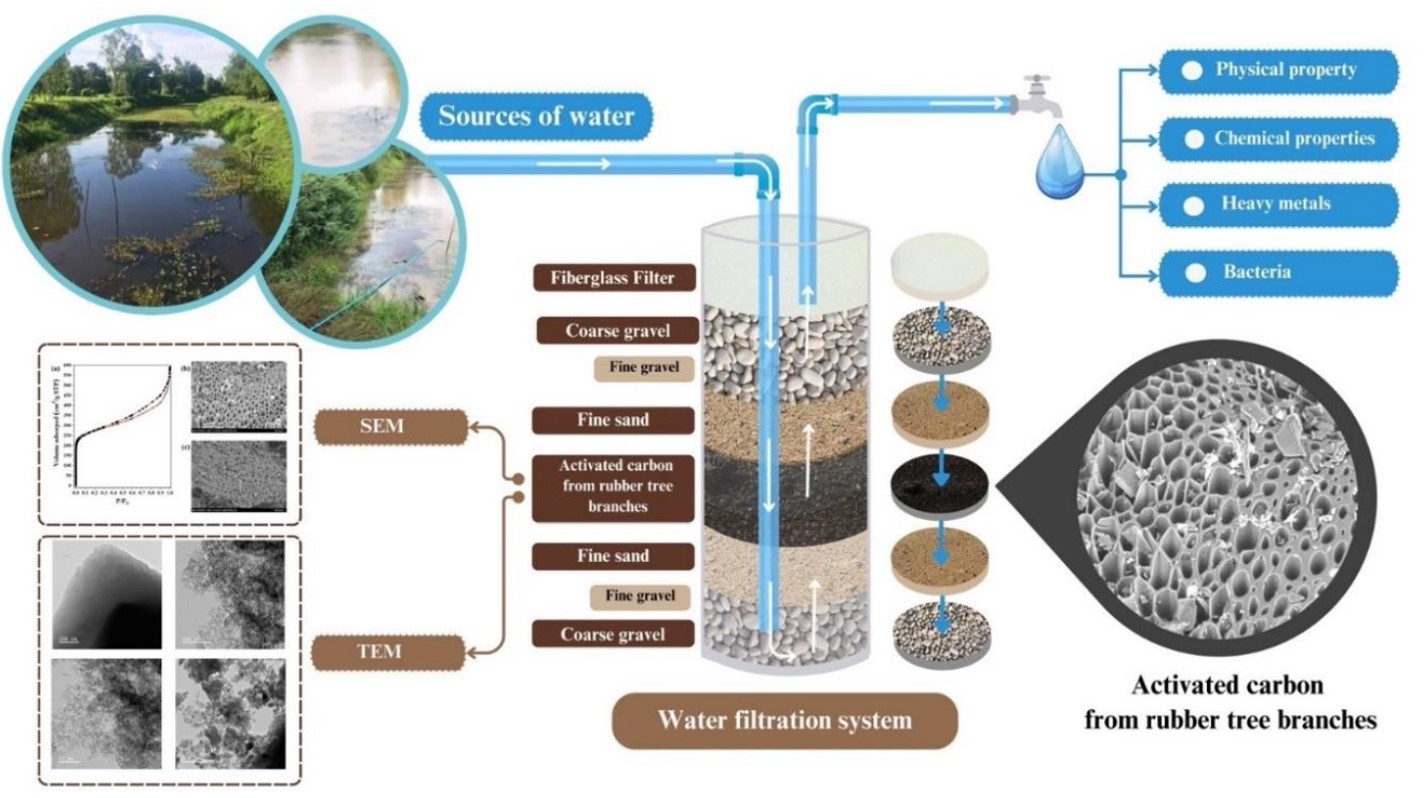
This study presents the development of a cost effective and an innovative household water filtration system utilizing activated carbon derived from locally sourced rubber tree branches. Aimed at improving tap water quality in the Ban Kut Saeng Community, Sakon Nakhon Province, Thailand, the research promotes sustainable material use and simple technology to enhance the availability of clean water in underdeveloped and developing regions. Activated carbon was produced through a dry activation process using NaOH, yielding high adsorption capacity 687.24 mg I₂/g for iodine and complete (100%) methylene blue removal at 100 ppm. BET surface area analysis indicated a value of 833.06 m²/g, with the pore structure exhibiting both microporous and mesoporous characteristics. The filtration performance was evaluated by comparing raw and treated water quality based on the standards of the American Public Health Association (APHA), American Water Works Association (AWWA), and Water Environment Federation (WEF), covering physical, chemical, heavy metal, and microbiological parameters. The raw water has shown high turbidity and bacterial contamination. Following two-stage filtration, Sample D exhibited the tap water quality standards, with turbidity of 9 NTU, apparent color of 2.1 Pt-Co, total dissolved solids (TDS) of 151 ppm, pH of 6.8, total hardness of 30 ppm as CaCO₃, and chloride ion concentration of 9.8 ppm. Total coliforms and E. coli counts were observed below the detectable limits (<1.1 CFU/100 mL), and heavy metals or other harmful ions found to be absent. The results have confirmed the system’s high efficiency in contaminant removal and water quality improvement, underscoring its potential as a low-cost, community-driven solution for household water treatment in the resource-limited areas.
Article Details

This work is licensed under a Creative Commons Attribution-NonCommercial-NoDerivatives 4.0 International License.

This work is licensed under a Creative Commons Attribution-NonCommercial-NoDerivatives 4.0 International License.
References
Gebre SL, Cattrysse D, Van Orshoven J. Multi-criteria decision-making methods to address water allocation problems: a systematic review. Water. 2021;13(2):125. DOI: https://doi.org/10.3390/w13020125
Dolores L, Macchiaroli M, De Mare G. Promotion of socio-environmental sustainability by water utilities: optimal budget estimation and analysis of varying company sizes. IFAC-PapersOnLine. 2024;58(2):1-6. DOI: https://doi.org/10.1016/j.ifacol.2024.07.082
Pacific Institute for Studies in Development, Environment, and Security, Stockholm Environment Institute. Water in crisis: a guide to the world's fresh water resources. New York: Oxford University Press; 1993.
Water Science School. How much water is there on Earth? [Internet]. 2019 [cited 2024 Aug 26]. Available from: https://www.usgs.gov/special-topics/water-science-school/science/how-much-water-there-earth.
Khilchevskyi V, Karamushka V. Global water resources: distribution and demand. In: Leal Filho W, Azul AM, Brandli L, Lange Salvia A, Wall T, editors. Clean Water and Sanitation. Cham: Springer; 2021. p. 1-11. DOI: https://doi.org/10.1007/978-3-319-70061-8_101-1
Wondimu M, Gonfa G. Freshwater resource scarcity, water salinity challenges, and possible remedies: a review. Heliyon. 2023;9(8):e18685. DOI: https://doi.org/10.1016/j.heliyon.2023.e18685
United Nations. Transforming our world: the 2030 agenda for sustainable development. New York: United Nations; 2015.
Ho L, Alonso A, Forio MAE, Vanclooster M, Goethals PLM. Water research in support of the sustainable development goal 6: a case study in Belgium. J Clean Prod. 2020;277:124082. DOI: https://doi.org/10.1016/j.jclepro.2020.124082
Zhu S, Xu J, Yu W, Kuang Y, Wang B, Ying G, et al. Simultaneous production of clean water and organic dye from dyeing wastewater by reusable lignin-derived porous carbon. Ind Crops Prod. 2022;187:115314. DOI: https://doi.org/10.1016/j.indcrop.2022.115314
Kuok KK, Chiu PC, Rahman MR, Chin MY, Bakri MKB. Sustainable bamboo and coconut shell activated carbon for purifying river water on Borneo Island. Waste Manag Bull. 2024;2:39-48. DOI: https://doi.org/10.1016/j.wmb.2023.12.008
Nidheesh PV, Kumar M, Venkateshwaran G, Ambika S, Bhaskar S, Vinay, et al. Conversion of locally available materials to biochar and activated carbon for drinking water treatment. Chemosphere. 2024;353:141566. DOI: https://doi.org/10.1016/j.chemosphere.2024.141566
Ponken T, Phumuen P, Phosopa N, Ponhan W, Phakkhawan A, Klangtakai P. Activated carbon synthesized from bamboo shoots for supercapacitor application. Creative Sci. 2022;15(1):247051. DOI: https://doi.org/10.55674/cs.v15i1.247051
Mistar EM, Alfatah T, Supardan MD. Synthesis and characterization of activated carbon from Bambusa vulgaris striata using two-step KOH activation. J Mater Res Technol. 2020;9(3):6278-86. DOI: https://doi.org/10.1016/j.jmrt.2020.03.041
Xu J, Yu J, Xu J, Sun C, He W, Huang J, et al. High-value utilization of waste tires: a review with focus on modified carbon black from pyrolysis. Sci Total Environ. 2020;742:140235. DOI: https://doi.org/10.1016/j.scitotenv.2020.140235
Kuśmierek K, Świątkowski A, Kotkowski T, Cherbański R, Molga E. Adsorption on activated carbons from end-of-life tyre pyrolysis for environmental applications. Part II. Adsorption from aqueous phase. J Anal Appl Pyrolysis. 2021;158:105206. DOI: https://doi.org/10.1016/j.jaap.2021.105206
Jones I, Zhu M, Zhang J, Zhang Z, Preciado-Hernandez J, Gao J, et al. The application of spent tyre activated carbons as low-cost environmental pollution adsorbents: a technical review. J Clean Prod. 2021;312:127566. DOI: https://doi.org/10.1016/j.jclepro.2021.127566
Muttil N, Jagadeesan S, Chanda A, Duke M, Singh SK. Production, types, and applications of activated carbon derived from waste tyres: an overview. Appl Sci. 2023;13(1):257. DOI: https://doi.org/10.3390/app13010257
Leelatam T, Roschat W, Fongwichai T, Tamprasee W, Phewphong S, Moonsin P, et al. The synthesis of activated carbon from agricultural residues for application as an adsorbent via easy method and using the innovative simple biomass incinerator. Trends Sci. 2025;22(8):10189. DOI: https://doi.org/10.48048/tis.2025.10189
Suwonnachot W, Chaisen K, Audtarat S. In vitro anti-pathogenic activity of composite materials made of activated carbon from bamboo containing silver nanoparticles. Creative Sci. 2025;17(1):258193. DOI: https://doi.org/10.55674/cs.v17i1.258193
Yang V, Senthil RA, Pan J, Khan A, Osman S, Wang L, et al. Highly ordered hierarchical porous carbon derived from biomass waste mangosteen peel as superior cathode material for high performance supercapacitor. J Electroanal Chem. 2019;855:113616. DOI: https://doi.org/10.1016/j.jelechem.2019.113616
Jantaboot A, Bunkham A, Aggarangsi P. Production of activated carbon from corncob by combined phosphoric acid and carbon dioxide activation. Thai Sci Technol J. 2023;31(5):94-107. (In Thai)
Cazetta AL, Vargas AMM, Nogami EM, Kunita MH, Guilherme MR, Martinset AC, et al. NaOH-activated carbon of high surface area produced from coconut shell: Kinetics and equilibrium studies from the methylene blue adsorption. Chem Eng J. 2011;174(1):117-25. DOI: https://doi.org/10.1016/j.cej.2011.08.058
Sarawanan T, Mahat NS, Rusli MN, Zaini MAA. Two-stage adsorber optimization of NaOH-prewashed oil palm empty fruit bunch activated carbon for methylene blue removal. Chem Prod Process Model. 2023;18(3):383-90. DOI: https://doi.org/10.1515/cppm-2022-0010
Al-Qaim FF, Jusof SH, Abdullah MP, Mussa ZH, Abu Tahrim N, Wan Mohd Khalik WMA, et al. Determination of caffeine in surface water using solid phase extraction and high-performance liquid chromatography. Malays J Anal Sci. 2017;21(1):95-104. DOI: https://doi.org/10.17576/mjas-2017-2101-11
Al-Qaim FF, Mussa ZH, Yuzir A, Abu Tahrim N, Hashim N, Azman S. Transportation of different therapeutic classes of pharmaceuticals to surface water, sewage treatment plant, and hospital samples in Malaysia. Water. 2018;10(7):916. DOI: https://doi.org/10.3390/w10070916
Al-Qaim FF, Al-Saedi HFS, Mussa ZH, Kadhim NJ, Al-Qaim ZH. Application of the response surface approach to the adsorption of methylene blue from water using acid-modified grape leaves. React Kinet Mech Catal. 2024;137:399-422. DOI: https://doi.org/10.1007/s11144-023-02542-5
Al-Asadi ST, Al-Qaim FF. Application of response surface methodology on efficiency of fig leaf activated carbon for removal of methylene blue dye. J Med Pharm Chem Res. 2023;5(9):794-811.
Abid LH, Mussa ZH, Deyab IF, Al-Ameer LR, Al-Saedi HFS, Al-Qaim FF, et al. Walnut shell as a bio-activated carbon for elimination of malachite green from its aqueous solution: adsorption isotherms, kinetics and thermodynamic studies. Results Chem. 2025;14:102124. DOI: https://doi.org/10.1016/j.rechem.2025.102124
Roschat W, Donrussamee S, Smanmit P, Jikjak S, Leelatam T, Phewphong S, et al. Quality improvement of crude glycerol from biodiesel production using activated carbon derived from Krabok (Irvingia malayana) seed shells. Korean J Mater Res. 2024;34(1):1-11. DOI: https://doi.org/10.3740/MRSK.2024.34.1.1
APHA. Standard methods for the examination of water and wastewater. 23rd ed. Washington: American Public Health Association; 2017.
Department of Health, Ministry of Public Health. Announcement of the Department of Health on drinking water quality criteria, B.E. 2563 (2020). Bangkok: Ministry of Public Health; 2020.
Ngernyen Y, Kamwilaisak K. Activated carbon from Thailand’s biomass: a review literature. KKU Eng J. 2013;40(2):267-83. (In Thai)
Roschat W, Jandaruang J, Jirawattanasomkul N, Khaephimphan S, Boontham N, Saikaew W, Phewphong S, Thammayoda A, Leelatam T, Khotsuno N, Phatai P, Nuengmatcha P, Promarakh V. Synthesis of multi-functional Cu-activated carbon for organic dye removal and antibacterial applications. Solid State Sci. 2026;176:108297. DOI: https://doi.org/10.1016/j.solidstatesciences.2026.108297
Li J, Tong Y, Guan L, Wu S, Li D. Optimization of COD determination by UV-visible spectroscopy using PLS chemometrics algorithms. Optik. 2018;174:591-9. DOI: https://doi.org/10.1016/j.ijleo.2018.08.111
Bardik V, Fisenko AI, Magazu S, Malomuzh NP. The crucial role of water in the formation of the physiological temperature range for warm-blooded organisms. J Mol Liq. 2020;306:112818. DOI: https://doi.org/10.1016/j.molliq.2020.112818
Guo Y, Liu C, Ye R, Duan Q. Advances on water quality detection by UV-Vis spectroscopy. Appl Sci. 2020;10(19):6874. DOI: https://doi.org/10.3390/app10196874
Diao Y, Walawender WP, Fan LT. Activated carbons prepared from phosphoric acid activation of grain sorghum. Bioresour Technol. 2002;81(1):47-52. DOI: https://doi.org/10.1016/S0960-8524(01)00100-6
Guo Y, Yang S, Yu K, Zhao J, Wang Z, Xu H. The preparation and mechanism studies of rice husk based porous carbon. Mater Chem Phys. 2002;74(3):320-3. DOI: https://doi.org/10.1016/S0254-0584(01)00473-4
Dao TM, Tran LL. Synthesis of activated carbon from macadamia nutshells activated by H2SO4 and K2CO3 for methylene blue removal in water. Bioresour Technol Rep. 2020;12:100583. DOI: https://doi.org/10.1016/j.biteb.2020.100583
Boulika H, El Hajam M, Hajji Nabih M, Idrissi Kandri N, Zerouale A. Activated carbon from almond shells using an eco-compatible method: screening, optimization, characterization, and adsorption performance testing. RSC Adv. 2022;12:34393-403. DOI: https://doi.org/10.1039/D2RA06220H
Phothong K, Tangsathitkulchai C, Lawtae P. The analysis of pore development and formation of surface functional groups in bamboo-based activated carbon during CO2 activation. Molecules. 2021;26(18):5641. DOI: https://doi.org/10.3390/molecules26185641
Wang B, Lan J, Bo C, Gong B, Ou J. Adsorption of heavy metal onto biomass-derived activated carbon: review. RSC Adv. 2023;13(7):4275-302. DOI: https://doi.org/10.1039/D2RA07911A
Ullah S, Shah SSA, Altaf M, Hossain I, El Sayed ME, Kallel M, et al. Activated carbon derived from biomass for wastewater treatment: Synthesis, application and future challenges. J Anal Appl Pyrolysis. 2024;179:106480. DOI: https://doi.org/10.1016/j.jaap.2024.106480
Wang Q, Lai Z, Luo C, Zhang J, Cao X, Liu J, et al. Honeycomb-like activated carbon with microporous nanosheets structure prepared from waste biomass cork for highly efficient dye wastewater treatment. J Hazard Mater. 2021;416:125896. DOI: https://doi.org/10.1016/j.jhazmat.2021.125896
Pathania D, Sharma S, Singh P. Removal of methylene blue by adsorption onto activated carbon developed from Ficus carica bast. Arab J Chem. 2017;10:S1445-51. DOI: https://doi.org/10.1016/j.arabjc.2013.04.021
Ramalingam RJ, Sivachidambaram M, Vijaya JJ, Al-Lohedan HA, Muthumareeswaran MR. Synthesis of porous activated carbon powder formation from fruit peel and cow dung waste for modified electrode fabrication and application. Biomass Bioenergy. 2020;142:105800. DOI: https://doi.org/10.1016/j.biombioe.2020.105800
Santoso E, Ediati R, Kusumawati Y, Bahruji H, Sulistiono DO, Prasetyoko D. Review on recent advances of carbon-based adsorbent for methylene blue removal from wastewater. Mater Today Chem. 2020;16:100233. DOI: https://doi.org/10.1016/j.mtchem.2019.100233
Rafatullah M, Sulaiman O, Hashim R, Ahmad A. Adsorption of methylene blue on low-cost adsorbents: a review. J Hazard Mater. 2010;177(1-3):70-80. DOI: https://doi.org/10.1016/j.jhazmat.2009.12.047
Deng H, Li G, Yang H, Tang J, Tang J. Preparation of activated carbons from cotton stalk by microwave assisted KOH and K2CO3 activation. Chem Eng J. 2010;163(1):373-81. DOI: https://doi.org/10.1016/j.cej.2010.08.019
Foo KY, Hameed BH. Preparation of activated carbon from date stones by microwave induced chemical activation: application for methylene blue adsorption. Chem Eng J. 2011;170(1):338-41. DOI: https://doi.org/10.1016/j.cej.2011.02.068
Mechnou I, Benabdallah A, Chham AI, Rachdi Y, Hlaibi M, El kartouti A, et al. Activated carbons for effective pharmaceutical adsorption: Impact of feedstock origin, activation agents, adsorption conditions, and cost analysis. Results Eng. 2025;27:105966. DOI: https://doi.org/10.1016/j.rineng.2025.105966
Togibasa O, Dahlan K, Ansanay YO, Runggaweri AF, Merani M. Surface modification of activated carbon from sago waste. J Met Mater Miner. 2023;33(1):95-100. DOI: https://doi.org/10.55713/jmmm.v33i1.1616
Abdullah NS, Hussin MH, Sharifuddin SS, Yusoff MAM. Preparation and characterization of activated carbon from Moringa oleifera seed pod. Sci Int (Lahore). 2017;29(1):7-11.
Luo Y, Street J, Steele P, Entsminger E, Guda V. Activated carbon derived from pyrolyzed pinewood char using elevated temperature, KOH, H3PO4, and H2O2. BioRes. 2016;11(4):10433-47. DOI: https://doi.org/10.15376/biores.11.4.10433-10447
Wang B, Qiu J, Feng H, Sakai E, Komiyama T. KOH-activated nitrogen doped porous carbon nanowires with superior performance in supercapacitors. Electrochim Acta. 2016;190:229-39. DOI: https://doi.org/10.1016/j.electacta.2016.01.038
Blachnio M, Derylo-Marczewska A, Charmas B, Zienkiewicz-Strzalka M, Bogatyrov V, Galaburda M. Activated carbon from agricultural wastes for adsorption of organic pollutants. Molecules. 2020;25(21):5105. DOI: https://doi.org/10.3390/molecules25215105
de Souza LKC, Martins JC, Oliveira DP, Ferreira CS, Gonçalves AAS, Araujo RO, et al. Hierarchical porous carbon derived from acai seed biowaste for supercapacitor electrode materials. J Mater Sci: Mater Electron. 2020;31:12148-57. DOI: https://doi.org/10.1007/s10854-020-03761-5
Osman AI, Blewitt J, Abu-Dahrieh JK, Farrell C, Al-Muhtaseb AH, Harrison J, et al. Production and characterisation of activated carbon and carbon nanotubes from potato peel waste and their application in heavy metal removal. Environ Sci Pollut Res. 2019;26:37228-41. DOI: https://doi.org/10.1007/s11356-019-06594-w
Holcomb DA, Stewart JR. Microbial indicators of fecal pollution: recent progress and challenges in assessing water quality. Curr Environ Health Rep. 2020;7(3):311-24. DOI: https://doi.org/10.1007/s40572-020-00278-1
Sarkar B, Mitchell E, Frisbie S, Grigg L, Adhikari S, Maskey Byanju R. Drinking water quality and public health in the Kathmandu Valley, Nepal: Coliform bacteria, chemical contaminants, and health status of consumers. J Environ Public Health. 2022;2022:3895859. DOI: https://doi.org/10.1155/2022/3895859
Bain R, Cronk R, Wright J, Yang H, Slaymaker T, Bartram J. Fecal contamination of drinking-water in low- and middle-income countries: a systematic review and meta-analysis. PLoS Med. 2014;11(5):e1001644. DOI: https://doi.org/10.1371/journal.pmed.1001644
