
Influence of rice husk ash calcination temperature in determining compressive strength and microstructure of mortar
Article Sidebar
Main Article Content
Abstract
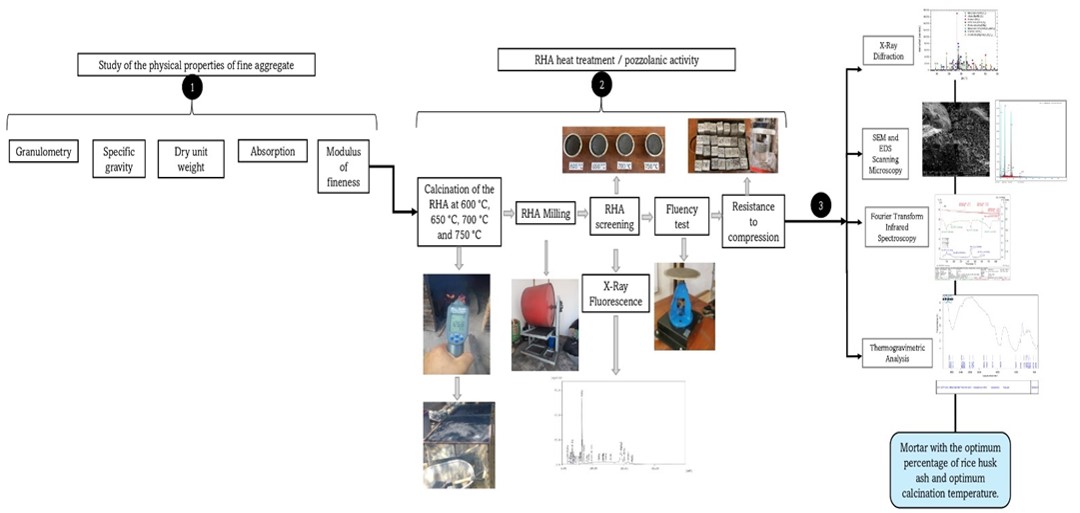
The construction industry consumes large quantities of cement and is therefore a major source carbon dioxide (CO2) emissions. As a more sustainable alternative, rice husk ash (RHA) can partially replace cement, taking advantage of its pozzolanic properties. The reactivity of RHA varies depending on the calcination temperature, affecting the strength and microstructure of the mortar (MM). This study evaluates how calcination temperature of RHA affects compressive strength and MM. RHA was heat treated at 600, 650, 700 and 750 °C to analyze the compressive strength of the mortar. Mortar specimens were prepared with RHA replacing cement at 5, 10, 15 and 20% to replace cement and compressive strength tests were performed at 7, 14, 21 and 28 days. In addition, the MM was characterized using X-ray diffraction (XRD), scanning electron microscopy (SEM), Fourier Transform Infrared Spectroscopy (FTIR) and Thermogravimetric Analysis (TGA) were used to evaluate the MM. The results indicate a maximum gain in compressive strength up to 55.87% when 15% of the cement was replaced with RHA calcined at 700 °C, whose amorphous silica content was 69.40%. Moreover, microstructural analyses evidenced the formation of C-S-H and C-A-S-H gels, which densified the mortar, improved the interfacial zone (ITZ), and reduced overall porosity. It is concluded that the calcination temperature significantly influences the pozzolanic reactivity of RHA, the mechanical strength, and MM; RHA calcined at 650 - 700 °C exhibited the best mechanical performance, attributable to higher amorphous silica content and greater microstructural densification. It is recommended for future works to investigate calcination temperatures above 750°C, analyze the relationship between RHA particle size and its amorphous silica content, and evaluate the mortar´s long-term durability. In addition, studies should assess the interaction of RHA with other alternative materials to identify synergistic effects and optimize the RHA dosage.
Article Details

This work is licensed under a Creative Commons Attribution-NonCommercial-NoDerivatives 4.0 International License.

This work is licensed under a Creative Commons Attribution-NonCommercial-NoDerivatives 4.0 International License.
References
Prayuda H, Monika F, Passa SA, Lubis RA, Wibowo DE. Engineering properties of mortar with untreated agricultural waste ashes as cement replacement materials. Innov Infrastruct Solut. 2023;8:227. DOI: https://doi.org/10.1007/s41062-023-01200-y
Jeffy PJ, Ninija MR, Subash N. Mechanical properties and microstructural characterization of ferrock as CO2–negative material in self-compacting concrete. Constr Build Mater. 2023;396:132289. DOI: https://doi.org/10.1016/j.conbuildmat.2023.132289
Hamada HM, Abed F, Beddu S, Humada A, Majdi A. Effect of volcanic ash and natural pozzolana on mechanical properties of sustainable cement concrete: a comprehensive review. Case Stud Constr Mater. 2023;19:e02425. DOI: https://doi.org/10.1016/j.cscm.2023.e02425
Adnan SH, Azemi NFNM, Osman MH, Jeni MLA, Ern PAS, Yassin NIM, et al. Influence of palm oil fuel ash (POFA) towards fire resistance performance of brick. J Adv Res Fluid Mech Therm Sci. 2019;64(2):316-25.
Kankia MU, Baloo L, Danlami N, Zawawi NA, Bello A, Muhammad SI. Microstructural analysis and compressive strength of fly ash and petroleum sludge ash geopolymer mortar under high temperatures. Sustainability. 2023;15(12):9846. DOI: https://doi.org/10.3390/su15129846
Aperador W, Bautista-Ruiz J, Sánchez-Molina J. Geopolymers based on a mixture of steel slag and fly ash, activated with rice husks and reinforced with Guadua angustifolia fibers. Sustainability. 2023;15(16):12404. DOI: https://doi.org/10.3390/su151612404
Salleh S, Alhallak M, Tayier W. Analysis of concrete performance from different waste as partial cement replacement. AIP Conf Proc. 2023;2599:070008. DOI: https://doi.org/10.1063/5.0117730
Lu T, Fang J, Yu Z, Xue Q. Hydration and mechanical property of the coral powder–fly ash–Portland cement ternary system. J Test Eval. 2024;52(1):776-87. DOI: https://doi.org/10.1520/JTE20230022
Hamada HM, Al-Attar A, Shi J, Yahaya F, Al Jawahery MS, Yousif ST. Optimization of sustainable concrete characteristics incorporating palm oil clinker and nano-palm oil fuel ash using response surface methodology. Powder Technol. 2023;413:118054. DOI: https://doi.org/10.1016/j.powtec.2022.118054
Abdulhaleem KN, Hamada HM, Majdi A, Yousif ST. Influence of palm oil fuel ash as agricultural waste on the environment and strength of geopolymer concrete. Res Eng Struct Mater. 2024;886:647-62. DOI: https://doi.org/10.17515/resm2024.306ma0602rv
Su Q, Xu J. Mechanical properties of concrete containing glass sand and rice husk ash. Constr Build Mater. 2023;393:132053. DOI: https://doi.org/10.1016/j.conbuildmat.2023.132053
Hamada HM, Al-Attar A, Beddu S, Askar MK, Yousif ST, Ali M. Impact of rice husk ash on geopolymer concrete: a literature review and future directions. Case Stud Constr Mater. 2025;22:e04476. DOI: https://doi.org/10.1016/j.cscm.2025.e04476
Hamada HM, Abdulhaleem KN, Majdi A, Al Jawahery MS, Thomas BS, Yousif ST. The durability of concrete produced from pozzolan materials as a partial cement replacement: a comprehensive review. Mater Today Proc. 2023. DOI: https://doi.org/10.1016/j.matpr.2023.03.337
Tanash AO, Abu Bakar BH, Muthusamy K, Al Biajawi MI. Effect of elevated temperature on mechanical properties of normal strength concrete: an overview. Mater Today Proc. 2024;107:152-7. DOI: https://doi.org/10.1016/j.matpr.2023.09.053
Pham VP, Tran VT. Rice husk ash burnt in simple conditions for soil stabilization. 4th International Conference on Geotechnics for Sustainable Infrastructure Development; 2019 Nov 28-29; Hanoi, Vietnam. Singapore: Springer; 2019. p. 717-21. DOI: https://doi.org/10.1007/978-981-15-2184-3_93
Rithuparna R, Jittin V, Bahurudeen A. Influence of different processing methods on the recycling potential of agro-waste ashes for sustainable cement production: a review. J Clean Prod. 2021;316:128242. DOI: https://doi.org/10.1016/j.jclepro.2021.128242
Mostafa M, Salah H, Shehata N. Role of low-cost nano RHA on physico-mechanical properties of cement mortar. Egypt J Chem. 2020;63(3): 1045-54.
Thiedeitz M, Ostermaier B, Kränkel T. Rice husk ash as an additive in mortar: contribution to microstructural, strength and durability performance. Resour Conserv Recycl. 2022;184:106389. DOI: https://doi.org/10.1016/j.resconrec.2022.106389
Muñoz Perez SP, Charca Mamani S, Villena Zapata LI, Piedra JLL, Gonzales Ayasta S, Rodriguez Lafitte ED, et al. Influence of rice husk ash (RHA) with gypsum and ichu fibers in the processing of geopolymers. Innov Infrastruct Solut. 2023;8:211. DOI: https://doi.org/10.1007/s41062-023-01176-9
Wang Z, Li B, Othman A, Zhang Z. Endogenous alkali silica reaction evaluation of rice husk ash in mortar. J Build Eng. 2023;75:106970. DOI: https://doi.org/10.1016/j.jobe.2023.106970
Zhang W, Liu H, Liu C. Impact of rice husk ash on the mechanical characteristics and freeze–thaw resistance of recycled aggregate concrete. Appl Sci. 2022;12(23):12238. DOI: https://doi.org/10.3390/app122312238
Bui PT, Huynh TP. Performance and microstructural evaluation of rice husk ash–ground granulated blast furnace slag–CFBC fly ash mixtures produced as an eco-cement. J Mater Civ Eng. 2022;34(3):04021485. DOI: https://doi.org/10.1061/(ASCE)MT.1943-5533.0004119
Vo DH, Hwang CL, Huynh TP. Performance evaluation of green mortars developed from a ternary eco-cement of industrial solid wastes. Adv Cem Res. 2022;34(6):245-59. DOI: https://doi.org/10.1680/jadcr.21.00102
Guo Y, Zhang JX, Lakhiar MT, Jiaji W. Eco-friendly cement mortar production using rice husk ash and oyster seashell powder: a comprehensive study of mechanical, durability and life cycle properties. Constr Build Mater. 2025;481:141590. DOI: https://doi.org/10.1016/j.conbuildmat.2025.141590
Hamada HM, Al-Attar AA, Tayeh B, Mat Yahaya FB. Optimizing the concrete strength of lightweight concrete containing nano palm oil fuel ash and palm oil clinker using response surface method. Case Stud Constr Mater. 2022;16:e01061. DOI: https://doi.org/10.1016/j.cscm.2022.e01061
Al Biajawi MI, Embong R, Shubbar A. Engineering properties of self-compacting concrete incorporating coal bottom ash (CBA) as sustainable materials for green concrete: a review. J Build Pathol Rehabil. 2023;8:105. DOI: https://doi.org/10.1007/s41024-023-00352-9
Zhu Z, Xu X, Liu R, Liu P, Tang H, Gong Y, et al. Feasibility study of highly alkaline biomass ash to activate alkali-activated grouts. Constr Build Mater. 2023;393:132067. DOI: https://doi.org/10.1016/j.conbuildmat.2023.132067
Barbosa FL, Cordeiro GC. Partial cement replacement by different sugar cane bagasse ashes: hydration-related properties, compressive strength and autogenous shrinkage. Constr Build Mater. 2021;272:121625. DOI: https://doi.org/10.1016/j.conbuildmat.2020.121625
Ji J, Li L, Quan L, Tian B, Zhang P, Li S. The effects of calcination process parameters on RHA reactivity and mortar mechanical properties. Materials. 2025;18(13):3129. DOI: https://doi.org/10.3390/ma18133129
Jaya RP, Nor M, Ahmad ZA, Amin ZM. Properties of mortar containing rice husk ash at different temperature and exposed to aggressive environment. Adv Mater Res. 2013;620:87-93. DOI: https://doi.org/10.4028/www.scientific.net/AMR.620.87
Muthukrishnan S, Gupta S, Kua HW. Application of rice husk biochar and thermally treated low silica rice husk ash to improve physical properties of cement mortar. Theor Appl Fract Mech. 2019;104:102376. DOI: https://doi.org/10.1016/j.tafmec.2019.102376
ASTM. ASTM C136, standard test method for sieve analysis of fine and coarse aggregates. USA: ASTM International; 2020.
ASTM. ASTM C1602, standard specification for mixing water used in the production of hydraulic cement concrete. USA: ASTM International; 2022.
ASTM. ASTM C128, standard test method for relative density (specific gravity) and absorption of fine aggregate. USA: ASTM International; 2023.
ASTM. ASTM C29, standard test method for bulk density (unit weight) and voids in aggregate. USA: ASTM International; 2017.
ASTM. ASTM C127, standard test method for relative density (specific gravity) and absorption of coarse aggregate. USA: ASTM International; 2017.
ASTM. ASTM C566, standard test method for total evaporable moisture content of aggregate by drying. USA: ASTM International; 2019.
Hossain SS, Roy PK, Bae CJ. Utilization of waste rice husk ash for sustainable geopolymer: a review. Constr Build Mater. 2021;310:125218. DOI: https://doi.org/10.1016/j.conbuildmat.2021.125218
ASTM. ASTM C618, standard specification for coal fly ash and raw or calcined natural pozzolan for use in concrete. USA: ASTM International; 2022.
ASTM. ASTM C39, standard test method for compressive strength of cylindrical concrete specimens. USA: ASTM International; 2021.
ASTM. ASTM E2809, standard guide for using scanning electron microscopy/energy dispersive X-ray spectroscopy (SEM/EDS) in forensic polymer examinations. USA: ASTM International; 2022.
ASTM. ASTM E1252, standard practice for general techniques for obtaining infrared spectra for qualitative analysis. ASTM International; 2021.
ASTM. ASTM E1131, standard test method for compositional analysis by thermogravimetry. USA: ASTM International; 2020.
ASTM. ASTM D3418, standard test method for transition temperatures and enthalpies of fusion and crystallization of polymers by differential scanning calorimetry. USA: ASTM International; 2021.
