
Identification and quantification of quality of intact durian fruits using NIR spectroscopy
Article Sidebar
Main Article Content
Abstract
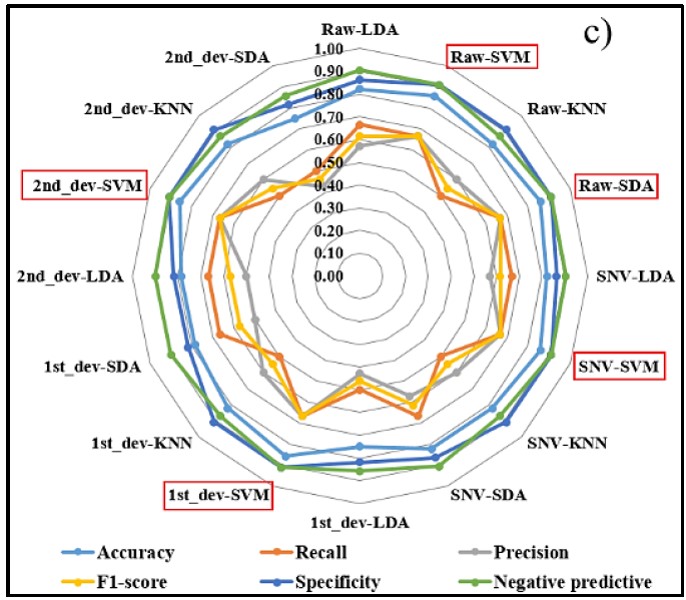
Quality classification of durian fruits is based on the dry matter (DM) content of the pulp. According to Thai agricultural standards, durian fruit (Monthong variety) must contain at least 32% DM. This study aimed to develop a classification model for assessing durian quality based on DM content, categorizing fruits as either “rejected” (DM < 32%) or “accepted” (DM ≥ 32%). Near-infrared (NIR) spectra were collected as the durian fruits moved along a conveyor belt. The models were developed using two spectral ranges: short-wavelength near-infrared (SWNIR; 4501000 nm) and long-wavelength near-infrared (LWNIR; 8601750 nm). Owing to the imbalance in the dataset between the two classes, the data were adjusted using the synthetic minority oversampling technique to create a balanced dataset. Prediction models were built using different spectral preprocessing methods and algorithms. For the LWNIR range, the models constructed using LDA, SVM, KNN, and SDA achieved accuracies of 95%, 90%, 93%, and 93%, respectively, for the test set. The SWNIR models, developed using the same algorithms, achieved accuracies of 90%, 88%, 90%, and 90%, respectively, for the test set. PLS-regression was used to predict the DM content from both LWNIR and SWNIR data. With the 2nd derivative preprocessing method, the models achieved R² values of 0.89 and 0.79, SEP values of 5% and 6.89%, and RPD values of 2.29 and 1.66, respectively. The wavelength range significantly influenced the model performance, whereas spectral pretreatment had a minor effect on the model's predictive ability. Overall, NIR spectroscopy demonstrated the potential for nondestructive quality grading of whole durian fruits. This work is the first to establish real-time, in-line models for durian grading based on DM content, advancing beyond the previous destructive method. The findings demonstrate the feasibility of automated, nondestructive, and objective quality assessment, supporting industrial automation, precision agriculture, and export quality assurance.
Article Details

This work is licensed under a Creative Commons Attribution-NonCommercial-NoDerivatives 4.0 International License.

This work is licensed under a Creative Commons Attribution-NonCommercial-NoDerivatives 4.0 International License.
References
Thai Government. Thai-Chinese trade is proceeding smoothly, with a target of exporting 700,000 tons of durian this year. [Internet]. 2023 [cited 2025 Feb 4]. Available from: https://archives.thaigov.go.th/th/t/34/media/infographic/view/7030.
Matichon Online. Keep an eye on exporting 'Thai durian' to the Chinese market [Internet]. 2023 [cited 2025 Feb 4]. Available from: https://www.matichon.co.th/economy/news_3904043. (In Thai)
Office of Agricultural Economics. Export statistics of fresh durian [Internet]. 2022 [cited 2025 Feb 4]. Available from: https://oae.go.th/home/article/386. (In Thai)
Ministry of Agriculture and Cooperatives. Establishing agricultural product standards (TAS 9028-2557) [Internet]. 2014 [cited
Feb 4]. Available from: https://www.ratchakitcha.soc.go.th/DATA/PDF/2557/E/200/7.PDF. (In Thai)
National Bureau of Agricultural Commodity and Food Standards. Thai Agricultural Standard TAS 3-2013; Durian [Internet]. 2013 [cited 2025 Feb 4]. Available from: http://patricklepetit.jalbum.net/RAYONG/LIBRARY/durian-TIS.pdf.
Posom J, Soonnamtiang N, Kotethum P, Konjun P, Sirisomboon P, Saengprachatanarug K, et al. Two different portables visible-near infrared and shortwave infrared region for on-tree measurement of soluble solid content of Marian plum fruit. Eng J. 2020;24(5):227-36. DOI: https://doi.org/10.4186/ej.2020.24.5.227
Maraphum K, Ounkaew A, Kasemsiri P, Hiziroglu S, Posom J. Wavelengths selection based on genetic algorithm (GA) and successive projections algorithms (SPA) combine with PLS regression for determination the soluble solids content in Nam-DokMai mangoes based on near infrared spectroscopy. Eng Appl Sci Res. 2022;49(1):119-26.
Pourdarbani R, Sabzi S, Arribas JI. Nondestructive estimation of three apple fruit properties at various ripening levels with optimal Vis-NIR spectral wavelength regression data. Heliyon. 2021;7(9):e07942. DOI: https://doi.org/10.1016/j.heliyon.2021.e07942
Martins JA, Rodrigues D, Cavaco AM, Antunes MD, Guerra R. Estimation of soluble solids content and fruit temperature in ’Rocha’ pear using Vis-NIR spectroscopy and the SpectraNet–32 deep learning architecture. Postharvest Biol Technol. 2023;199:112281. DOI: https://doi.org/10.1016/j.postharvbio.2023.112281
Malai C, Maraphum K, Saengprachatanarug K, Wongpichet S, Phuphaphud A, Posom J. Effective measurement of starch and dry matter content in fresh cassava tubers using interactance Vis/NIR spectra. J Food Compos Anal. 2024;125:105783. DOI: https://doi.org/10.1016/j.jfca.2023.105783
Posom J, Maraphum K. Achieving prediction of starch in cassava (Manihot esculenta Crantz) by data fusion of Vis-NIR and Mid-NIR spectroscopy via machine learning. J Food Compos Anal. 2023;122:105415. DOI: https://doi.org/10.1016/j.jfca.2023.105415
Maraphum K, Saengprachatanarug K, Wongpichet S, Phuphuphud A, Posom J. Achieving robustness across different ages and cultivars for an NIRS-PLSR model of fresh cassava root starch and dry matter content. Comput Electron Agric. 2022;196:106872. DOI: https://doi.org/10.1016/j.compag.2022.106872
Tipsod N, Santalunai W, Posom J, Phuphaphudand A, Saengprachatanarug K. The low cost spectrometer for estimation of dry matter in fresh cassava tuber. Ag Bio Eng. 2024;1(4):108-12.
Onsawai P, Phetpan K, Khurnpoon L, Sirisomboon P. Evaluation of physiological properties and texture traits of durian pulp using near-infrared spectra of the pulp and intact fruit. Measurement. 2021;174:108684. DOI: https://doi.org/10.1016/j.measurement.2020.108684
Sharma S, Sirisomboon P, Sumesh KC, Terdwongworakul A, Phetpan K, Kshetri TB, et al. Near-infrared hyperspectral imaging combined with machine learning for physicochemical-based quality evaluation of durian pulp. Postharvest Biol Technol. 2023;200:112334. DOI: https://doi.org/10.1016/j.postharvbio.2023.112334
Ali MM, Hashim N, Shahamshah MI. Durian (Durio zibethinus) ripeness detection using thermal imaging with multivariate analysis. Postharvest Biol Technol. 2021;176:111517. DOI: https://doi.org/10.1016/j.postharvbio.2021.111517
Saechua W, Sharma S, Nakawajana N, Leepaitoon K, Chunsri R, Posom J, et al. Integrating Vis-SWNIR spectrometer in a conveyor system for in-line measurement of dry matter content and soluble solids content of durian pulp. Postharvest Biol Technol. 2021;181:111640. DOI: https://doi.org/10.1016/j.postharvbio.2021.111640
Phuangsombut K, Phuangsombut A, Talabnark A, Terdwongworakul A. Empirical reduction of rind effect on rind and flesh absorbance for evaluation of durian maturity using near infrared spectroscopy. Postharvest Biol Technol. 2018;142:55-9. DOI: https://doi.org/10.1016/j.postharvbio.2018.04.004
Ditcharoen S, Sirisomboon P, Saengprachatanarug K, Phuphaphud A, Rittiron R, Terdwongworakul A, et al. Improving the non-destructive maturity classification model for durian fruit using near-infrared spectroscopy. Artif Intell Agric. 2023;7:35-43. DOI: https://doi.org/10.1016/j.aiia.2023.02.002
Phanomsophon T, Jaisue N, Worphet A, Tawinteung N, Shrestha B, Posom J, et al. Rapid measurement of classification levels of primary macronutrients in durian (Durio zibethinus Murray CV. Mon Thong) leaves using FT-NIR spectrometer and comparing the effect of imbalanced and balanced data for modelling. Measurement. 2022;203:111975. DOI: https://doi.org/10.1016/j.measurement.2022.111975
Zhang Z, Liu H, Chen D, Zhang J, Li H, Shen M, et al. SMOTE-based method for balanced spectral nondestructive detection of moldy apple core. Food Control. 2022;141:109100. DOI: https://doi.org/10.1016/j.foodcont.2022.109100
Tongdee SC, Suwanagul A, Neamprem S. Durian fruit ripening and effect of variety, maturity stage at harvest, and atmospheric gases. Acta Hortic. 1990;269:323-34. DOI: https://doi.org/10.17660/ActaHortic.1990.269.43
Buasub W. Agricultural extension academic manual (Durian) [Internet]. 2007 [cited 2025 Feb 4]. Available from: https://agkb.lib.ku.ac.th/doae/search_detail/result/282214. (In Thai)
Williams PC. Implementation of near-infrared technology. In: Williams PC, Norris KH, editors. Near-infrared technology in the agricultural and food industries. 2nd ed. Saint Paul: AACC Inc; 2001:145-71.
Onsawai P, Sirisomboon P. Determination of dry matter and soluble solids of durian pulp using diffuse reflectance near-infrared spectroscopy. J Near Infrared Spectrosc. 2015;23(3):167-79. DOI: https://doi.org/10.1255/jnirs.1158
Matharaarachchi S, Domaratzki M, Muthukumarana S. Enhancing SMOTE for imbalanced data with abnormal minority instances. Mach Learn Appl. 2024;18:100597 DOI: https://doi.org/10.1016/j.mlwa.2024.100597
Liu D, Sun DW, Zeng XA. Recent advances in wavelength selection techniques for hyperspectral image processing in the food industry. Food Bioprocess Technol. 2014;7:307-23. DOI: https://doi.org/10.1007/s11947-013-1193-6
Award M, Khanna R. Support vector regression. In: Award M, Khanna R, editors. Efficient Learning Machines. Berkeley: Apress; 2015. p. 67-80. DOI: https://doi.org/10.1007/978-1-4302-5990-9_4
Sutton O. Introduction to k nearest neighbour classification and condensed nearest neighbour data reduction [Internet]. 2012 [cited 2025 Feb 4]. Available from: https://www.semanticscholar.org/paper/Introduction-to-k-Nearest-Neighbour-Classification-Sutton/5aa3c91b59709bf9bbd4d9d856e1a10d79c9494f?utm_source=chatgpt.com.
Brownlee J. Why use ensemble learning? [Internet]. 2021 [cited 2025 Feb 4]. Available from: https://machinelearningmastery. com/why-use-ensemble-learning.
Wu H, Song Z, Niu X, Liu J, Jiang J, Li Y. Classification of Toona sinensis Young Leaves Using Machine Learning and UAV-Borne Hyperspectral Imagery. Front Plant Sci. 2022;13:940327. DOI: https://doi.org/10.3389/fpls.2022.940327
Shajihan N. Classification of stages of diabetic retinopathy using deep learning [Internet]. 2020 [cited 2025 Feb 4]. Available from: https://www.researchgate.net/publication/347447352_Classification_of_stages_of_Diabetic_Retinopathy_using_Deep_Learning.
Zornoza R, Guerrero C, Mataix-Solera J, Scow KM, Arcenegui V, Mataix-Beneyto J. Near infrared spectroscopy for determination of various physical, chemical and biochemical properties in Mediterranean soils. Soil Biol Biochem. 2008;40(7): 1923-30. DOI: https://doi.org/10.1016/j.soilbio.2008.04.003
Benelli A, Cevoli C, Fabbri A, Ragni L. Ripeness evaluation of kiwifruit by hyperspectral imaging. Biosyst Eng. 2021;223:42-52. DOI: https://doi.org/10.1016/j.biosystemseng.2021.08.009
Osborne BG, Fearn T, Hindle PH. Practical NIR spectroscopy with applications in food and beverage analysis. Harlow: Longman Scientific and Technical; 1993.
Burns DA, Ciurczak EW. Handbook of near-infrared analysis. 3rd ed. Boca Raton: CRC Press; 2007. DOI: https://doi.org/10.1201/9781420007374
Somton W, Pathaveerat S, Terdwongworakul A. Application of near infrared spectroscopy for indirect evaluation of ‘Monthong’ durian maturity. Int J Food Prop. 2015;18(6):1155-68. DOI: https://doi.org/10.1080/10942912.2014.891609
Sharma S, Sumesh KC, Sirisomboon P. Rapid ripening stage classification and dry matter prediction of durian pulp using a pushbroom near infrared hyperspectral imaging system. Measurement. 2022;189:110464. DOI: https://doi.org/10.1016/j.measurement.2021.110464
Sirisomboon P, Funke A, Posom J. Improvement of proximate data and calorific value assessment of bamboo through near infrared wood chips acquisition. Renew Energy. 2020;147:1921-31. DOI: https://doi.org/10.1016/j.renene.2019.09.128
Cen H, He Y. Theory and application of near infrared reflectance spectroscopy in determination of food quality. Trends Food Sci Technol. 2007;18(2):72-83. DOI: https://doi.org/10.1016/j.tifs.2006.09.003
Taskiran SF, Turkoglu B, Kaya E, Asuroglu T. A comprehensive evaluation of oversampling techniques for enhancing text classification performance. Sci Rep. 2025;15:21631. DOI: https://doi.org/10.1038/s41598-025-05791-7
Talabnark A, Terdwongworakul A. Minimally destructive evaluation of durian maturity using near infrared spectroscopy. Thai Soc Agric Eng J. 2017;23(2):9-16. (In Thai)
Timkhum P, Terdwongworakul A. Non-destructive classification of durian maturity of ‘Monthong’ cultivar by means of visible spectroscopy of the spine. J Food Eng. 2012;112(4):263-7. DOI: https://doi.org/10.1016/j.jfoodeng.2012.05.018
Puttipipatkajorn A, Terdwongworakul A, Puttipipatkajorn A, Kulmutwat S, Sangwanangkul P, Cheepsomsong T. Indirect prediction of dry matter in durian pulp with combined features using miniature NIR Spectrophotometer. IEEE Access. 2023;11: 84810-21. DOI: https://doi.org/10.1109/ACCESS.2023.3303020
