
Assessing carbon dioxide emissions for long-span cable stay bridge of railway construction project
Article Sidebar
Main Article Content
Abstract
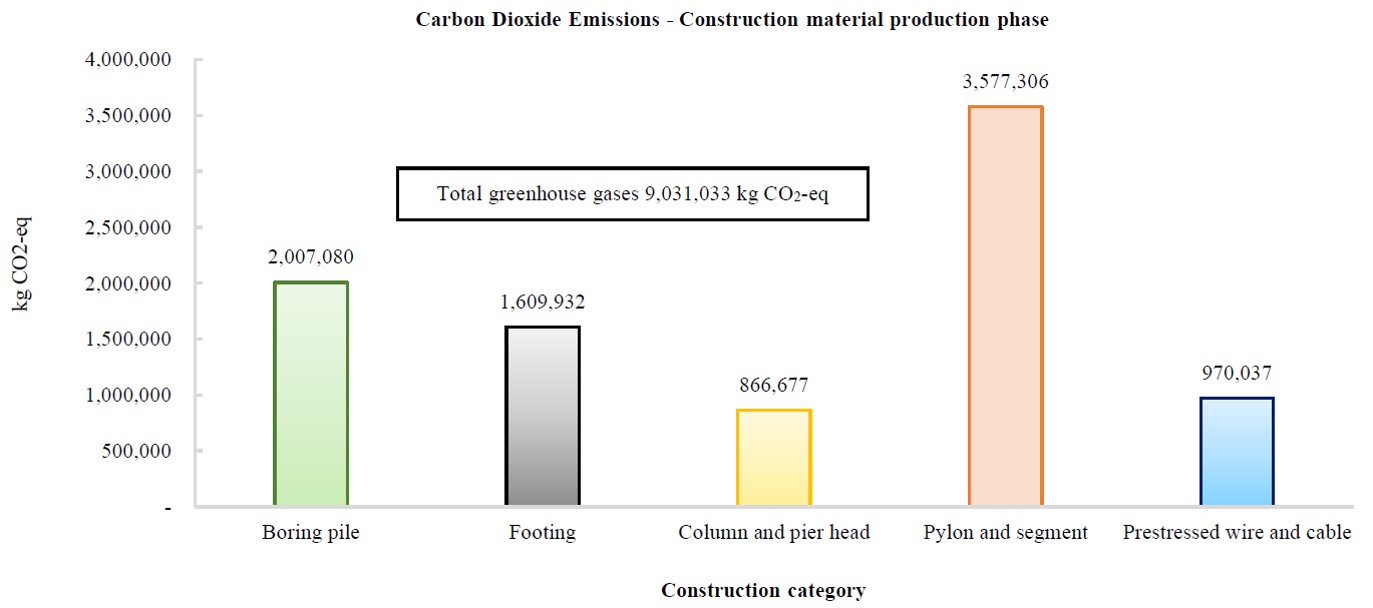
The purpose of this study was to assess the quantity of greenhouse gas emissions associated with the long-span cable stay bridge of railway construction project. The amount of greenhouse gas in term of carbon dioxide equivalent (CO2-eq) emission was calculated from the construction project of a double-track railway cable stay bridge across the Mae Klong River in Thailand. Then, the results of the calculation were classified according to work types such as bored pile, foundation, column and pier head, pylon and segment, pre-stressed wire and cable. The study also included the emission of machinery and material transportation on the site, from cradle to gate and gate to gate. Both national and international database of carbon dioxide emissions coefficients were applied. The results showed that total CO2-eq emission emit 10,144,522 kg CO2-eq or 29,837 tons CO2-eq per kilometer. The types of work that emit the most carbon dioxide is pylon and segment which accounted for 36.0%. Meanwhile, the CO2-eq emission from bored piles, footing, column and pier head, prestressed wire and cable, and transportation of machinery and material within site accounted for 23.0%, 18.0%, 10.0%, 9.5%, and 3.5%, respectively. To sum up, the CO2-eq emission is caused by up to 89.0% of construction materials production.
Article Details

This work is licensed under a Creative Commons Attribution-NonCommercial-NoDerivatives 4.0 International License.

This work is licensed under a Creative Commons Attribution-NonCommercial-NoDerivatives 4.0 International License.
References
Thailand Greenhouse Gas Management Organization (TGO). Low carbon society guidebook [Internet]. 2022 [cited 2024 Dec 15]. Available from: http://www.tgo.or.th.
Thailand Greenhouse Gas Management Organization (Public Organization) (TGO). Emission factor [Internet]. 2022 [cited 2024 Dec 9]. Available from: https://thaicarbonlabel.tgo.or.th/.
Chen P, Lu Y, Wan Y, Zhang A. Assessing carbon dioxide emissions of high-speed rail: the case of Beijing-Shanghai corridor. Transp Res D: Transp Environ. 2021;97:102949. DOI: https://doi.org/10.1016/j.trd.2021.102949
International Energy Agency (IEA). Global status report for buildings and construction 2019: towards a zero-emission, efficient and resilient buildings and construction sector [Internet]. 2023 [cited 2024 Dec 15]. Available from: https://www.iea.org.
Chang B, Kendall A. Life cycle greenhouse gas assessment of infrastructure construction for California’s high-speed rail system. Transp Res D: Transp Environ. 2011;16(6):429-34. DOI: https://doi.org/10.1016/j.trd.2011.04.004
Jiamvoraphong N. A study of construction processes in reinforced concrete houses affecting the environment by using carbon footprint analysis [dissertation]. Bangkok: Chulalongkorn University; 2012. (In Thai)
Rungreangthanaphol N. Greenhouse gas emission from construction and operation of Bann Pracharat project of national housing authority [dissertation]. Bangkok: Chulalongkorn University; 2016. (In Thai)
Liwthaisong S, Chaithongrat T, Aksorn P. Reinforced concrete and embodied carbon in construction: challenges and pathways to reduction in Thailand. Eng Appl Sci Res. 2025;52(2):125-34.
Chester MV, Horvath A. Environmental assessment of passenger transportation should include infrastructure andsupply chains. Environ Res Lett. 2009;4(2):024008. DOI: https://doi.org/10.1088/1748-9326/4/2/024008
Baron T, Martinetti G, Pepion D. Carbon footprint of high-speed rail. Paris: International Union of Railways (UIC); 2011.
Yue Y, Wang T, Liang S, Yang J, Hou P, Qu S, et al. Life cycle assessment of high speed rail in China. Transp Res D: Transp Environ. 2015;41:367-76. DOI: https://doi.org/10.1016/j.trd.2015.10.005
Krezo S, Mirza O, He Y, Makim P, Kaewunruen S. Field investigation and parametric study of greenhouse gas emissions from railway plain-line renewals. Transp Res D: Transp Environ. 2016;42:77-90. DOI: https://doi.org/10.1016/j.trd.2015.10.021
Dalkic G, Balaban O, Tuydes-Yaman H, Celikkol-Kocak T. An assessment of the CO2 emissions reduction in high speed rail lines: Two case studies from Turkey. J Clean Prod. 2017;165:746-61. DOI: https://doi.org/10.1016/j.jclepro.2017.07.045
Nithisakdiyanond S, Rukijkanpanich J. Carbon footprint assessment of the construction project of the subway station and tunnel. Eng J CMU. 2017;24(2):114-127. (In Thai)
Baumeister S. Replacing short-haul flights with land-based transportation modes to reduce greenhouse gas emissions: the case of Finland. J Clean Prod. 2019;225:262-9. DOI: https://doi.org/10.1016/j.jclepro.2019.03.329
Chang Y, Lei S, Teng J, Zhang J, Zhang L, Xu X. The energy use and environmental emissions of high-speed rail transportation in China: a bottom-up modeling. Energy. 2019;182:1193-201. DOI: https://doi.org/10.1016/j.energy.2019.06.120
Hagedorn T, Sieg G. Emissions and external environmental costs from the perspective of differing travel purposes. Sustainability. 2019;11(24):7233. DOI: https://doi.org/10.3390/su11247233
Kaewunruen S, Sresakoolchai J, Peng J. Life cycle cost, energy and carbon assessments of Beijing-Shanghai high-speed railway. Sustainability. 2019;12(1):206. DOI: https://doi.org/10.3390/su12010206
Zhang A, Wan Y, Yang H. Impacts of high-speed rail on airlines, airports and regional economies: a survey of recent research. Transp Policy. 2019;81:A1-19. DOI: https://doi.org/10.1016/j.tranpol.2019.06.010
Liu S, Wan Y, Zhang A. Does China’s high-speed rail development lead to regional disparities? a network perspective. Transp Res A: Policy Pract. 2020;138:299-321. DOI: https://doi.org/10.1016/j.tra.2020.06.010
Aranyasen S, Srinavin K, Aksorn P, Kusonkhum W. Comparison of carbon dioxide emissions (CO2-e) produced between ordinary concrete production and geopolymer concrete for environmentally friendly construction industry by using life cycle assessment methods. KKU Res J (Graduate Studies). 2021;21(4):71-82. (In Thai)
Aksorn P, Phansri B. The influencing factors of area-based infrastructure project sustainability in Thailand. Environ Dev Sustain. 2023;25(11):13521-39. DOI: https://doi.org/10.1007/s10668-022-02644-5
Kaenla K, Aksorn P. Greenhouse gas emissions assessment of construction waste in the mass rapid transit orange line construction project (Thailand Cultural Center–Min Buri Section). KKU Res J (Graduate Studies), 2023;23(2):40-52. (In Thai)
Aksorn P, Tuntiratananon V, Phansri B. The influencing factors developing PDCA model to achieve sustainability of area-based infrastructure project evaluation (AIPE). Environ Dev Sustain. 2024;26:30999-1034. DOI: https://doi.org/10.1007/s10668-023-04157-1
Kuntiyawichai K, Aksorn P. The knowledge and holistic management indicators to measure the sustainability of area-based infrastructure project (AIP). Heliyon. 2024;10(9):e30159. DOI: https://doi.org/10.1016/j.heliyon.2024.e30159
Du G, Safi M, Pettersson L, Karoumi R. Life cycle assessment as a decision support tool for bridge procurement: environmental impact comparison among five bridge designs. Int J Life Cycle Assess. 2014;19(12):1948-64. DOI: https://doi.org/10.1007/s11367-014-0797-z
Gervásio H, da Silva LS. Comparative life-cycle analysis of steel and concrete composite bridges. Struct Infrastruct Eng. 2008;4(4):251-69. DOI: https://doi.org/10.1080/15732470600627325
Hammervold J, Reenaas M, Brattebø H. Environmental life cycle assessment of bridges. J Bridge Eng. 2013;18(2):153-61. DOI: https://doi.org/10.1061/(ASCE)BE.1943-5592.0000328
Du G, Karoumi R. Life cycle assessment of a railway bridge: comparison of two superstructure designs. Struct Infrastruct Eng. 2013;9(11):1149-60. DOI: https://doi.org/10.1080/15732479.2012.670250
Intergovernmental Panel on Climate Change (IPCC). IPCC guidelines for national greenhouse gas inventories (volume 2): energy [Internet]. 2008 [cited 2024 Dec 15]. Available from: https://www.ipcc-nggip.iges.or.jp/public/2006gl/vol2.html.
Lee JY, Lee CK, Chun YY. Greenhouse gas emissions from high-speed rail infrastructure construction in Korea. Transp Res D: Transp Environ. 2020;87:102514. DOI: https://doi.org/10.1016/j.trd.2020.102514
United State Environmental Protection Agency (EPA). Greenhouse gas emissions: understanding global warming potentials [Internet]. 2025 [cited 2024 Dec 15]. Available from: https://www.epa.gov/ghgemissions/.
Hammond G, Jones C. Inventory of carbon & energy: ICE. Bath: Sustainable Energy Research Team, Department of Mechanical Engineering, University of Bath; 2008.
Ghayeb HH, Razak HA, Sulong NHR. Evaluation of the CO2 emissions of an innovative composite precast concrete structure building frame. J Clean Prod. 2020;242:118567. DOI: https://doi.org/10.1016/j.jclepro.2019.118567
Flower DJM, Sanjayan JG. Green house gas emissions due to concrete manufacture. Int J Life Cycle Assess. 2007;12:282-8. DOI: https://doi.org/10.1065/lca2007.05.327
Nik Nurul-Hidayah NY, Shamzani Affendy MD, Abdullah A, Sugiyama T, Purwanto H. CO2 emissions for concrete bore piling construction. Jurnal Teknologi. 2015;77(30):25-34. DOI: https://doi.org/10.11113/jt.v77.6861
Hasan S, Bouferguene A, Al-Hussein M, Gillis P, Telyas A. Productivity and CO2 emission analysis for tower crane utilization on high-rise building projects. Autom Constr. 2013;31:255-64. DOI: https://doi.org/10.1016/j.autcon.2012.11.044
McLellan BC, Williams RP, Lay J, Van Riessen A, Corder GD. Costs and carbon emissions for geopolymer pastes in comparison to ordinary portland cement. J Clean Prod. 2011;19(9-10):1080-90. DOI: https://doi.org/10.1016/j.jclepro.2011.02.010
Chen X, Shi P, Wang H. Life cycle environmental impact assessment of bridges based on comparison of different construction schemes. Environ Dev Sustain. 2025:1-33. DOI: https://doi.org/10.1007/s10668-024-05895-6
Das S, Saha P, Jena SP, Panda P. Geopolymer concrete: Sustainable green concrete for reduced greenhouse gas emission–a review. Mater Today Proc. 2022;60:62-71. DOI: https://doi.org/10.1016/j.matpr.2021.11.588
Davidovits J. Geopolymer chemistry and applications. 4th ed. France: Geopolymer Institute; 2015.
Sandanayake M, Gunasekara C, Law D, Zhang G, Setunge S. Greenhouse gas emissions of different fly ash based geopolymer concretes in building construction. J Clean Prod. 2018;204:399-408. DOI: https://doi.org/10.1016/j.jclepro.2018.08.311
Habert G, Miller SA, John VM, Provis JL, Favier A, Horvath A, et al. Environmental impacts and decarbonization strategies in the cement and concrete industries. Nat Rev Earth Environ. 2020;1(11):559-73. DOI: https://doi.org/10.1038/s43017-020-0093-3
Turner LK, Collins FG. Carbon dioxide equivalent (CO₂-e) emissions: A comparison between geopolymer and OPC cement concrete. Constr Build Mater. 2013;43:125-30. DOI: https://doi.org/10.1016/j.conbuildmat.2013.01.023
Tushar Q, Bhuiyan MA, Abunada Z, Lemckert C, Giustozzi F. Carbon footprint and uncertainties of geopolymer concrete production: a comprehensive life cycle assessment (LCA). C. 2025;11(3):55. DOI: https://doi.org/10.3390/c11030055
Liwthaisong S, Kuntiyawichai K, Tirapat S, Srinavin K, Ngowtanasawan G, Chaithongrat T, et al. Investigating critical management factors influencing carbon emissions across the life cycle of building construction projects (BCPs). Int J Environ Sci Technol. 2026;23(4):327. DOI: https://doi.org/10.1007/s13762-026-07085-5
Nahangi M, Guven G, Olanrewaju B, Saxe S. Embodied greenhouse gas assessment of a bridge: a comparison of preconstruction building information model and construction records. J Clean Prod. 2021;295:126388. DOI: https://doi.org/10.1016/j.jclepro.2021.126388
López-Mesa B, Pitarch Á, Tomás A, Gallego T. Comparison of environmental impacts of building structures with in situ cast floors and with precast concrete floors. Build Environ. 2009;44(4):699-712 DOI: https://doi.org/10.1016/j.buildenv.2008.05.017
