
Electrospinning nanofibers for wound healing using antioxidant from Rang Jued (Thunbergia laurifolia Lindl.) extract via subcritical fluid extraction
Article Sidebar
Main Article Content
Abstract
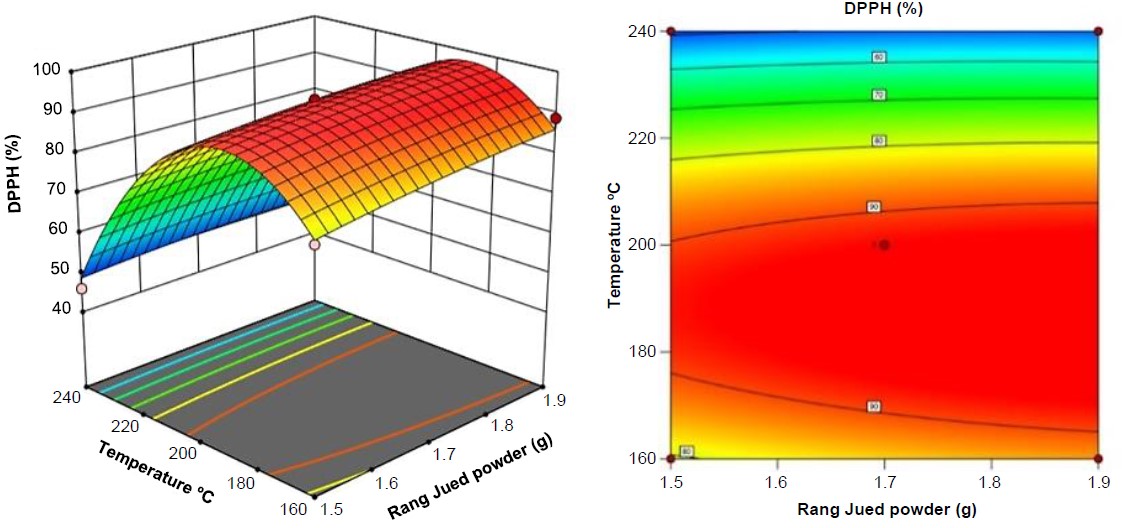
Rang Jued (Thunbergia laurifolia Lindl.) is a local Thai plant known for its bioactive compounds. In this study, subcritical ethanol extraction was used to extract antioxidant from Rang Jued (RJ) leaves. A total of 15 experiments were designed using Box-Behnken design. Response surface methodology was employed to determine the optimal condition, which yielded the highest DPPH scavenging activity of 94.91% and a total phenolic content of 30.35 mg GAE/g under the conditions of 1.64 g of Rang Jued powder, an extraction temperature of 190 ºC, and an extraction time of 15.14 minutes. Furthermore, the electrospinning technique was used to fabricate antioxidant wound dressing nanofibers. The process was conducted by varying the ratio between PVA and RJ extract, as well as the voltage supply. Scanning electron microscopy (SEM) was used to investigate the morphology of the nanofibers. The average diameter ranged from 248 to 362 nm. The highest antioxidant activity of the nanofibers was observed at 72.25%, using a PVA:RJ extract ratio of 7:3 and a voltage of 40 kV.
Article Details

This work is licensed under a Creative Commons Attribution-NonCommercial-NoDerivatives 4.0 International License.

This work is licensed under a Creative Commons Attribution-NonCommercial-NoDerivatives 4.0 International License.
References
Tipduangta P, Julsrigival J, Chaithatwatthana K, Pongterdsak N, Tipduangta P, Chansakaow S. Antioxidant properties of Thai traditional herbal teas. Beverages. 2019;5(3):44. DOI: https://doi.org/10.3390/beverages5030044
Wanyo P, Chomnawang C, Huaisan K, Chamsai T. Comprehensive analysis of antioxidant and phenolic profiles of Thai medicinal plants for functional food and pharmaceutical development. Plant Foods Hum Nutr. 2024;79(2):394-400. DOI: https://doi.org/10.1007/s11130-024-01179-6
Essiedu JA, Gonu H, Adadi P, Withayagiat U. Polyphenols and antioxidant activity of Thunbergia laurifolia infused tea under drying conditions. J Food Qual. 2023;2023(1):5046880. DOI: https://doi.org/10.1155/2023/5046880
Junsi M, Siripongvutikorn S. Thunbergia laurifolia, a traditional herbal tea of Thailand: botanical, chemical composition, biological properties and processing influence. Int Food Res J. 2016;23(3):923-7.
Woottisin N, Kongkiatpaiboon S, Sukprasert S, Sathirakul K. Development and validation of stability indicating HPLC method for determination of caffeic acid, vitexin and rosmarinic acid in Thunbergia laurifolia leaf extract. Pharmacogn J. 2020;12(3):611-8. DOI: https://doi.org/10.5530/pj.2020.12.91
Suwanchaikasem P, Chaichantipyuth C, Sukrong S. Antioxidant-guided isolation of rosmarinic acid, a major constituent from Thunbergia laurifolia, and its use as a bioactive marker for standardization. Chiang Mai J Sci. 2014;41(1):117-27.
Onsawang T, Suwanvecho C, Sithisarn P, Phechkrajang C, Rojsanga P. Experimental design approach for the quantitative analysis of multicomponents by single marker and HPLC fingerprinting of Thunbergia laurifolia aqueous extract. Phytochem Anal. 2024;35(6):1472-85. DOI: https://doi.org/10.1002/pca.3378
Chaiyana W, Chansakaow S, Intasai N, Kiattisin K, Lee KH, Lin WC, et al. Chemical constituents, antioxidant, anti-MMPs, and anti-hyaluronidase activities of Thunbergia laurifolia Lindl. leaf extracts for skin aging and skin damage prevention. Molecules. 2020;25(8):1923. DOI: https://doi.org/10.3390/molecules25081923
Fadimu GJ, Ghafoor K, Babiker EE, Al-Juhaimi F, Abdulraheem RA, Adenekan MK. Ultrasound-assisted process for optimal recovery of phenolic compounds from watermelon (Citrullus lanatus) seed and peel. J Food Meas Charact. 2020;14:1784-93. DOI: https://doi.org/10.1007/s11694-020-00426-z
Yoswathana N, Eshtiaghi MN. Optimization of subcritical ethanol extraction for xanthone from mangosteen pericarp. Int J Chem Eng Appl. 2015;6(2):115-9. DOI: https://doi.org/10.7763/IJCEA.2015.V6.463
Plangklang T, Khuwijitjaru P, Klinchongkon K, Adachi S. Chemical composition and antioxidant activity of oil obtained from coconut meal by subcritical ethanol extraction. J Food Meas Charact. 2021;15(5):4128-37. DOI: https://doi.org/10.1007/s11694-021-00989-5
Chiou TY, Neoh TL, Kobayashi T, Adachi S. Properties of extract obtained from defatted rice bran by extraction with aqueous ethanol under subcritical conditions. Food Sci Technol Res. 2012;18(1):37-45. DOI: https://doi.org/10.3136/fstr.18.37
Sriyanti I, Jauhari J. Electrospun of poly(vinyl alcohol) nanofiber as carrier of Garcinia mangostana L. pericarp extract. J Phys: Conf Ser. 2019;1170:012056. DOI: https://doi.org/10.1088/1742-6596/1170/1/012056
Amer AA, Mohammed RS, Hussein Y, Ali ASM, Khalil AA. Development of Lepidium sativum extracts/PVA electrospun nanofibers as wound healing dressing. ACS Omega. 2022;7(24):20683-95. DOI: https://doi.org/10.1021/acsomega.2c00912
Mouro C, Gomes AP, Gouveia IC. Emulsion electrospinning of PLLA/PVA/Chitosan with Hypericum perforatum L. as an antibacterial nanofibrous wound dressing. Gels. 2023;9(5):353. DOI: https://doi.org/10.3390/gels9050353
Quintero-Borregales LM, Vergara-Rubio A, Santos A, Famá L, Goyanes S. Black tea extracts/polyvinyl alcohol active nanofibers electrospun mats with sustained release of polyphenols for food packaging applications. Polymers. 2023;15(5):1311. DOI: https://doi.org/10.3390/polym15051311
Marjani ME, Shirazi RHMT, Mohammadi T. CDI crosslinked chitosan/poly (vinyl alcohol) electrospun nanofibers loaded with Achillea millefolium and Viola extract: a promising wound dressing. Carbohydr Polym. 2024;336:122117. DOI: https://doi.org/10.1016/j.carbpol.2024.122117
Jung SM, Min SK, Lee HC, Kwon YS, Jung MH, Shin HS. Spirulina‐PCL nanofiber wound dressing to improve cutaneous wound healing by enhancing antioxidative mechanism. J Nanomater. 2016;2016(1):6135727. DOI: https://doi.org/10.1155/2016/6135727
Maleki H, Doostan M, Khoshnevisan K, Baharifar H, Maleki SA, Fatahi MA. Zingiber officinale and thymus vulgaris extracts co-loaded polyvinyl alcohol and chitosan electrospun nanofibers for tackling infection and wound healing promotion. Heliyon. 2024;10(1):e23719. DOI: https://doi.org/10.1016/j.heliyon.2023.e23719
Doostan M, Doostan M, Mohammadi P, Khoshnevisan K, Maleki H. Wound healing promotion by flaxseed extract-loaded polyvinyl alcohol/chitosan nanofibrous scaffolds. Int J Biol Macromol. 2023;228:506-16. DOI: https://doi.org/10.1016/j.ijbiomac.2022.12.228
Aruan NM, Sriyanti I, Edikresnha D, Suciati T, Munir MM, Khairurrijal. Polyvinyl alcohol/soursop leaves extract composite nanofibers synthesized using electrospinning technique and their potential as antibacterial wound dressing. Procedia Eng. 2017;170:31-5. DOI: https://doi.org/10.1016/j.proeng.2017.03.006
Sim P, Strudwick XL, Song YM, Cowin AJ, Garg S. Influence of acidic pH on wound healing in vivo: a novel perspective for wound treatment. Int J Mol Sci. 2022;23(21):13655. DOI: https://doi.org/10.3390/ijms232113655
Bagheri M, Validi M, Gholipour A, Makvandi P, Sharifi E. Chitosan nanofiber biocomposites for potential wound healing applications: antioxidant activity with synergic antibacterial effect. Bioeng Transl Med. 2022;7(1):e10254. DOI: https://doi.org/10.1002/btm2.10254
Wonkchalee O, Boonmars T, Aromdee C, Laummaunwai P, Khunkitti W, Vaeteewoottacharn K, et al. Anti-inflammatory, antioxidant and hepatoprotective effects of Thunbergia laurifolia Linn. on experimental opisthorchiasis. Parasitol Res. 2012;111(1):353-9. DOI: https://doi.org/10.1007/s00436-012-2846-5
Chitkrachang N, Panthong S, Ploysombun S, Choosrichom S, Ngamkham N, Kwanchian D, et al. A comparison of antibacterial activity against acne-inducing bacteria, anti-inflammatory activity, and total phenolic content of fresh and dried leaves of Thunbergia laurifolia Lindl extracts. J Thai Trad Alt Med. 2023;21(2):356-66. (In Thai)
Destaye AG, Lin CK, Lee CK. Glutaraldehyde vapor cross-linked nanofibrous PVA mat with in situ formed silver nanoparticles. ACS Appl Mater Interfaces. 2013;5(11):4745-52. DOI: https://doi.org/10.1021/am401730x
Teixeira MA, Antunes JC, Amorim MTP, Felgueiras HP. Green optimization of glutaraldehyde vapor-based crosslinking on poly (vinyl alcohol)/cellulose acetate electrospun mats for applications as chronic wound dressings. Proceedings. 2021;69(1):30. DOI: https://doi.org/10.3390/CGPM2020-07193
Truong YB, Choi J, Mardel J, Gao Y, Maisch S, Musameh M, et al. Functional cross‐linked electrospun polyvinyl alcohol membranes and their potential applications. Macromol Mater Eng. 2017;302(8):1700024. DOI: https://doi.org/10.1002/mame.201700024
Charernsriwilaiwat N, Rojanarata T, Ngawhirunpat T, Opanasopit P. Electrospun chitosan/polyvinyl alcohol nanofibre mats for wound healing. Int Wound J. 2014;11(2):215-22. DOI: https://doi.org/10.1111/j.1742-481X.2012.01077.x
Huang SM, Liu SM, Tseng HY, Chen WC. Effect of citric acid on swelling resistance and physicochemical properties of post-crosslinked electrospun polyvinyl alcohol fibrous membrane. Polymers. 2023;15(7):1738. DOI: https://doi.org/10.3390/polym15071738
Baliyan S, Mukherjee R, Priyadarshini A, Vibhuti A, Gupta A, Pandey RP, et al. Determination of antioxidants by DPPH radical scavenging activity and quantitative phytochemical analysis of Ficus religiosa. Molecules. 2022;27(4):1326. DOI: https://doi.org/10.3390/molecules27041326
Ibrahim UK, Yusof MIS, Zamil KAA, Kamarrudin N, Maqsood-ul-Haque SNS, Ab Rashid SR. Total phenolic content and antioxidant activity of local fruit wastes in Malaysia. Adv Mater Res. 2015;1113:471-6. DOI: https://doi.org/10.4028/www.scientific.net/AMR.1113.471
Prgomet I, Gonçalves B, Domínguez-Perles R, Pascual-Seva N, Barros AIRNA. A Box-Behnken design for optimal extraction of phenolics from almond by-products. Food Anal Methods. 2019;12:2009-24. DOI: https://doi.org/10.1007/s12161-019-01540-5
Martin-Garcia B, Pimentel-Moral S, Gómez-Caravaca AM, Arráez-Román D, Segura-Carretero A. Box-Behnken experimental design for a green extraction method of phenolic compounds from olive leaves. Ind Crops Prod. 2020;154:112741. DOI: https://doi.org/10.1016/j.indcrop.2020.112741
Bodoira R, Velez A, Andreatta AE, Martínez M, Maestri D. Extraction of bioactive compounds from sesame (Sesamum indicum L.) defatted seeds using water and ethanol under sub-critical conditions. Food Chem. 2017;237:114-20. DOI: https://doi.org/10.1016/j.foodchem.2017.05.102
Sulejmanović M, Jerković I, Zloh M, Nastić N, Milić N, Drljača J, et al. Supercritical fluid extraction of ginger herbal dust bioactives with an estimation of pharmacological potential using in silico and in vitro analysis. Food Biosci. 2024;59:104074. DOI: https://doi.org/10.1016/j.fbio.2024.104074
Faki R, Gursoy O, Yilmaz Y. Effect of electrospinning process on total antioxidant activity of electrospun nanofibers containing grape seed extract. Open Chem. 2019;17:912-8. DOI: https://doi.org/10.1515/chem-2019-0098
Anaya-Mancipe JM, Queiroz VM, Dos Santos RF, Castro RN, Cardoso VS, Vermelho AB, et al. Electrospun nanofibers loaded with Plantago major L. extract for potential use in cutaneous wound healing. Pharmaceutics. 2023;15(4):1047. DOI: https://doi.org/10.3390/pharmaceutics15041047
Sarhan WA, Azzazy HM, El-Sherbiny IM. Honey/chitosan nanofiber wound dressing enriched with Allium sativum and Cleome droserifolia: enhanced antimicrobial and wound healing activity. ACS Appl Mater Interfaces. 2016;8(10):6379-90. DOI: https://doi.org/10.1021/acsami.6b00739
Charernsriwilaiwat N, Rojanarata T, Ngawhirunpat T, Sukma M, Opanasopit P. Electrospun chitosan-based nanofiber mats loaded with Garcinia mangostana extracts. Int J Pharm. 2013;452(1-2):333-43. DOI: https://doi.org/10.1016/j.ijpharm.2013.05.012
Ko SW, Lee JY, Lee J, Son BC, Jang SR, Aguilar LE, et al. Analysis of drug release behavior utilizing the swelling characteristics of cellulosic nanofibers. Polymers. 2019;11(9):1376. DOI: https://doi.org/10.3390/polym11091376
Vilchez A, Acevedo F, Cea M, Seeger M, Navia R. Applications of electrospun nanofibers with antioxidant properties: a review. Nanomaterials. 2020;10(1):175. DOI: https://doi.org/10.3390/nano10010175
Fayemi OE, Ekennia AC, Katata-Seru L, Ebokaiwe AP, Ijomone OM, Onwudiwe DC, et al. Antimicrobial and wound healing properties of polyacrylonitrile-moringa extract nanofibers. ACS Omega. 2018;3(5):4791-7. DOI: https://doi.org/10.1021/acsomega.7b01981
Sadri M, Arab-Sorkhi S, Vatani H, Bagheri-Pebdeni A. New wound dressing polymeric nanofiber containing green tea extract prepared by electrospinning method. Fibers Polym. 2015;16:1742-50. DOI: https://doi.org/10.1007/s12221-015-5297-7
Golkar P, Kalani S, Allafchian AR, Mohammadi H, Jalali SAH. Fabrication and characterization of electrospun Plantago major seed mucilage/PVA nanofibers. J Appl Polym Sci. 2019;136(32):47852. DOI: https://doi.org/10.1002/app.47852
