
Corrosion behavior of Sn-0.7Cu-xIn solders on simulated acid rain
Article Sidebar
Main Article Content
Abstract
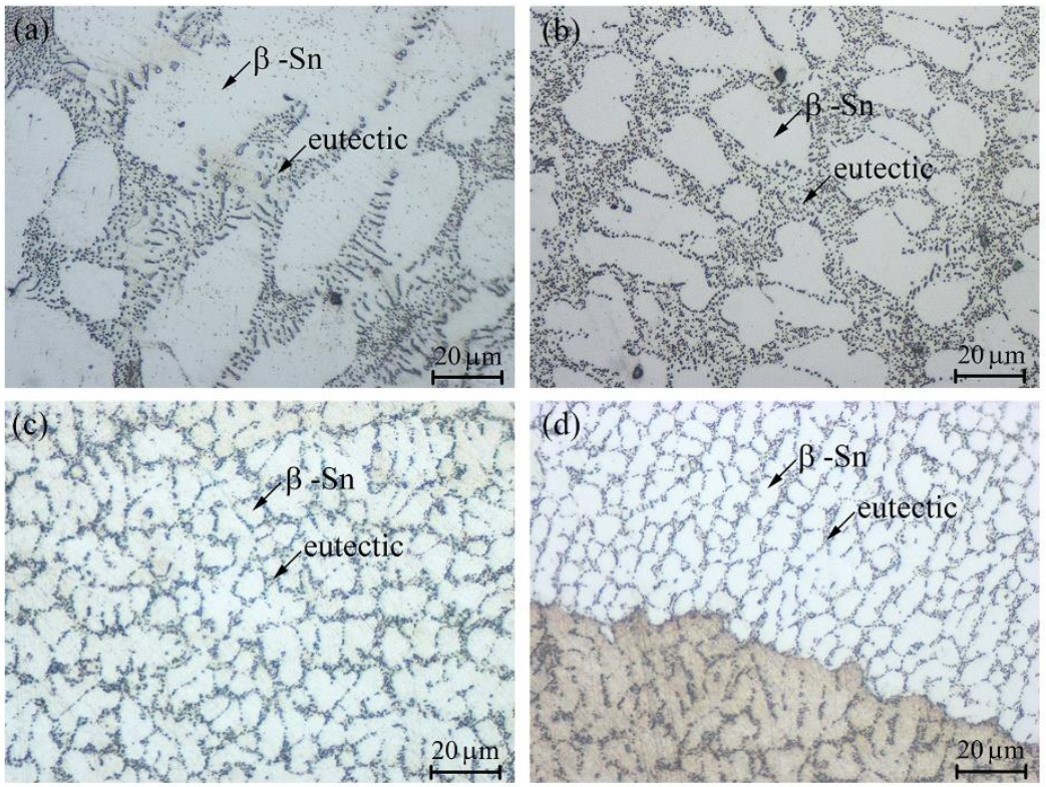
This study investigated the effect of minor indium additions (0.1, 0.5, 1.0 wt.%) on Sn-0.7Cu solder, resulting in Sn-0.7Cu-0.1In, Sn-0.7Cu-0.5In, and Sn-0.7Cu-1.0In solders. The influence of indium addition on microstructure, melting temperature, microhardness, and corrosion resistance of the alloys was investigated. Corrosion resistance was evaluated in simulated acid rain with a pH of 3.5 using immersion and potentiodynamic polarization tests. Results indicated that the melting temperature decreased from 225.9 °C to 223.1 °C with increasing indium content. The addition of indium also refined the microstructure, reduced the β-Sn phase fraction, and improved the microhardness of the solder. Analysis of corrosion products identified SnO and SnO2, confirming that tin is the primary element susceptible to corrosion in Sn-0.7Cu-xIn solders exposed to acidic conditions. Polarization curves revealed that corrosion resistance improved significantly with increasing indium content, with the lowest corrosion rate observed at 1.0 wt.% of indium.
Article Details

This work is licensed under a Creative Commons Attribution-NonCommercial-NoDerivatives 4.0 International License.

This work is licensed under a Creative Commons Attribution-NonCommercial-NoDerivatives 4.0 International License.
References
Cheng S, Huang CM, Pecht M. A review of lead-free solders for electronics applications. Microelectron Reliab. 2017;75:77-95. DOI: https://doi.org/10.1016/j.microrel.2017.06.016
Mallampati S, Yin L, Shaddock D, Schoeller H, Cho J. Lead-free alternatives for interconnects in high-temperature electronics. J Electron Packag. 2018;140(1):010906. DOI: https://doi.org/10.1115/1.4039027
Jiang N, Zhang L, Liu ZQ, Sun L, Long WM, He P, et al. Reliability issues of lead-free solder joints in electronic devices. Sci Technol Adv Mater. 2019;20(1):876-901. DOI: https://doi.org/10.1080/14686996.2019.1640072
Fahim A, Ahmed S, Suhling JC, Lall P. Mechanical characterization of intermetallic compounds in SAC solder joints at elevated temperatures. 2018 17th IEEE Intersociety Conference on Thermal and Thermomechanical Phenomena in Electronic Systems (ITherm); 2018 May 29 - Jun 1; San Diego, USA. USA: IEEE; 2018. p. 1081-90. DOI: https://doi.org/10.1109/ITHERM.2018.8419525
Ahmed S, Hasnine M, Suhling JC, Lall P. Mechanical characterization of SAC solder joints at high temperature using nanoindentation. 2017 IEEE 67th Electronic Components and Technology Conference (ECTC); 2017 May 30 - Jun 2; Orlando, USA. USA: IEEE; 2017. p. 1128-35. DOI: https://doi.org/10.1109/ECTC.2017.336
Akkara FJ, Hamasha S, Alahmer A, Evans J, Belhadi MEA, Wei X. The effect of micro-alloying and surface finishes on the thermal cycling reliability of doped SAC solder alloys. Materials. 2022;15(19):6759. DOI: https://doi.org/10.3390/ma15196759
Salleh MAAM, Al Bakri AMM, Somidin F, Sandu AV, Saud N, Kamaruddin H, et al. A comparative study of solder properties of Sn–0.7Cu lead-free solder fabricated via the powder metallurgy and casting methods. Revista de Chimie. 2013;64(7):725-8.
Yang L, Zhang Y, Dai J, Jing Y, Ge J, Zhang N. Microstructure, interfacial IMC and mechanical properties of Sn–0.7Cu–xAl (x= 0–0.075) lead-free solder alloy. Mater Des. 2015;67:209-16. DOI: https://doi.org/10.1016/j.matdes.2014.11.036
El-Daly AA, Hammad AE. Development of high strength Sn–0.7Cu solders with the addition of small amount of Ag and In. J Alloys Compd. 2011;509(34):8554-60. DOI: https://doi.org/10.1016/j.jallcom.2011.05.119
Nabihah A, Nurulakmal MS. Effect of In addition on microstructure, wettability and strength of SnCu solder. Mater Today: Proc. 2019;17:803-9. DOI: https://doi.org/10.1016/j.matpr.2019.06.366
Fazal MA, Liyana NK, Rubaiee S, Anas A. A critical review on performance, microstructure and corrosion resistance of Pb-free solders. Measurement. 2019;134:897-907. DOI: https://doi.org/10.1016/j.measurement.2018.12.051
Li LF, Cheng YK, Xu GL, Wang EZ, Zhang ZH, Wang H. Effects of indium addition on properties and wettability of Sn–0.7 Cu–0.2 Ni lead-free solders. Mater Des. 2014;64:15-20. DOI: https://doi.org/10.1016/j.matdes.2014.07.035
Wang J, Yin M, Lai Z, Li X. Wettability and microstructure of Sn-Ag-Cu-In solder. Trans China Weld Ins. 2011;32(11):69-72.
Ismail N, Yusoff WYW, Amat A, Manaf NAA, Ahmad N. A review of extreme condition effects on solder joint reliability: understanding failure mechanisms. Def Technol. 2024;41:134-58. DOI: https://doi.org/10.1016/j.dt.2024.05.013
Wang M, Wang J, Ke W. Corrosion behavior of Sn–3.0 Ag–0.5 Cu solder under high-temperature and high-humidity condition. J Mater Sci: Mater Electron. 2014;25:1228-36. DOI: https://doi.org/10.1007/s10854-014-1714-8
Wang X, Kumagai S, Yoshimura N. Acid rain affecting the electrical properties of outdoor composite dielectric materials. Jpn J Appl Phys. 1998;37:6476. DOI: https://doi.org/10.1143/JJAP.37.6476
Jumali N, Mohamad AA, Mohd Nazeri MF. Corrosion properties of Sn-9Zn solder in acidic solution. Mater Sci Forum. 2017;888:365-72. DOI: https://doi.org/10.4028/www.scientific.net/MSF.888.365
Nordarina J, Mohd HZ, Ahmad AM, Muhammad FMN. Corrosion behaviour of Sn-based lead-free solders in acidic solution. IOP Conf Ser: Mater Sci Eng. 2018;318:012003. DOI: https://doi.org/10.1088/1757-899X/318/1/012003
Nurwahida MZ, Mukridz MM, Ahmad AM, Muhammad FMN. Corrosion properties of SAC305 solder in different solution of HCl and NaCl. IOP Conf Ser: Mater Sci Eng. 2018;318:012004. DOI: https://doi.org/10.1088/1757-899X/318/1/012004
Wierzbicka-Miernik A, Guspiel J, Zabdyr L. Corrosion behavior of lead-free SAC-type solder alloys in liquid media. Arch Civ Mech Eng. 2015;15(1):206-13. DOI: https://doi.org/10.1016/j.acme.2014.03.003
ASTM. ASTM G92-17: Standard Test Methods for Vickers Hardness and Knoop Hardness of Metallic Materials. West Conshohocken: ASTM; 2017.
ASTM. ASTM G31-21: Standard Guide for Laboratory Immersion Corrosion Testing of Metals. West Conshohocken: ASTM; 2021.
Lal N, Singh H. The effects of simulated acid rain of different pH-levels on biomass and leaf area in Sunflower (Helianthus annuus). Curr Bot. 2012;3(5):45-50.
Lee S. The third periodic report on the state of acid deposition in East Asia, part II national assessments. Japan: Acid deposition monitoring network in East Asia (EANET); 2016.
Lv Y, Yang W, Mao J, Li Y, Zhang X, Zhan Y. Effect of graphene nano-sheets additions on the density, hardness, conductivity, and corrosion behavior of Sn–0.7 Cu solder alloy. J Mater Sci: Mater Electron. 2020;31:202-11. DOI: https://doi.org/10.1007/s10854-019-02538-9
El-Daly AA, El-Tantawy F, Hammad AE, Gaafar MS, El-Mossalamy EH, Al-Ghamdi AA. Structural and elastic properties of eutectic Sn–Cu lead-free solder alloy containing small amount of Ag and In. J Alloys Compd. 2011;509(26):7238-46. DOI: https://doi.org/10.1016/j.jallcom.2011.01.062
El-Daly AA, Hammad AE. Enhancement of creep resistance and thermal behavior of eutectic Sn–Cu lead-free solder alloy by Ag and In-additions. Mater Des. 2012;40:292-8. DOI: https://doi.org/10.1016/j.matdes.2012.04.007
Tan S, Zou M, Chen B, Zhang Z, Chen W, Hu X, et al. Effects of In and aging treatment on the microstructure, mechanical properties and electrochemical corrosion behavior of Sn–2Cu solder alloy. Mater Charact. 2024;209:113740. DOI: https://doi.org/10.1016/j.matchar.2024.113740
Liu XJ, Liu HS, Ohnuma I, Kainuma R, Ishida K, Itabashi S, et al. Experimental determination and thermodynamic calculation of the phase equilibria in the Cu–In–Sn system. J Electron Mater. 2001;30:1093-103. DOI: https://doi.org/10.1007/s11664-001-0135-7
Tian S, Li S, Zhou J, Xue F. Thermodynamic characteristics, microstructure and mechanical properties of Sn–0.7Cu–xIn lead-free solder alloy. J Alloys Compd. 2018;742:835-43. DOI: https://doi.org/10.1016/j.jallcom.2018.01.386
Tian S, Li S, Zhou J, Xue F, Cao R, Wang F. Effect of indium addition on interfacial IMC growth and bending properties of eutectic Sn–0.7Cu solder joints. J Mater Sci: Mater Electron. 2017;28:16120-32. DOI: https://doi.org/10.1007/s10854-017-7512-3
Khaled KF, Fadl-Allah SA, Hammouti B. Some benzotriazole derivatives as corrosion inhibitors for copper in acidic medium: experimental and quantum chemical molecular dynamics approach. Mater Chem Phys. 2009;117(1):148-55. DOI: https://doi.org/10.1016/j.matchemphys.2009.05.043
Gao YF, Cheng CQ, Zhao J, Wang LH, Li XG. Electrochemical corrosion of Sn–0.75Cu solder joints in NaCl solution. Trans Nonferrous Met Soc China. 2012;22(4):977-82. DOI: https://doi.org/10.1016/S1003-6326(11)61273-9
Jaffery HA, Sabri MFM, Said SM, Hasan SW, Sajid IH, Nordin NIM, et al. Electrochemical corrosion behavior of Sn–0.7Cu solder alloy with the addition of bismuth and iron. J Alloys Compd. 2019;810:151925. DOI: https://doi.org/10.1016/j.jallcom.2019.151925
Jaiswal D, Singh V, Pathote D, Behera CK. Electrochemical behaviour of lead-free Sn–0.7Cu–xIn solders alloys in 3.5 wt% NaCl solution. J Mater Sci: Mater Electron. 2021;32:23371-84. DOI: https://doi.org/10.1007/s10854-021-06824-3
Jaiswal D, Pathote D, Singh V, Behera CK. Effect of Al addition on electrochemical behavior of Sn–0.7Cu–xAl lead-free solders alloys in 3.5 wt.% NaCl solution. J Mater Eng Perform. 2022;31:7550-60. DOI: https://doi.org/10.1007/s11665-022-06771-y
Jaiswal D, Pathote D, Singh V, Kumar MR, Behera CK. Effect of Ti addition on the electrochemical behaviour of Sn–0.7Cu–xTi lead-free solders alloys in 3.5 wt.% NaCl solution. Bull Mater Sci. 2024;47:282. DOI: https://doi.org/10.1007/s12034-024-03354-6
Aziz MZH, Zainon N, Mohamad AA, Nazeri MFM. Corrosion investigation of Sn-0.7Cu Pb-free solder in open-circuit and polarized conditions. IOP Conf Ser: Mater Sci Eng. 2020;957:012012. DOI: https://doi.org/10.1088/1757-899X/957/1/012012
Guśpiel J, Wierzbicka-Miernik A, Reczyński W. Kinetics of corrosion process in H2SO4 and HNO3 aqueous solutions of lead free Sn–Ag–Cu solder alloys. Arch Metall Mater. 2016;61(2):559-68. DOI: https://doi.org/10.1515/amm-2016-0096
Huang HZ, Lu D, Shuai GW, Wei XQ. Effects of phosphorus addition on the corrosion resistance of Sn–0.7Cu lead-free solder alloy. Trans Indian Inst Met. 2016;69:1537-43. DOI: https://doi.org/10.1007/s12666-015-0727-1
Jiao X, Yang Z, Yan J, Zhang J, Chen X, Guan R. Electrodeposition and corrosion behavior of Cu–Sn alloys in 3.5 wt.% NaCl and 0.1 M HNO3 solutions. Metals. 2025;15(4):426. DOI: https://doi.org/10.3390/met15040426
McCafferty E. Introduction to Corrosion Science. USA: Springer; 2010. DOI: https://doi.org/10.1007/978-1-4419-0455-3
Horváth B, Illés B, Shinohara T, Harsányi G. Copper-oxide whisker growth on tin-copper alloy coatings caused by the corrosion of Cu6Sn5 intermetallics. J Mater Sci. 2013;48:8052-9. DOI: https://doi.org/10.1007/s10853-013-7619-8
Tsao LC, Chen CW. Corrosion characterization of Cu–Sn intermetallics in 3.5 wt.% NaCl solution. Corros Sci. 2012;63:393-8. DOI: https://doi.org/10.1016/j.corsci.2012.06.015
Pourbaix M. Atlas of Electrochemical Equilibria in Aqueous solutions. New York: Pergamon Press; 1966.
Kanlayasiri K, Mongkolwongrojn M, Ariga T. Influence of indium addition on characteristics of Sn–0.3Ag–0.7Cu solder alloy. J Alloys Compd. 2009;485(1-2):225-30. DOI: https://doi.org/10.1016/j.jallcom.2009.06.020
