
Combination of cassava starch and peel, using corn stalks and husks, and bentonite clay as fillers to enhance the mechanical properties of bioplastics
Article Sidebar
Main Article Content
Abstract
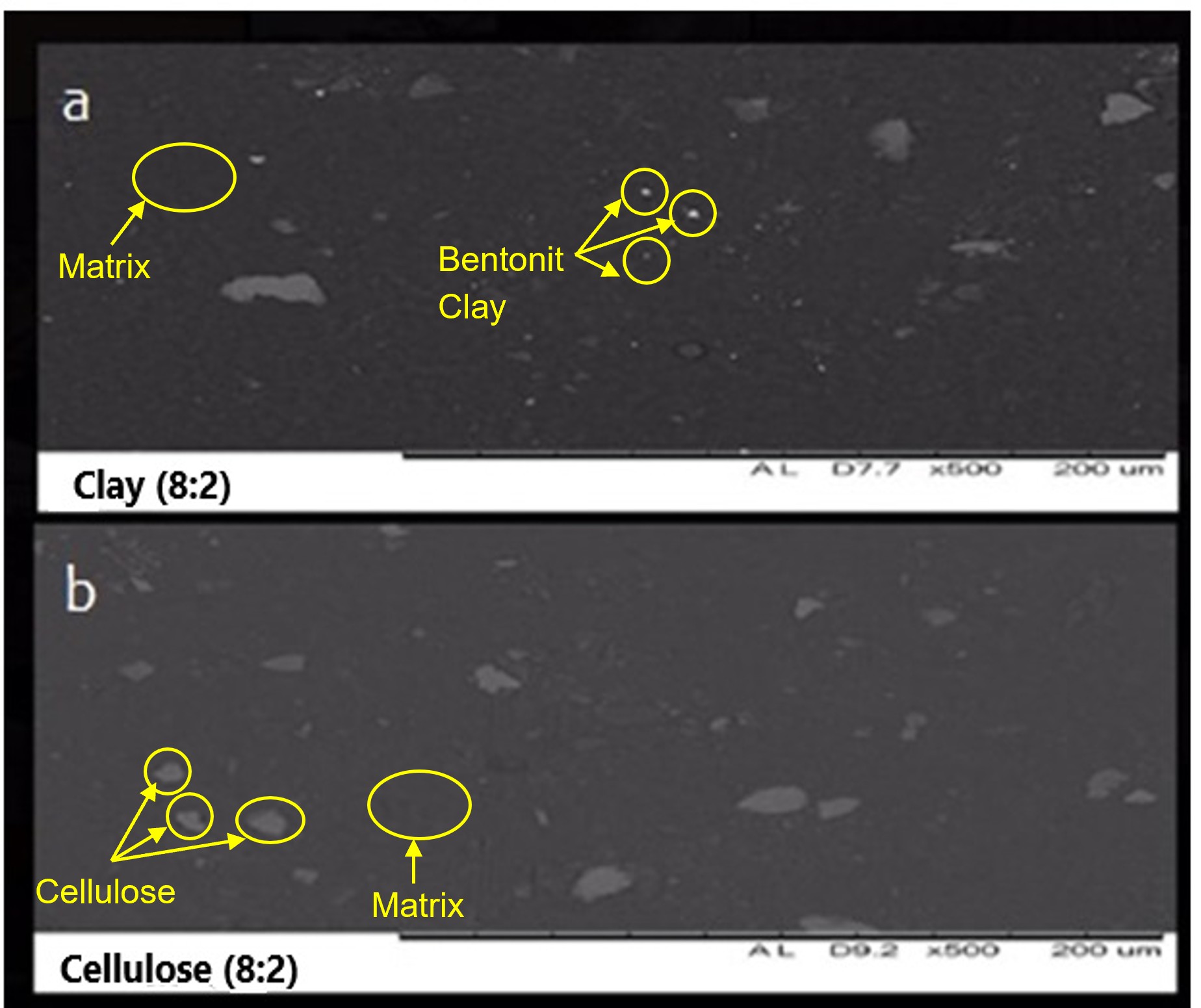
This study investigates the effect of combining cassava starch gelatin and cassava peel gelatin and evaluates the influence of two different fillers, cellulose and bentonite clay, on the mechanical properties of bioplastics. It aims to obtain bioplastics with tensile strength and elongation properties comparable to low-density polyethylene (LDPE). The study employs different mass ratios of starch to gelatin (9:1, 8:2, and 7:3 g/g) and incorporates bentonite clay and cellulose fillers (corn stalks and husks), each at 0.4 g. The materials were processed with a 200-mesh sieve. Bioplastic synthesis involved a glycerol concentration of 25% (w/w), stirring at 375 rpm for 35 minutes at 90°C. Mechanical properties (tensile strength, elongation, and Young's modulus) were analyzed, along with SEM and FTIR characterization. The results indicate that the bioplastic formulation with a starch-to-gelatin ratio of 8:2 and bentonite clay as a filler exhibits the most promising mechanical properties, with a tensile strength of 1.837 MPa, elongation of 33.584%, and a Young's modulus of 5.47 MPa. Comparatively, bentonite clay enhanced tensile strength and rigidity, while cellulose fillers provided higher elongation and flexibility but lower reinforcement due to particle agglomeration. FTIR analysis identified key functional groups, including O-H, CH2, C=O, N-H, and C-O. The combination of cassava starch, cassava peels, corn stalk-derived cellulose, fillers, and plasticizers significantly impacts the quality and mechanical properties of bioplastics.
Article Details

This work is licensed under a Creative Commons Attribution-NonCommercial-NoDerivatives 4.0 International License.

This work is licensed under a Creative Commons Attribution-NonCommercial-NoDerivatives 4.0 International License.
References
Pilapitiya PGCNT, Ratnayake AS. The world of plastic waste: a review. Cleaner Mater. 2024;11:100220. DOI: https://doi.org/10.1016/j.clema.2024.100220
Moshood TD, Nawanir G, Mahmud F, Mohamad F, Ahmad MH, AbdulGhani A. Sustainability of biodegradable plastics: new problem or solution to solve the global plastic pollution?. Curr Res Green Sustainable Chem. 2022;5:100273. DOI: https://doi.org/10.1016/j.crgsc.2022.100273
Pooja N, Chakraborty I, Rahman MH, Mazumder N. An insight on sources and biodegradation of bioplastics: a review. 3 Biotech. 2023;13:220. DOI: https://doi.org/10.1007/s13205-023-03638-4
Parmar A, Sturm B, Hensel O. Crops that feed the world: production and improvement of cassava for food, feed, and industrial uses. Food Sec 9. 2017;9:907-27. DOI: https://doi.org/10.1007/s12571-017-0717-8
Azkiya NI, Udjiana SS, Irangga AR, Febiyanti AT. The potential of cassava peel waste as a material of biodegradable plastic using calcium silicate filler. J Tek Kim Ling. 2023;7(2):85-91. DOI: https://doi.org/10.33795/jtkl.v7i2.1721
Liang J, Li Z, Dai S, Tian G, Wang Z. Production of hemicelluloses sugars, cellulose pulp, and lignosulfonate surfactant using corn stalk by prehydrolysis and alkaline sulfite cooking. Ind Crops Prod. 2023;192:115880. DOI: https://doi.org/10.1016/j.indcrop.2022.115880
Pramudia M, Umami MK, Prihantoko A. Effect of fiber volume fraction on tensile strength and fracture analysis of corn husk reinforced epoxy resin composite. International Conference on Science and Technology 2022 “Advancing Science and Technology Innovation on Post Pandemic Through Society 5.0” (ICST-2022); 2022 Nov 18; West Java, Indonesia. France: EDP Sciences; 2022. p. 1-4.
Sari NH, Suteja S. Corn husk fibers reinforced polyester composites: tensile strength properties, water absorption behavior, and morphology. 3rd International Conference on Engineering Technology for Sustainable Development (ICET4SD); 2019 Oct 23-24; Yogyakarta, Indonesia. UK: IPO Science; 2019. p. 1-11.
Mapossa AB, da Silva Júnior AH, de Oliveira CRS, Mhike W. Thermal, morphological and mechanical properties of multifunctional composites based on biodegradable polymers/bentonite clay: a review. Polymers. 2023;15(16):3443. DOI: https://doi.org/10.3390/polym15163443
Fernández MV, González MJA, Oyanadel RB, Rivera JLV, Soto AR, Ortega AG, et al. Effect of nanometric particles of bentonite on the mechanical properties of a thermoset polymeric matrix reinforced with hemp fibers. Polymers 2023;15(6):1571. DOI: https://doi.org/10.3390/polym15061571
Żołek-Tryznowska Z, Cichy Ł. Glycero derivatives as a modern plastisizers for starch films. 9th International Symposium on Graphic Engineering and Design 2018; 2018 Nov 1; Cluj-Napoca, Romania. Serbia: Graphic Engineering and Design; 2018. p. 217-22. DOI: https://doi.org/10.24867/GRID-2018-p27
El-Seedi HR, Said NS, Yosri N, Hawash HB, El-Sherif DM, Abouzid M, et al. Gelatin nanofibers: recent insights in synthesis, bio-medical applications, and limitations. Heliyon. 2023;9(5):e16228. DOI: https://doi.org/10.1016/j.heliyon.2023.e16228
Lu Y, Luo Q, Chu Y, Tao N, Deng S, Wang L, et al. Application of gelatin in food packaging: a review. Polymers. 2022;14(3);436. DOI: https://doi.org/10.3390/polym14030436
Wu Y, Liu C, Song X, Liang J, Zhi M, Lu J, et al. A novel lignocellulose pretreatment technology by combining KOH, urea peroxide and organosilane to improve glucose yield. Chem Eng J. 2023;457:141296. DOI: https://doi.org/10.1016/j.cej.2023.141296
Zhang J, Ying Y, Yi X, Han W, Yin L, Zheng Y, et al. H2O2 solution steaming combined method to cellulose skeleton for transparent wood infiltrated with cellulose acetate. Polymers. 2023;15(7);1733. DOI: https://doi.org/10.3390/polym15071733
Zhang Y, Zhang Y, Xu W, Wu H, Shao Y, Han X, et al. Preparation methods of cellulose nanocrystal and its application in treatment of environmental pollution: a mini-review. Colloid Interface Sci Commun. 2023;53:100707. DOI: https://doi.org/10.1016/j.colcom.2023.100707
Hoo DY, Low ZL, Low DYS, Tang SY, Manickam S, Tan KW, et al. Ultrasonic cavitation: an effective cleaner and greener intensification technology in the extraction and surface modification of nanocellulose review. Ultrason Sonochem. 2022;90;106176. DOI: https://doi.org/10.1016/j.ultsonch.2022.106176
Widiarto S, Pramono E, Suharso, Rochliadi A, Arcana IM. Cellulose nanofibers preparation from cassava peels via mechanical disruption. Fibers. 2019;7(5):44. DOI: https://doi.org/10.3390/fib7050044
Wicaksono R, Syamsu K, Yuliasih I, Nasir M. Characteristics of cellulose nanofibers from cassava pulp and its use as tapioca-film reinforcement. J Teknol Ind Pertan. 2013;23(1):38-45.
Maghsoodi M, Yari Z. Effect of drying phase on the agglomerates prepared by spherical crystallization. Iran J Pharm Res. 2015;14(1):51-7.
Chen J, Javaheri H, Sulaiman BAC, Dahman Y. Chapter 1 - synthesis, characterization and applications of nanoparticles. In: Grumezescu AM, editor. Fabrication and self-assembly of nanobiomaterials applications of nanobiomaterials. UK: William Andrew; 2016. p. 1-27. DOI: https://doi.org/10.1016/B978-0-323-41533-0.00001-5
Endres SC, Ciacchi LC, Mädler L. A review of contact force models between nanoparticles in agglomerates, aggregates, and films. J Aerosol Sci. 2021;153:105719. DOI: https://doi.org/10.1016/j.jaerosci.2020.105719
Sellman FA, Benselfelt T, Larsson PT, Wågberg L. Hornification of cellulose-rich materials – a kinetically trapped state. Carbohydr Polym. 2023;318:121132. DOI: https://doi.org/10.1016/j.carbpol.2023.121132
Ludvik CN, Glenn GM, Klamczynski AP, Wood DF. Cellulose filler/bentonite clay/biodegradable thermoplastic composites. J Polym Environ. 2007;15:251-7. DOI: https://doi.org/10.1007/s10924-007-0072-5
Li T, Li R, Luo H, Peng L, Wang J, Li S, et al. Eggshell powder as a bio-filler for starch and gelatin: ternary biodegradable composite films manufactured by extrusion compression molding. Food Hydrocolloids. 2024;150:109632. DOI: https://doi.org/10.1016/j.foodhyd.2023.109632
Yang Y, Fu J, Duan Q, Xie H, Dong X, Yu L. Strategies and methodologies for improving toughness of starch films. Foods 2024;13(24):4036. DOI: https://doi.org/10.3390/foods13244036
Nurintan S, Ahmad A, Natsir H, Fauziah S, Soekamto NH, Hala Y, Anita A. Isolation of cellulose from Gracilaria sp. for the development of biodegradable edible film: A sustainable approach for eco-friendly food packaging, Ecol Eng Environ Technol. 2026;27(3):188-208. DOI: https://doi.org/10.12912/27197050/218056
Safitri A, Sinaga PSD, Nasution H, Harahap H, Masyithah Z, Iriany, et al. The role of various plastisizers and fillers additions in improving tensile strength of starch-based bioplastics: a mini review. IOP Conf Ser: Earth Environ Sci. 2022;1115:012076. DOI: https://doi.org/10.1088/1755-1315/1115/1/012076
Boey JY, Lee CK, Tay GS. Factors affecting mechanical properties of reinforced bioplastics: a review. Polymers. 2022;14(18):3737. DOI: https://doi.org/10.3390/polym14183737
Serrano-Martínez VM, Pérez-Aguilar H, Carbonell-Blasco MP, Llobell-Andrés C, Aran-Ais F, García-García A, et al. Exploring the mechanical and thermal impact of natural fillers on thermoplastic polyurethane and styrene–butadiene rubber footwear sole materials. Polymers.2024;16(22):3201. DOI: https://doi.org/10.3390/polym16223201
Shojaeiarani J, Bajwa DS, Chanda S. Cellulose nanocrystal based composites: a review. Composites Part C Open Access. 2021;5:100164. DOI: https://doi.org/10.1016/j.jcomc.2021.100164
Zhou Y, Fan M, Chen L. Interface and bonding mechanisms of plant fibre composites: an overview. Composites Part B. 2016;101:31-4. DOI: https://doi.org/10.1016/j.compositesb.2016.06.055
Tan SX, Andriyana A, Ong HC, Lim S, Pang YL, Ngoh GC. A Comprehensive review on the emerging roles of nanofillers and plasticizers towards sustainable starch-based bioplastic fabrication. Polymers. 2022;14(4):664. DOI: https://doi.org/10.3390/polym14040664
Melani A, Herawati N, Kurniawan AF. Bioplastik Pati Daging Talas Melalui Proses melt intercalation (Kajian Pengaruh Jenis Bahan Pengisi, Konsentrasi Bahan Pengisi Dan Jenis plasticiezer). J Distil. 2017;2(2):53-67. (In Indonesian) DOI: https://doi.org/10.32502/jd.v2i2.1204
Jang Y, Jang J, Kim BY, Song YS, Lee DY. Effect of gelatin content on degradation behavior of PLLA/gelatin hybrid membranes. Tissue Eng Regen Med. 2024;21(4):557-69. DOI: https://doi.org/10.1007/s13770-024-00626-4
Romisuhani A, Salmah H, Akmal H. Tensile properties of low density polypropylene (LDPE)/palm kernel shell (PKS) biocomposites. 9th National Symposium on Polymeric Materials (NSPM 2009); 2009 Dec 14-16; Putrajaya, Malaysia. UK: IPO Science; 2009. p. 1-7.
de Carvalho Benini KCC, Arantes V. Evaluating the reinforcing potential of enzymatic cellulose nanocrystals in polypropylene nanocomposite. Carbohydr Res. 2024;542:109171. DOI: https://doi.org/10.1016/j.carres.2024.109171
Rather JA, Akhter N, Ashraf QS, Mir SA, Makroo HA, Majid D, et al. A comprehensive review on gelatin: understanding impact of the sources, extraction methods, and modifications on potential packaging applications. Food Packag Shelf Life. 2022;34:100945. DOI: https://doi.org/10.1016/j.fpsl.2022.100945
Abang S, Wong F, Sarbatly R, Sariau J, Baini R, Besar NA. Review bioplastic classifications and innovations in antibacterial, antifungal, and antioxidant applications. J Bioresour Bioprod. 2023;8(4):361-87. DOI: https://doi.org/10.1016/j.jobab.2023.06.005
Zhao X, Wang Y, Chen X, Yu X, Li W, Zhang S, et al. Sustainable bioplastics derived from renewable natural resources for food packaging. Matter. 2023;6(1);97-127. DOI: https://doi.org/10.1016/j.matt.2022.11.006
Sarifuddin N, Ismail H. Comparative study on the effect of bentonite or feldspar filled low density polyethylene/thermoplastic sago starch/kenaf core fiber composites. BioRes. 2013;8(3):4238-57. DOI: https://doi.org/10.15376/biores.8.3.4238-4257
Negrete-Bolagay D, Guerrero VH. Opportunities and challenges in the application of bioplastics: perspectives from formulation, processing, and performance. Polymers. 2024;16(18);2561. DOI: https://doi.org/10.3390/polym16182561
Ruamcharoen J, Ratana T, Ruamcharoen P. Bentonite as a reinforcing and compatibilizing filler for natural rubber and polystyrene blends in latex stage. Polym Eng Sci. 2014;54(6):1436-43. DOI: https://doi.org/10.1002/pen.23665
Huang X, Sun Z, Zhong Y, Ding X, Chen L, Chen H, et al. Constructing a “micro-nano collaboration” network via disk-milling: value-enhanced utilization of flexible temperature-resistant cellulose insulation films. Int J Biol Macromol. 2024;26(2):130345. DOI: https://doi.org/10.1016/j.ijbiomac.2024.130345
Zaborowska M, Bernat K, Pszczółkowski B, Kulikowska D, Wojnowska-Baryła I. Assessment of biodegradability of cellulose and poly(butylene succinate)-based bioplastics under mesophilic and thermophilic anaerobic digestion with a view towards biorecycling. Waste Manage. 2023;168:413-22. DOI: https://doi.org/10.1016/j.wasman.2023.06.022
Venkatarajan S, Athijayamani A. An overview on natural cellulose filler reinforced polymer composites. Mater Today Proc. 2021;37(2);3620-4. DOI: https://doi.org/10.1016/j.matpr.2020.09.773
Lee CM, Kubicki JD, Fan B, Zhong L, Jarvis MC, Kim SH. Hydrogen-bonding network and OH stretch vibration of cellulose: comparison of computational modeling with polarized IR and SFG spectra. J Phys Chem B. 2015;119(49): 15138-49. DOI: https://doi.org/10.1021/acs.jpcb.5b08015
Vonnie JM, Rovina K, Nur ‘Aqilah NM, Felicia XWL. Development and characterization of biosorbent film from eggshell/orange waste enriched with banana starch. Polymers. 2023;15(11):2414. DOI: https://doi.org/10.3390/polym15112414
Zhirong L, Uddin MA. Sun Z. FT-IR and XRD analysis of natural Na-bentonite and Cu(II)-loaded Na-bentonite. Spectrochim Acta Part A. 2011;79(5):1013-6. DOI: https://doi.org/10.1016/j.saa.2011.04.013
Amin MR, Chowdhury MA, Kowser MA. Characterization and performance analysis of composite bioplastics synthesized using titanium dioxide nanoparticles with corn starch. Heliyon. 2019;5(8):e02009. DOI: https://doi.org/10.1016/j.heliyon.2019.e02009
Trigueiro P, de L Pereira JP, Ferreira MG, Silva LB, Neves L, Peña-Garcia RR. Clay minerals and biopolymers in film design: overview of properties and applications. Minerals. 2024;14(6):613. DOI: https://doi.org/10.3390/min14060613
Lisovskyy IP, Litovchenko VG, Mazunov DO, Kaschieva S, Koprinarova J, Dmitriev SN. Infrared spectroscopy study of Si-SiO₂ structures irradiated with high-energy electrons. J Optoelectron Adv Mater. 2005;7(1):325-8.
Alekseeva OV, Rodionova AN, Bagrovskaya NA, Agafonov AV, Noskov AV. Effect of the bentonite filler on structure and properties of composites based on hydroxyethyl cellulose. Arab J Chem. 2019;12(3):398-404. DOI: https://doi.org/10.1016/j.arabjc.2015.07.011
Moldovan A, Cuc S, Prodan D, Rusu M, Popa D, Taut AC, et al. Development and characterization of polylactic acid (PLA)-based nanocomposites used for food packaging. Polymers. 2023;15(13):2855. DOI: https://doi.org/10.3390/polym15132855
Rao LS, Naidu CD, Tiwari S. Investigation on synthesis, structure and degradability of starch-based bioplastics. Mater Today Proc. 2021;49(2):257-61. DOI: https://doi.org/10.1016/j.matpr.2021.01.917
Tabassum N, Rafique U, Qayyum M, Mohammed AAA, Asif S, Bokhari A. Kaolin–polyvinyl alcohol–potato starch composite films for environmentally friendly packaging: optimization and characterization. J Compos Sci. 2024;8(1):29. DOI: https://doi.org/10.3390/jcs8010029
Zidan HM, Abdelrazek EM, Abdelghany AM, Tarabiah AE. Characterization and some physical studies of PVA/PVP filled with MWCNTs. J Mater Res Technol. 2019;8(1):904-13. DOI: https://doi.org/10.1016/j.jmrt.2018.04.023
Jayalath UT, Samaraweera H, Samarasinghe A. Development and characterization of gelatin-starch bioplastics: a comparative study of cassava, corn, and rice-based alternatives. J Mater Res Technol. 2025;9:100190. DOI: https://doi.org/10.1016/j.scenv.2024.100190
