
Assessment of the water quality index and pesticide genotoxicity via the Single-Cell Gel Electrophoresis (SCGE) assay utilizing aquatic plants
Article Sidebar
Main Article Content
Abstract
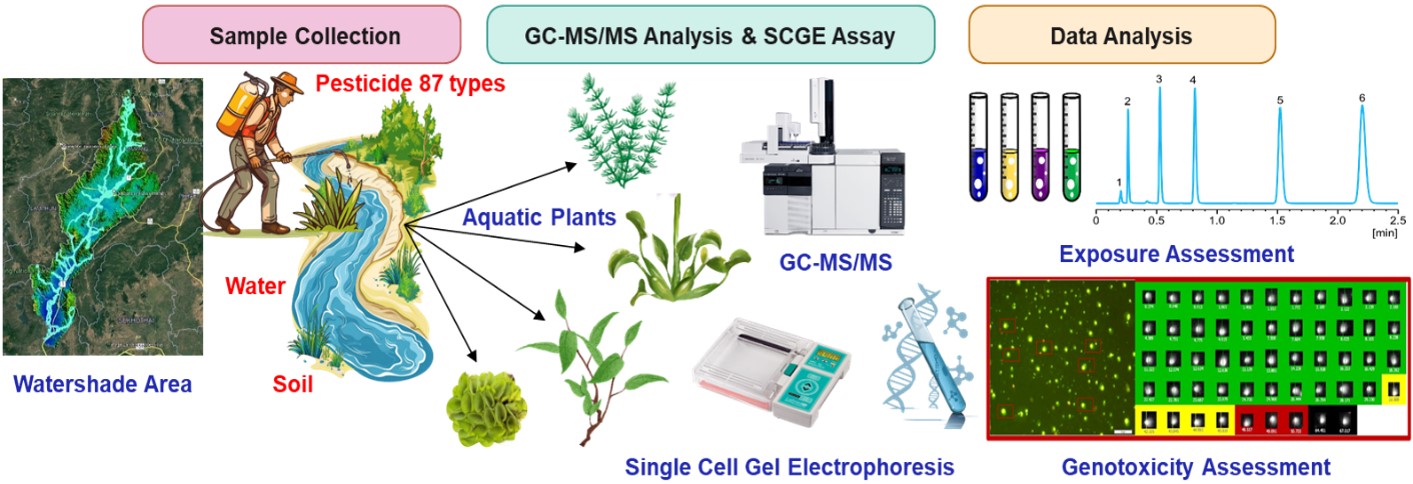
Pesticides pose significant threats to the integrity and functionality of aquatic ecosystems worldwide, necessitating thorough assessment and mitigation by all stakeholders. Chemical analysis alone cannot predict the synergistic effects of various contaminants found in aquatic ecosystems. This study assesses water quality indicators, including the Water Quality Index (WQI) for physicochemical and biological parameters, alongside the human health risks associated with pesticide exposure. The investigation focuses primarily on pesticide toxicity, persistence, and the impacts on water resources. Gas Chromatography-Mass Spectrometry (GC-MS/MS) is employed to quantify pesticides in aquatic ecosystems. Chemical analyses revealed detectable pesticide concentrations in water supplies, albeit at relatively low levels. Additionally, the single-cell gel electrophoresis (SCGE) assay was utilized to evaluate DNA damage in aquatic plants. Genotoxic effects were assessed using four species as bioindicators: Ceratophyllum demersum L., Eichhornia crassipes (Mart.) Solms, Ipomoea aquatica Forssk., and Salvinia cucullata Roxb. ex Bory, to evaluate aquatic ecosystem health. The results demonstrated that DNA fragmentation increased in proportion to pesticide exposure levels, with maximum damage reaching 17.49% and statistically significant differences from control specimens (p < 0.01). Complex species-specific responses were revealed during analysis, with trends suggesting potential phytoremediation mechanisms rather than simple bioaccumulation patterns. The SCGE assay proved effective for assessing DNA migration rates under conditions of low-level pesticide contamination, establishing aquatic plants as valuable biomonitoring tools for environmental risk assessment.
Article Details

This work is licensed under a Creative Commons Attribution-NonCommercial-NoDerivatives 4.0 International License.

This work is licensed under a Creative Commons Attribution-NonCommercial-NoDerivatives 4.0 International License.
References
Sathishkumar P, Mohan K, Ganesan AR, Govarthanan M, Yusoff ARM, Gu FL. Persistence, toxicological effect and ecological issues of endosulfan - a review. J Hazard Mater. 2021;416:125779. DOI: https://doi.org/10.1016/j.jhazmat.2021.125779
Vryzas Z. Pesticide fate in soil-sediment-water environment in relation to contamination preventing actions. Curr Opin Environ Sci Health. 2018;4:5-9. DOI: https://doi.org/10.1016/j.coesh.2018.03.001
Manyilizu WB. Pesticides, anthropogenic activities, history and the health of our environment: lessons from Africa. In: Larramendy ML, Soloneski S, editors. Pesticides - use and misuse and their impact in the environment. IntechOpen; 2019. p. 1-13.
Food and Agriculture Organization (FAO). Pesticides use and trade - 1990-2022. FAOSTAT Analytical Briefs, No. 89. Rome: FAO; 2024.
Bank of Thailand. Labor force survey [Internet]. 2025 [cited 2025 Mar 12]. Available from: https://app.bot.or.th/BTWS_STAT/statistics/BOTWEBSTAT.aspx?reportID=638&language=eng.
Worldometer. Pesticide use by country [Internet]. 2024 [cited 2025 Jan 9]. Available from: https://www.worldometers.info/food-agriculture/pesticides-by-country.
Moebus S, Boedeker W. Case fatality as an indicator for the human toxicity of pesticides - a systematic scoping review on the availability and variability of severity indicators of pesticide poisoning. Int J Environ Res Public Health. 2021;18(16):8307. DOI: https://doi.org/10.3390/ijerph18168307
Department of Disease Control, Ministry of Public Health. Annual epidemiological surveillance report 2020 [Internet]. 2020 [cited 2024 Oct 13]. Available from: https://apps-doe.moph.go.th/boeeng/download/AW_AESR_NCD_2563.pdf. (In Thai)
Sooksawat N, Adsatroo S, Bunmanat S, Chittwanij A, Vangnai A, Kongtip P, et al. Phytoremediation potential of sunn hemp for carbaryl-contaminated soil. ScienceAsia. 2024;50(5):1-7. DOI: https://doi.org/10.2306/scienceasia1513-1874.2024.089
Ore OT, Adeola AO, Bayode AA, Adedipe DT, Nomngongo PN. Organophosphate pesticide residues in environmental and biological matrices: occurrence, distribution and potential remedial approaches. Environ Chem Ecotoxicol. 2023;5:9-23. DOI: https://doi.org/10.1016/j.enceco.2022.10.004
Anagnostopoulou K, Nannou C, Evgenidou E, Lambropoulou D. Overarching issues on relevant pesticide transformation products in the aquatic environment: a review. Sci Total Environ. 2022;815:152863. DOI: https://doi.org/10.1016/j.scitotenv.2021.152863
Raffa CM, Chiampo F. Bioremediation of agricultural soils polluted with pesticides: a review. Bioengineering. 2021;8(7):92. DOI: https://doi.org/10.3390/bioengineering8070092
Jia Q, Liao GQ, Chen L, Qian YZ, Yan X, Qiu J. Pesticide residues in animal-derived food: current state and perspectives. Food Chem. 2024;438:137974. DOI: https://doi.org/10.1016/j.foodchem.2023.137974
US Environmental Protection Agency (US EPA). Guidelines for carcinogen risk assessment. Washington: US EPA; 2005.
Juárez-Santacruz L, García-Nieto E, García-Gallegos E, Romo-Gómez C, Ortiz-Ortiz E, Costilla-Salazar R, et al. DNA damage in Vicia faba by exposure to agricultural soils from Tlaxcala, Mexico. Bull Environ Contam Toxicol. 2015;95:764-9. DOI: https://doi.org/10.1007/s00128-015-1652-z
Abarna VP, Muthuswami M, Nelson SJ, Edward YSJT, Boopathi NM, Anita B. Effective biopesticides for sustainable management of Plutella xylostella L. (Lepidoptera: Plutellidae) in cauliflower: a comprehensive study on isolation, characterization and virulence assessment of highly virulent entomopathogenic fungi. ScienceAsia. 2024;50(5):1-8. DOI: https://doi.org/10.2306/scienceasia1513-1874.2024.087
Lanier C, Manier N, Cuny D, Deram A. The comet assay in higher terrestrial plant model: review and evolutionary trends. Environ Pollut. 2015;207:6-20. DOI: https://doi.org/10.1016/j.envpol.2015.08.020
Na Roi-et V, Chiemchaisri W, Chiemchaisri C, Yamamoto K. Assessment of genotoxicity of landfill leachate by comet assay using golden pothos (Epipremnum aureum). Int J Environ Technol Manag. 2012;15(3-6):247-60. DOI: https://doi.org/10.1504/IJETM.2012.049226
Na Roi-et V, Chiemchaisri W, Chiemchaisri C. Genotoxicity assessment of volatile organic compounds in landfill gas emission using comet assay in higher terrestrial plant. Bull Environ Contam Toxicol. 2017;98:283-89. DOI: https://doi.org/10.1007/s00128-016-2012-3
Wei X, Lyu S, Yu Y, Wang Z, Liu H, Pan D, et al. Phylloremediation of air pollutants: exploiting the potential of plant leaves and leaf-associated microbes. Front Plant Sci. 2017;8:1318. DOI: https://doi.org/10.3389/fpls.2017.01318
de Lapuente J, Lourenço J, Mendo SA, Borràs M, Martins MG, Costa PM, et al. The comet assay and its application in the field of ecotoxicology: a mature tool that continues to expand its perspectives. Front Genet. 2015;6:180. DOI: https://doi.org/10.3389/fgene.2015.00180
Plessl C, Otachi EO, Körner W, Avenant-Oldewage A, Jirsa F. Fish as bioindicators for trace element pollution from two contrasting lakes in the Eastern Rift Valley, Kenya: spatial and temporal aspects. Environ Sci Pollut Res. 2017;24:19767-76. DOI: https://doi.org/10.1007/s11356-017-9518-z
Tasneem S, Yasmeen R. Evaluation of genotoxicity by comet assay (single-cell gel electrophoresis) in tissues of the fish Cyprinus carpio during sub-lethal exposure to Karanjin. J Basic Appl Zool. 2018;79:19. DOI: https://doi.org/10.1186/s41936-018-0033-7
World Health Organization (WHO). Guidelines for drinking-water quality. 4th ed. Geneva: WHO; 2022.
Khan MHRB, Ahsan A, Imteaz M, Shafiquzzaman M, Al-Ansari N. Evaluation of the surface water quality using global water quality index (WQI) models: perspective of reiver water pollution. Sci Rep. 2023;13:20454. DOI: https://doi.org/10.1038/s41598-023-47137-1
Fathi E, Zamani-Ahmadmahmoodi R, Zare-Bidaki R. Water quality evaluation using water quality index and multivariate methods, Beheshtabad River, Iran. Appl Water Sci. 2018;8:210. DOI: https://doi.org/10.1007/s13201-018-0859-7
Wongaree M. Water quality assessment by using of water quality index for Mak Khaeng Canal, Udon Thani Province, Thailand. EnvironmentAsia. 2019;12(2):96-104.
Uddin MG, Nash S, Olbert AI. A review of water quality index models and their use for assessing surface water quality. Ecol Indic. 2021;122:107218. DOI: https://doi.org/10.1016/j.ecolind.2020.107218
US Environmental Protection Agency (US EPA). National recommended water quality criteria-correction. Washington: US EPA; 1999.
Environment and Pollution Control Office 2. Water Quality Index: WQI. Lampang: Ministry of Natural Resources and Environment; 2024. (In Thai)
Rattanavijit U, Chaipetch W, Kaewpiban P, Chansang T, Patsinghasanee R. Relationships between water quality index (WQI) and community participation in water resource conservation in Phum Duang River, Surat Thani Province, Thailand. Burapha Sci J. 2024;29(2):672-89.
Obana H, Okihashi M, Akutsu K, Kitagawa Y, Hori S. Determination of neonicotinoid pesticide residues in vegetables and fruits with solid phase extraction and liquid chromatography mass spectrometry. J Agric Food Chem. 2003;51(9):2501-5. DOI: https://doi.org/10.1021/jf0261102
Lee SJ, Mehler L, Beckman J, Diebolt-Brown B, Prado J, Lackovic M, et al. Acute pesticide illnesses associated with off-target pesticide drift from agricultural applications: 11 states, 1998-2006. Environ Health Perspect. 2011;119(8):1162-9. DOI: https://doi.org/10.1289/ehp.1002843
Chaikasem S, Na Roi-et V. Health risk assessment of pesticide residues in vegetables from river basin area. Appl Environ Res. 2020;42(2):46-61. DOI: https://doi.org/10.35762/AER.2020.42.2.4
American Public Health Association (APHA). Standard methods for the examination of water and wastewater. 23rd ed. Washington: APHA; 2017.
Klonjapo J, Therdkiattikul N, Siripattanakul-Ratpukdi S. Profenofos pesticide biodegradation under presence of natural organic carbon. KKU Eng J. 2016;43:314-6.
Sarkar A, Bhagat J, Sarker S. Evaluation of impairment of DNA in marine gastropod, Morula granulata as a biomarker of marine pollution. Ecotoxicol Environ Saf. 2014;106:253-61. DOI: https://doi.org/10.1016/j.ecoenv.2014.04.023
Akinnusotu A, Ukpebor JE, Okieimen FE. Assessment of polycyclic aromatic hydrocarbons in the soil around River Owan in Edo State, Nigeria: occurrence, distribution, source, and health risk. Eng Appl Sci Res. 2024;51(3):399-408.
