
The effect of EDTA concentration on antimicrobial chitosan, EDTA, and polyvinyl alcohol films for inhibiting aerobic bacteria on stored tilapia fillets
Article Sidebar
Main Article Content
Abstract
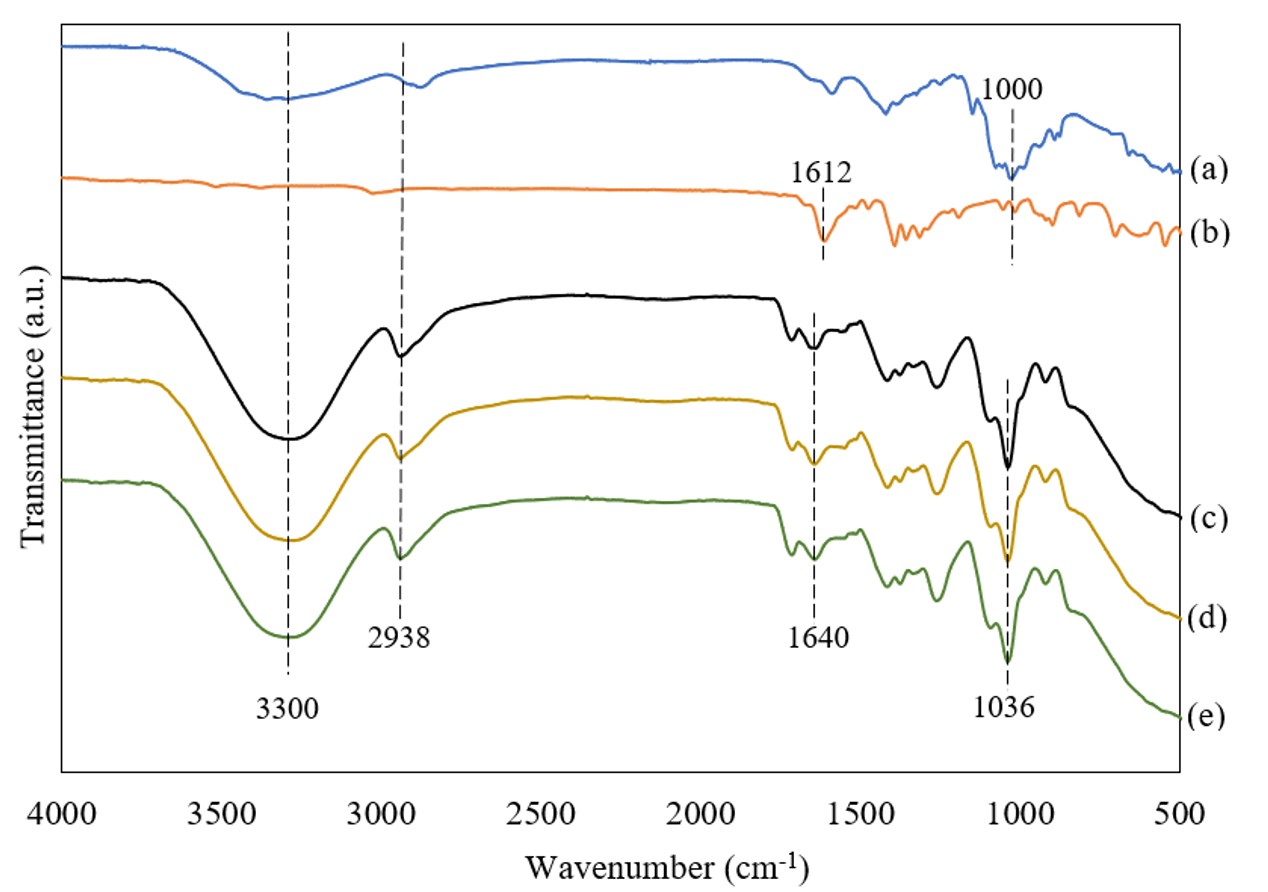
This study proposes to create packaging films using a blend of polyvinyl alcohol (PVA), chitosan (CS), and ethylenediaminetetraacetic acid (EDTA) in order to inhibit bacterial growth on tilapia fillets during storage. The films were prepared in three formulations with varying weight ratios: PVA6/CS10, PVA6/CS10/EDTA2, and PVA6/CS10/EDTA4. The results showed that as the concentration of EDTA increased, the ∆E* value, thickness, moisture content, and water vapor transmission rate of the films also increased. The morphology of the cross-sectional microstructure revealed a small spot in the PVA6/CS10/EDTA4 film, while the other formulations exhibited a homogeneous structure. FT-IR analysis indicated that the hydroxyl and carboxyl group peaks in the blended films (PVA, CS, and EDTA) were more prominent than in the individual components. Further, the tilapia fillets wrapped in the PVA6/CS10/EDTA4 film showed the greatest total color change but experienced less weight loss than the other films after storage at 4-7 °C for 7 days. The increased EDTA concentration in the wrapped film enhanced the inhibition of aerobic bacteria on the tilapia fillets. Therefore, the combination of PVA, CS, and EDTA in the film effectively inhibited bacterial growth and extended the shelf life of the tilapia fillets.
Article Details

This work is licensed under a Creative Commons Attribution-NonCommercial-NoDerivatives 4.0 International License.

This work is licensed under a Creative Commons Attribution-NonCommercial-NoDerivatives 4.0 International License.
References
Remya S, Mohan CO, Venkateshwarlu G, Sivaraman GK, Ravishankar CN. Combined effect of O2 scavenger and antimicrobial film on shelf life of fresh cobia (Rachycentron canadum) fish steaks stored at 2 oC. Food Control. 2017;70:71-8. DOI: https://doi.org/10.1016/j.foodcont.2016.05.038
Hansen AÅ, Moen B, Rødbotten M, Berget I, Pettersen MK. Effect of vacuum or modified atmosphere packaging (map) in combination with a CO2 emitter on quality parameter of cod loins (Gadus morhua). Food Packag Shelf Life. 2016;9:29-37. DOI: https://doi.org/10.1016/j.fpsl.2016.05.005
Masniyom P, Benjakul S, Visessanguan W. Combination effect of phosphate and modified atmosphere on quality and shelf-life extension of refrigerated seabass slices. LWT - Food Sci Technol. 2005;38(7):745-56. DOI: https://doi.org/10.1016/j.lwt.2004.09.006
Alemán A, González F, Arancibia MY, López-Caballero ME, Montero P, Gómez- Guillén MC. Comparative study between film and coating packaging based on shrimp concentrate obtained from marine industrial waste for fish sausage preservation. Food Control. 2016;70:325-32. DOI: https://doi.org/10.1016/j.foodcont.2016.06.007
Naewkanya P, Sowasod N. Development of packaging films based on polyvinyl alcohol and a tannic acid blend for inactivation of bacteria in tilapia (Oreochromis niloticus) fillets. J Ind Technol. 2023;19(3):16-30. (In Thai)
Hamza AM, Shakir AK, Alhtheal ED. Synthesis and characterizations of chitosan/EDTA/PVA nanofiber for antimicrobial applications. J Global Pharma Technol. 2019;11(7):453-9.
Chang SH, Chen YJ, Tseng HJ, Hsiao HI, Chai HJ, Shang KC, et al. Applications of nisin and EDTA in food packaging for improving fabricated chitosan-polylactate plastic film performance and fish fillet preservation. Membranes. 2021;11(11):852. DOI: https://doi.org/10.3390/membranes11110852
Arbia W, Arbia L, Adour L, Amrane A. Chitin extraction from crustacean shells using biological methods – a review. Food Technol Biotechnol. 2013;51(1):12-25.
de Souza Costa-Júnior E, Pereira MM, Mansur HS. Properties and biocompatibility of chitosan films modified by blending with PVA and chemically crosslinked. J Mater Sci: Mater Med. 2009;20:553-61. DOI: https://doi.org/10.1007/s10856-008-3627-7
Yan D, Li Y, Liu Y, Li N, Zhang X, Yan C. Antimicrobial properties of chitosan and chitosan derivatives in the treatment of enteric infections. Molecules. 2021;26(23):7136. DOI: https://doi.org/10.3390/molecules26237136
Shih PY, Liao YT, Tseng YK, Deng FS, Lin CH. A potential antifungal effect of chitosan against Candida albicans is mediated via the inhibition of SAGA complex component expression and the subsequent alteration of cell surface integrity. Front Microbiol. 2019;10:602. DOI: https://doi.org/10.3389/fmicb.2019.00602
Lo WH, Deng FS, Chang CJ, Lin CH. Synergistic antifungal activity of chitosan with fluconazole against Candida albicans, Candida tropicalis, and fluconazole-resistant strains. Molecules. 2020;25(21):5114. DOI: https://doi.org/10.3390/molecules25215114
Raafat D, von Bargen K, Haas A, Sahl HG. Insights into the mode of action of chitosan as an antibacterial compound. Appl Environ Microbiol. 2008;74(12):3764-73. DOI: https://doi.org/10.1128/AEM.00453-08
Federal Register. 60 FR 19524 [Internet]. 2024 [cited 2025 Dec 10]. Available from: https://www.federalregister.gov/citation/60-FR-19524.
Liu J, Guo Y, Li X, Si T, McClements DJ, Ma C. Effects of chelating agents and salts on interfacial properties and lipid oxidation in oil-in-water emulsions. J Agric Food Chem. 2019;67(49):13718-27. DOI: https://doi.org/10.1021/acs.jafc.8b05867
Simůnek J, Brandysová V, Koppová I, Simůnek J. The antimicrobial action of chitosan, low molar mass chitosan, and chitooligosaccharides on human colonic bacteria. Folia Microbiol. 2012;57:341-5. DOI: https://doi.org/10.1007/s12223-012-0138-1
Lewandowska K. Surface studies of microcrystalline chitosan/poly (vinyl alcohol) mixtures. Appl Surf Sci. 2012;263:115-23. DOI: https://doi.org/10.1016/j.apsusc.2012.09.011
Haghighi H, Leugoue SK, Pfeifer F, Siesler HW, Licciardello F, Fava P, et al. Development of antimicrobial films based on chitosan-polyvinyl alcohol blend enriched with ethyl lauroyl arginate (LAE) for food packaging applications. Food Hydrocolloids. 2020;100:105419. DOI: https://doi.org/10.1016/j.foodhyd.2019.105419
Boon-ek P. Tilapia market situation and products in 2023 and trends in 2024 [Internet]. 2024 [cited 2025 Feb 26]. Available from: https://www4.fisheries.go.th/local/file_announce/ 202403141256582_announce.pdf. (In Thai)
FAO. The state of world fisheries and aquaculture 2022. Towards blue transformation. Rome: FAO; 2022.
Sequino G, Valentino V, Villani F, De Filippis F. Omics-based monitoring of microbial dynamics across the food chain for the improvement of food safety and quality. Food Res Int. 2022;157:111242. DOI: https://doi.org/10.1016/j.foodres.2022.111242
Yong H, Wang X, Bai R, Miao Z, Zhang X, Liu J. Development of antioxidant and intelligent pH-sensing packaging films by incorporating purple-fleshed sweet potato extract into chitosan matrix. Food Hydrocolloids. 2019;90:216-24. DOI: https://doi.org/10.1016/j.foodhyd.2018.12.015
AOAC. Official methods of analysis. 16th ed. Virginia: Association of Official Analytical Chemists; 2002.
Hu Y, Topolkaraev V, Hiltner A, Baer E. Measurement of water vapor transmission rate in highly permeable films. J Appl Polym Sci. 2001;81(7):1624-33. DOI: https://doi.org/10.1002/app.1593.abs
Tamzi NN, Faisal M, Sultana T, Ghosh SK. Extraction and properties evaluation of chitin and chitosan prepared from different crustacean waste. Bangladesh J Vet Anim Sci. 2020;8(2):69-76.
Jones JB, Zivanovic S. Metal binding applications of chitosan films containing cross-linkers and plasticizers [CHP Projects]. Knoxville: University of Tennessee; 2009 [cited 2025 Feb 26]. Available from: https://trace.tennessee.edu/utk_chanhonoproj/
Sanyang ML, Sapuan SM, Jawaid M, Ishak MR, Sahari J. Effect of plasticizer type and concentration on tensile, thermal and barrier properties of biodegradable films based on sugar palm (Arenga pinnata) starch. Polymers. 2015;7(6):1106-24. DOI: https://doi.org/10.3390/polym7061106
Pitiphatharaworachot S, Puangsin B. Effect of glycerol on physical and thermal properties of tapioca starch films. 55th Kasetsart University Annual Conference: Science and Genetic Engineering, Architecture and Engineering, Agro-Industry, Natural Resources and Environment; 2017 Jan 31-Feb 3; Bangkok, Thailand. Thailand: Kasetsart University; 2017. p. 786-93. (In Thai)
Wang QZ, Chen XG, Liu N, Wang SX, Liu CS, Meng XH, et al. Protonation constants of chitosan with different molecular weight and degree of deacetylation. Carbohydr Polym. 2006;65(2):194-201. DOI: https://doi.org/10.1016/j.carbpol.2006.01.001
Singh K, Suri R, Tiwary AK, Rana V. Chitosan films: crosslinking with EDTA modifies physicochemical and mechanical properties. J Mater Sci: Mater Med. 2012;23:687-95. DOI: https://doi.org/10.1007/s10856-012-4554-1
Ghaderi J, Hosseini SF, Keyvani N, Gomez-Guillen MC. Polymer blending effects on the physicochemical and structural features of the chitosan/poly (vinyl alcohol)/fish gelatin ternary biodegradable films. Food Hydrocolloids. 2019;95:122-32. DOI: https://doi.org/10.1016/j.foodhyd.2019.04.021
Sharma P, Agrawal PK, Singh VK, Chauhan S, Bhaskar J. A comprehensive review on properties of polyvinyl alcohol (PVA) crosslinked with carboxylic acid. J Mater Environ Sci. 2023;14(10):1236-52.
Açik G, Kamaci M, Özata B, Özen Cansoy CE. Effect of polyvinyl alcohol/chitosan blend ratios on morphological, optical, and thermal properties of electrospun nanofibers. Turk J Chem. 2019;43(1):137-49. DOI: https://doi.org/10.3906/kim-1801-68
Liao J, Li J, Wang H, Zhu Y, Essawy H, Du G, et al. Development of antioxidant packaging film based on chinese bayberry tannin extract and polyvinyl alcohol. J Renewable Mater. 2022;10(1):19-31. DOI: https://doi.org/10.32604/jrm.2021.016152
Xie X, Zhai X, Chen M, Li Q, Huang Y, Zhao L, et al. Effects of frozen storage on texture, chemical quality indices and sensory properties of crisp Nile tilapia fillets. Aquacult Fish. 2023;8(6):626-33. DOI: https://doi.org/10.1016/j.aaf.2022.11.007
Castro-Rosas J, Ferreira-Grosso CR, Gómez-Aldapa CA, Rangel-Vargas E, Rodríguez-Marín ML, Guzmán-Ortiz FA, et al. Recent advances in microencapsulation of natural sources of antimicrobial compounds used in food - a review. Food Res Int. 2017;102:575-87. DOI: https://doi.org/10.1016/j.foodres.2017.09.054
Belfiore C, Castellano P, Vignolo G. Reduction of Escherichia coli population following treatment with bacteriocins from lactic acid bacteria and chelators. Food Microbiol. 2007;24(3):223-9. DOI: https://doi.org/10.1016/j.fm.2006.05.006
