
Effect of SiO2 derived natural bamboo leaf ash on paving blocks to reduce pollutants
Article Sidebar
Main Article Content
Abstract
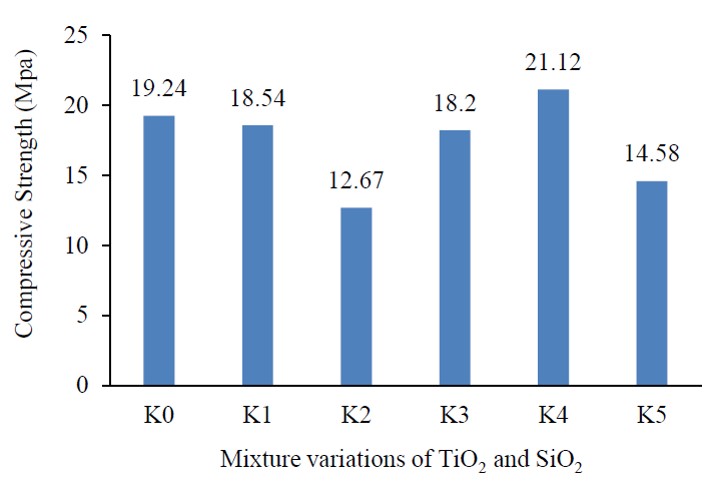
The annual increase in traffic volume contributes approximately 71% of nitrogen oxide (NOx) emissions and 15% of sulfur oxide (SOx) emissions, along with other air pollutants. Paving blocks with a TiO2-SiO2 photocatalyst layer offer a promising solution for mitigating these pollutants by enhancing the adsorption and degradation of organic compounds. Since, conventional SiO2 sources are typically derived from nonrenewable materials, bamboo leaf ash presents a renewable and environmentally friendly alternative. This study aimed to identify the optimal TiO2-SiO2 composition and evaluate the adsorption efficiency and physical properties of paving blocks incorporating SiO2 derived from bamboo leaf ash. TiO2-SiO2 composites were synthesized with mass ratios of 2:0.5 (K1), 2:1 (K2), 0.5:2 (K3), 1:2 (K4), and 2:2 (K5). Paving blocks were fabricated by mixing cement, sand, water, and the TiO2-SiO2 composite in a ratio of 1:4:0.5:1, then molded into 20 × 10 × 6 cm blocks. Each block featured a 5 mm photocatalyst layer atop a 55 mm base layer. Characterization included scanning electron microscopy (SEM), compressive strength testing, water absorption analysis, and UV-Vis spectrophotometry. The optimal performance was found in sample K5 (TiO2:SiO2 = 2:2), which demonstrated a pollutant adsorption value of 0.086 ppm, water absorption of 8.47%, and a compressive strength of 14.58 MPa. These results indicate a uniform distribution of the TiO2-SiO2 composite, enhancing the efficiency of pollutant removal. The paving blocks meet the SNI 03-0691-1996 Quality Standard C, confirming their suitability for practical application.
Article Details

This work is licensed under a Creative Commons Attribution-NonCommercial-NoDerivatives 4.0 International License.

This work is licensed under a Creative Commons Attribution-NonCommercial-NoDerivatives 4.0 International License.
References
Fazakas E, Neamtiu IA, Gurzau ES. Health effects of air pollutant mixtures (volatile organic compounds, particulate matter, sulfur and nitrogen oxides) - a review of the literature. Rev Environ Health. 2023;39(3):459-78.
Shetty SS, Deepthi D, Harshitha S, Sonkusare S, Naik PB, Suchetha Kumari N, et al. Environmental pollutants and their effects on human health. Heliyon. 2023;9(9):e19496.
Seaton M, O’Neill J, Bien B, Hood C, Jackson M, Jackson R, et al. A multi-model air quality system for health research: road model development and evaluation. Environ Model Softw. 2022;155:105455.
Leirião LFL, Miraglia SGEK. Environmental and health impacts due to the violation of Brazilian emissions control program standards in Sao Paulo Metropolitan Area. Transp Res D Transp Environ. 2019;70:70-6.
Gulia S, Shukla N, Padhi L, Bosu P, Goyal SK, Kumar R. Evolution of air pollution management policies and related research in India. Environ Challenges. 2022;6:100431.
Lu J, Li B, Li H, Al-Barakani A. Expansion of city scale, traffic modes, traffic congestion, and air pollution. Cities. 2021;108:102974.
Angelevska B, Atanasova V, Andreevski I. Urban air quality guidance based on measures categorization in road transport. Civ Eng J. 2021;7(2):253-67.
Santoso M, Lestiani DD, Kurniawati S, Damastuti E, Kusmartini I, Atmodjo DPD, et al. Assessment of urban air quality in Indonesia. Aerosol Air Qual Res. 2020;20:2142-58.
Nadafianshahamabadi R, Tayarani M, Rowangould G. A closer look at urban development under the emergence of autonomous vehicles: Traffic, land use and air quality impacts. J Transp Geogr. 2021;94:103113.
Anugerah AR, Muttaqin PS, Purnama DA. Effect of large-scale social restriction (PSBB) during COVID-19 on outdoor air quality: evidence from five cities in DKI Jakarta Province, Indonesia. Environ Res. 2021;197:111164.
Nesterovic A, Djatkov D, Viskovic M, Martinov M, Adamovic D. Air pollutants emissions from biomass combustion in the City of Novi Sad, Serbia. Biomass Convers Biorefinery. 2023;13:10935-46.
Indwek DD, Agustina W, Mumpuni RY. Studi Literatur: Pengaruh Lama Kerja terhadap Kadar Hemoglobin pada Pekerja yang Terpapar Asap Kendarahan Bermotor. J Penelit Perawat Prof. 2022;4(2):383-92. (In Indonesian)
Bica BO, De Melo JVS, Gleize PJP. Photocatalytic concrete blocks nanomodified with zinc oxide for paving: mechanical performance and microstructural characteristics. J Test Eval. 2021;49(4):2860-84.
Khair H, Dewi K, Irsyad M. Pemanfaatan Titanium Dioxide pada Trotoar untuk Mengurangi Gas Pencemar NOx di Udara. J Dampak. 2016;13(1):35-43. (In Indonesian)
Setiawan AA, Diana AIN. Pengaruh Penambahan Serbuk Besi Sebagai Bahan Campuran Pasir Pada Pembuatan Paving Block Terhadap Kuat Tekan Dan Daya Serap Air. J Tek Sipil. 2022;3(2):395-402. (In Indonesian)
Wulandari M, Astuti, Muldarisnur. Sintesis Nanopartikel TiO2-SiO2 Berpori Sebagai Fotokatalis untuk Penjernihan Air Limbah Rumah Tangga. J Fis Unand. 2018;7(1):33-8.
Ansari MA, Shariq M, Ansari SS, et al. Efficiency assessment of TiO2-based photocatalytic concrete for clean and sustainable construction: a state-of-the-art review. Iran J Sci Technol Trans Civ Eng. 2024;48:3871-98.
Hassan M, Mohammad LN, Asadi S, Dylla H, Cooper S. Sustainable photocatalytic asphalt pavements for mitigation of nitrogen oxide and sulfur dioxide vehicle emissions. J Mater Civ Eng. 2013;25(3):365-71.
Li X, Wang F, You L, Wu S, Yang C, Zhang L, et al. A review on photocatalytic asphalt pavement designed for degradation of vehicle exhausts. Transp Res D Transp Environ. 2023;115:103605.
Boonen E, Beeldens A. Recent photocatalytic applications for air purification in Belgium. Coatings. 2014;4(3):553-73.
Zairawati O, Dahlan D. Pengaruh Konsentrasi SiO2 dalam Komposit TiO2-SiO2 sebagai Lapisan Swabersih pada Katun Tekstil. J Fis Unand. 2018;7(3):240-5. (In Indonesian)
Rüssel C. Introduction to glass science and technology. Cambridge: Royal Society of Chemistry; 1999.
Patil AR, Sathe SB. Feasibility of sustainable construction materials for concrete paving blocks: a review on waste foundry sand and other materials. Mater Today Proc. 2021;43:1552-61.
Siddique R, de Schutter G, Noumowe A. Effect of used-foundry sand on the mechanical properties of concrete. Constr Build Mater. 2009;23(2):976-80.
de Rosso LT, de Melo JVS. Impact of incorporating recycled glass on the photocatalytic capacity of paving concrete blocks. Constr Build Mater. 2020;259:119778.
Grubeša IN, Barišić I, Habuda-Stanić M, Grdić D. Effect of CRT glass and TiO2 as a replacement for fine aggregate and cement on properties of pervious concrete paving flags. Constr Build Mater. 2023;397:132426.
Campos Teixeira AH, Soares Junior PRR, Silva TH, Barreto RR, da Silva Bezerra AC. Low-Carbon concrete based on binary biomass ash–silica fume binder to produce eco-friendly paving blocks. Materials. 2020;13(7):1534.
Solanki P, Sancheti G, Singh S. Sustainable use of waste glass in pavement systems–review, limitations and potential application. J Solid Waste Technol Manag. 2021;47(2):235-51.
Diana AIN, Fansuri S, Deshariyanto D. Penambahan abu daun bambu sebagai substitusi material semen terhadap kinerja beton. Paduraksa: J Tek Sipil Univ Warmadewa. 2020;9(2):172-82. (In Indonesian)
Iskandar A, Hidayat M, Jepriani S. Abu Daun Bambu Sebagai Bahan Subtitusi Semen Terhadap Kinerja Beton Normal. J Inersia. 2022;14(2):21-6. (In Indonesian)
Umoh AA, Odesola L. Characteristics of bamboo leaf ash blended cement paste and mortar. Civ Eng Dimens. 2015;17(1):22-8.
Lubis RY, Nasution MI. Sintesis Dan Karakterisasi Dari Tio2/Sio2 Dengan Doping CuO2 Menggunakan Metode Kopresipitasi. J Einstein. 2021;9(1):40-5. (In Indonesian)
Hoang NTM, Tran ATK, Le TA, Nguyen DD. Enhancing efficiency and photocatalytic activity of TiO2-SiO2 by combination of glycerol for MO degradation in continuous reactor under solar irradiation. J Environ Chem Eng. 2021;9(5):105789.
Sun W, Zhang S, Liu Z, Wang C, Mao Z. Studies on the enhanced photocatalytic hydrogen evolution over Pt/PEG-modified TiO2 photocatalysts. Int J Hydrogen Energy. 2008;33(4):1112-7.
de Melo JVS, Trichês G. Evaluation of mechanical behavior and microstructural characteristics of photocatalytic concretes to be used as pavement blocks. J Eng Mater Technol. 2016;138(3):1-8.
Hua K, Wu Z, Chen W, Xi X, Chen X, Yang S, et al. Preparation and photocatalytic properties of Al2O3-SiO2-TiO2 porous composite semiconductor ceramics. Molecules. 2024;29(18):4391.
Badan Standardisasi Nasional. SNI 03-0691-1996 tentang bata beton (paving block). Jakarta: Badan Standardisasi Nasional; 1996. (In Indonesian)
Wu L, Mei M, Li Z, Liu S, Wang X. Study on photocatalytic and mechanical properties of TiO2 modified pervious concrete. Case Stud Constr Mater. 2022;17:e01606.
Abdullah GMS, Chohan IM, Ali M, Bheel N, Ahmad M, Najeh T, et al. Effect of titanium dioxide as nanomaterials on mechanical and durability properties of rubberised concrete by applying RSM modelling and optimizations. Front Mater. 2024;11:1-24.
Al Muttaqii M, Amin M, Handoko AS, Birawidha DC, Isnugroho K, Hendronursito Y, et al. The characterization and physical properties of paving block products over basalt minerals. AIP Conf Proc. 2020;2232:050006.
Tavakoli D, Dehkordi RS, Divandari H, de Brito J. Properties of roller-compacted concrete pavement containing waste aggregates and nano SiO2. Constr Build Mater. 2020;249:118747.
Bilir T, Aygun BF, Shi J, Gencel O, Ozbakkaloglu T. Influence of different types of wastes on mechanical and durability properties of interlocking concrete block paving (ICBP): a review. Sustainability. 2022;14(7):3733.
Avizovas R, Baskutis S, Navickas V, Tamándl L. Effect of chemical composition of clay on physical-mechanical properties of clay paving blocks. Buildings. 2022;12(7):943.
Ihfansyah KN, Teguh M. Effect of coconut shell ash substitution on compressive strength, wear resistance and water absorption in paving blocks. Teknisia. 2024;29(1):37-46.
Kusaimi NFM, Hamzah F, Jai J, Zaki NAM, Ibrahim N. Compressive strength and water absorption of pavement derived from palm oil eco processed pozzolan (Epp) material as partial cement replacement. ASEAN J Chem Eng. 2020;20(2):205-15.
Matthew D, Hadiwardoyo SP, Iduwin T, Lumingkewas RH. Water absorption rate in porous concrete paving block as a permeable pavement structure. E3S Web Conf. 2024;517:12003.
Cao X, Yang X, Li H, Huang W, Liu X. Investigation of Ce-TiO2 photocatalyst and its application in asphalt- based specimens for NO degradation. Constr Build Mater. 2017;148:824-32.
Zhang L, Lu Q, Shan R, Zhang F, Muhammad Y, Huang K. Photocatalytic degradation of vehicular exhaust by nitrogen-doped titanium dioxide modified pavement material. Transp Res D Transp Environ. 2021;91:102690.
Hamidi F, Aslani F. Tio2-based photocatalytic cementitious composites: materials, properties, influential parameters, and assessment techniques. Nanomaterials. 2019;9(10):1444.
Lee JW, Lee SH, Jang YI, Park HM. Evaluation of reducing NO and SO2 concentration in nano SiO2-TiO2 photocatalytic concrete blocks. Materials. 2021;14(23):7182.
