Development of A Composite Sustainability Index Within An Integrated Coastal Zone Management Framework: A Case Study of Ho Chi Minh City, Vietnam
Article Sidebar
Main Article Content
Abstract
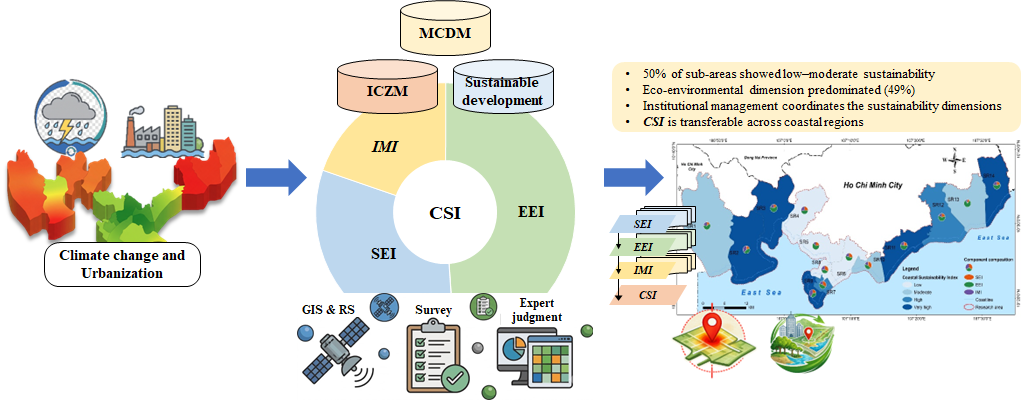
Coastal regions are increasingly under compounded pressures from climate change and rapid socioeconomic development, and integrated approaches to sustainability assessment are needed. This study assesses coastal sustainability in Ho Chi Minh City by developing a composite sustainability index (CSI) structured around three key dimensions: socioeconomic, ecoenvironmental, and institutional management. An integrated coastal zone management (ICZM) framework was adopted to reorganize the index system, enhancing cross-dimensional linkages while explicitly clarifying the predominant role of the environmental dimension and the coordinating function of management. The CSI was quantified and spatially represented through the integration of multicriteria decision-making (MCDM), geographic information systems (GIS), and remote sensing. The results indicated that the CSI values ranged from 0.378 to 0.630, with half of the subareas falling within low to moderate levels, reflecting significant imbalances among the three dimensions. Although the eco-environmental component remained predominant (49%), the findings revealed clear trade-offs between economic growth and environmental quality. Overall, ecosystem degradation emerged as the primary driver of reduced sustainability, highlighting the need to prioritize mangrove conservation and restoration alongside strengthened environmental monitoring within an ICZM-based planning approach. Beyond the case study, the proposed CSI provides a transferable, spatially explicit ICZM-based framework to support sustainability assessment and evidence-based decision-making across coastal regions.
Article Details

This work is licensed under a Creative Commons Attribution-NonCommercial 4.0 International License.
Published articles are under the copyright of the Applied Environmental Research effective when the article is accepted for publication thus granting Applied Environmental Research all rights for the work so that both parties may be protected from the consequences of unauthorized use. Partially or totally publication of an article elsewhere is possible only after the consent from the editors.
