Effects of the PSB-to-OW Ratio and Light Intensity on Biogas Composition during Phototrophic-Assisted Anaerobic Fermentation of Organic Waste
Article Sidebar
Main Article Content
Abstract
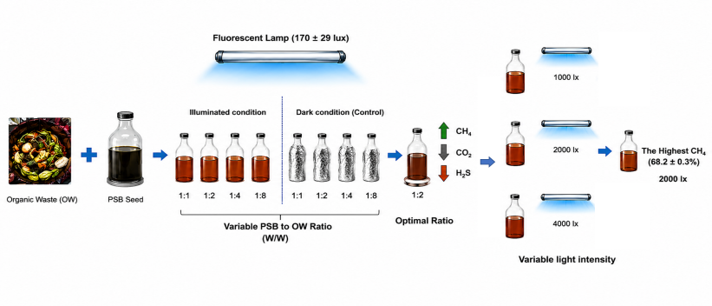
The integration of phototrophic processes into anaerobic fermentation offers a promising strategy for improving biogas quality; however, the combined effects of the photosynthetic bacteria-to-organic waste (PSB-to-OW) ratio and light intensity remain unclear. In this study, the photosynthetic bacteria (PSB)-assisted anaerobic fermentation of municipal organic waste under varying PSB-to-OW ratios and light intensities was evaluated. An optimal PSB-to-OW ratio of 1:2 resulted in significantly higher CH4 concentrations and lower CO2 and H2S concentrations than the other tested ratios did (p < 0.05). At this ratio, moderate illumination (2000 lx) resulted in the highest CH4 concentration (68.2 ± 0.3%), compared with 1000 lx (61.5 ± 0.4%) and 4000 lx (63.1 ± 0.5%). Under illumination, the CO2 and H2S concentrations were lower than those under dark conditions, indicating a more favorable biogas composition. Kinetic analysis indicated that CO2 and H2S exhibited apparent first-order behavior under illumination, with the highest rates occurring at 2000 lx (kH2S = 0.093 day-1; kCO2 = 0.059 day-1), suggesting light-dependent transformation processes. Metagenomic analysis revealed a microbial community dominated by sulfide-oxidizing (Chlorobium sp.), photoheterotrophic (Rhodopseudomonas sp.), and syntrophic bacteria, supporting coupled carbon conversion and sulfur transformation. Overall, optimization of the PSB-to-OW ratio and light intensity improved the biogas composition by increasing the CH4 concentration while reducing the CO2 and H2S concentrations. These findings demonstrate a coupled mechanism of light-driven sulfide oxidation and carbon conversion, providing a basis for integrating phototrophic processes into anaerobic systems for improved energy recovery and biogas purification.
Article Details

This work is licensed under a Creative Commons Attribution-NonCommercial 4.0 International License.
Published articles are under the copyright of the Applied Environmental Research effective when the article is accepted for publication thus granting Applied Environmental Research all rights for the work so that both parties may be protected from the consequences of unauthorized use. Partially or totally publication of an article elsewhere is possible only after the consent from the editors.
