Synergistic Application of Sawdust Bottom Ash and Kaolin for Mitigating Arsenic Uptake in Thai Eggplant (Solanum melongena L.)
Article Sidebar
Main Article Content
Abstract
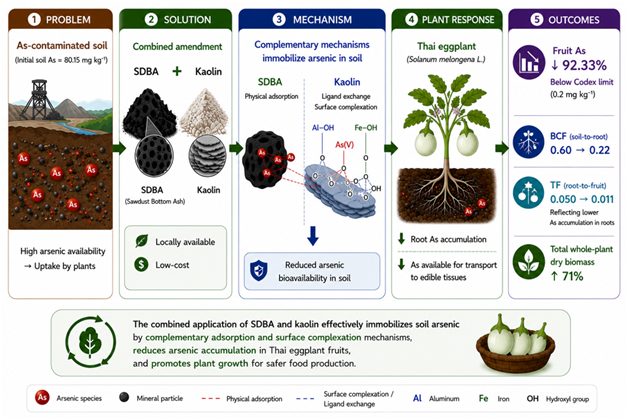
Arsenic (As) contamination of agricultural soils remains a major environmental challenge in Thailand, particularly in Ron Phibun District, Nakhon Si Thammarat Province, where historical tin mining has resulted in long-term soil contamination. This study evaluated the effectiveness of sawdust bottom ash (SDBA) and kaolin as soil amendments for reducing arsenic uptake in Thai eggplant (Solanum melongena L.) cultivated in soil containing an initial As concentration of 80.15 mg kg-1. A pot experiment investigated SDBA (1 and 3%, w/w), kaolin (1 and 3%, w/w), and their combined applications (1% (w/w) SDBA + 1% (w/w) kaolin and 3% (w/w) SDBA + 3% (w/w) kaolin). The combined application of 1% (w/w) SDBA and 1% (w/w) kaolin reduced fruit As concentration to 0.39 ± 0.10 mg kg-1, outperforming either 3% (w/w) SDBA or 3% (w/w) kaolin alone despite the lower total amendment rate, demonstrating a synergistic interaction. The combined application of 3% (w/w) SDBA and 3% (w/w) kaolin achieved the highest remediation efficiency, reducing fruit As from 2.40 ± 0.24 to 0.184 ± 0.04 mg kg-1, corresponding to a 92.33% reduction and lowering As below the Codex Alimentarius maximum permissible limit of 0.2 mg mg kg-1. The bioconcentration factor (BCF; soil-to-root) decreased from 0.60 in the untreated control to 0.22 in the combined treatment, while the root-to-fruit translocation factor (TF) decreased from 0.050 to 0.011, indicating reduced As accumulation in roots and consequently less As available for translocation to edible tissues. The combined amendment also significantly enhanced plant growth, resulting in the highest total whole-plant dry biomass (33.66 ± 0.73 g pot-1) and indicating alleviation of As-induced phytotoxicity. Collectively, these findings demonstrate that synergistic application of SDBA and kaolin effectively immobilizes soil arsenic and provides a practical, cost-effective strategy for reducing arsenic accumulation in edible crops cultivated on contaminated agricultural soils.
Article Details

This work is licensed under a Creative Commons Attribution-NonCommercial 4.0 International License.
Published articles are under the copyright of the Applied Environmental Research effective when the article is accepted for publication thus granting Applied Environmental Research all rights for the work so that both parties may be protected from the consequences of unauthorized use. Partially or totally publication of an article elsewhere is possible only after the consent from the editors.
