Tree Composition and Carbon Sequestration Potential of A University Campus in Bangkok, Thailand
Article Sidebar
Main Article Content
Abstract
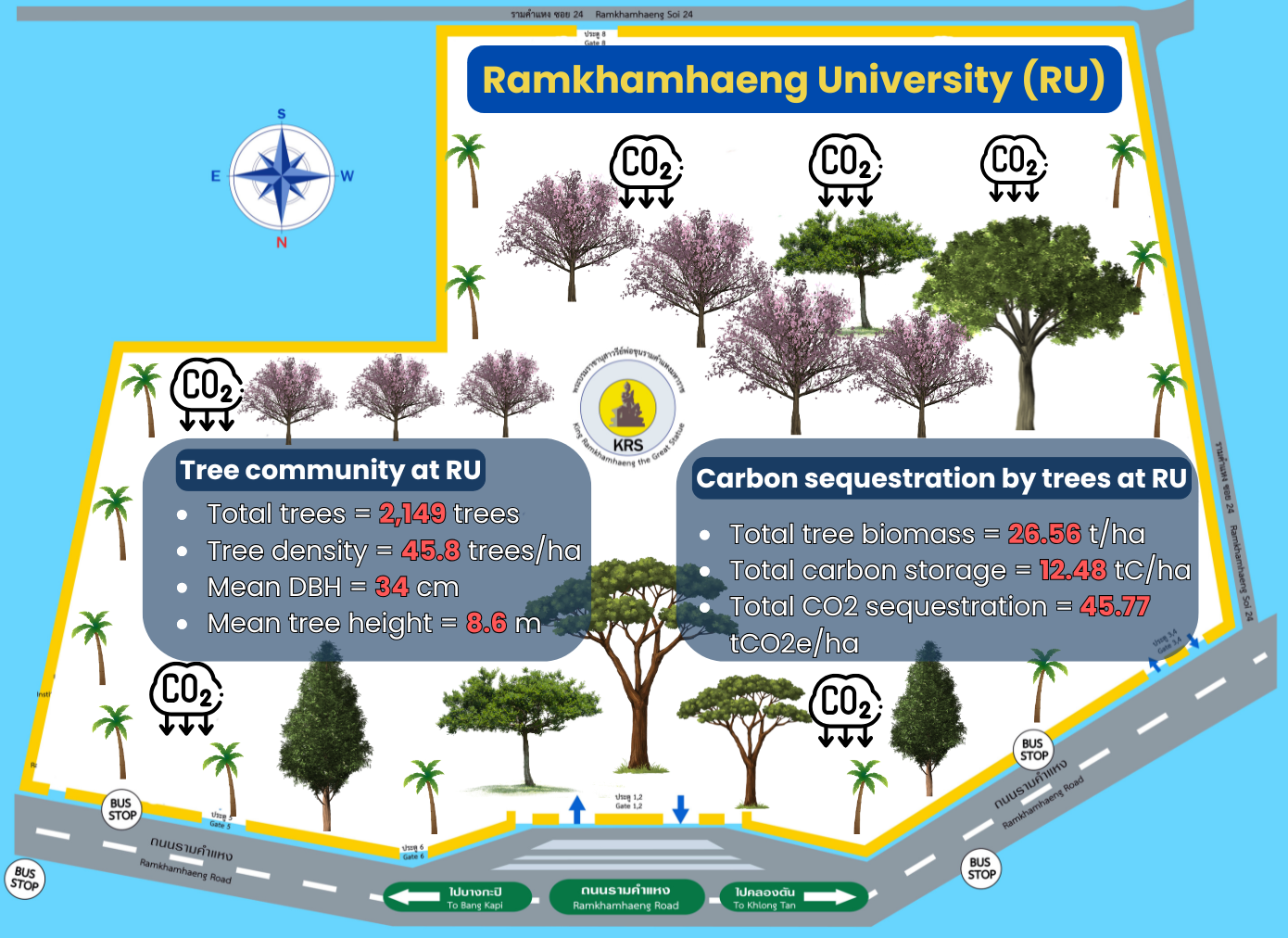
Trees play important roles in atmospheric carbon dioxide (CO2) absorption and climate change mitigation. The objective of this study was to assess tree characteristics and carbon sequestration potential at Ramkhamhaeng University (Hua Mak Campus), Bangkok, Thailand. Tree attributes, including species composition, abundance, diameter at breast height (DBH), and tree height, were recorded. Tree biomass, carbon storage, and CO2 sequestration were estimated using appropriate allometric equations. A total of 2,149 trees were recorded in the study area, corresponding to a tree density of 45.8 trees ha-1. The tree community was dominated by the palm family (Arecaceae), while Terminalia ivorensis was the most abundant species. The overall mean DBH and tree height were 34 cm and 8.6 m, respectively. The total estimated biomass, carbon storage, and CO2 sequestration were 26.56 t ha-1, 12.48 tC ha-1, and 45.77 tCO2e ha-1, respectively. Tabebuia rosea contributed the most to total biomass, carbon storage, and CO2 sequestration at the species level, whereas Samanea saman presented the highest average values on a per-tree basis. These findings provide valuable information for green space planning and tree management on university campuses and serve as essential baseline data for estimating net CO2 emissions and supporting the development of low-carbon universities.
Article Details

This work is licensed under a Creative Commons Attribution-NonCommercial 4.0 International License.
Published articles are under the copyright of the Applied Environmental Research effective when the article is accepted for publication thus granting Applied Environmental Research all rights for the work so that both parties may be protected from the consequences of unauthorized use. Partially or totally publication of an article elsewhere is possible only after the consent from the editors.
