Performance and Mechanisms of Activated Natural Coagulants for Efficient Microcystis Removal via Coagulation–Flocculation in Thailand
Article Sidebar
Main Article Content
Abstract
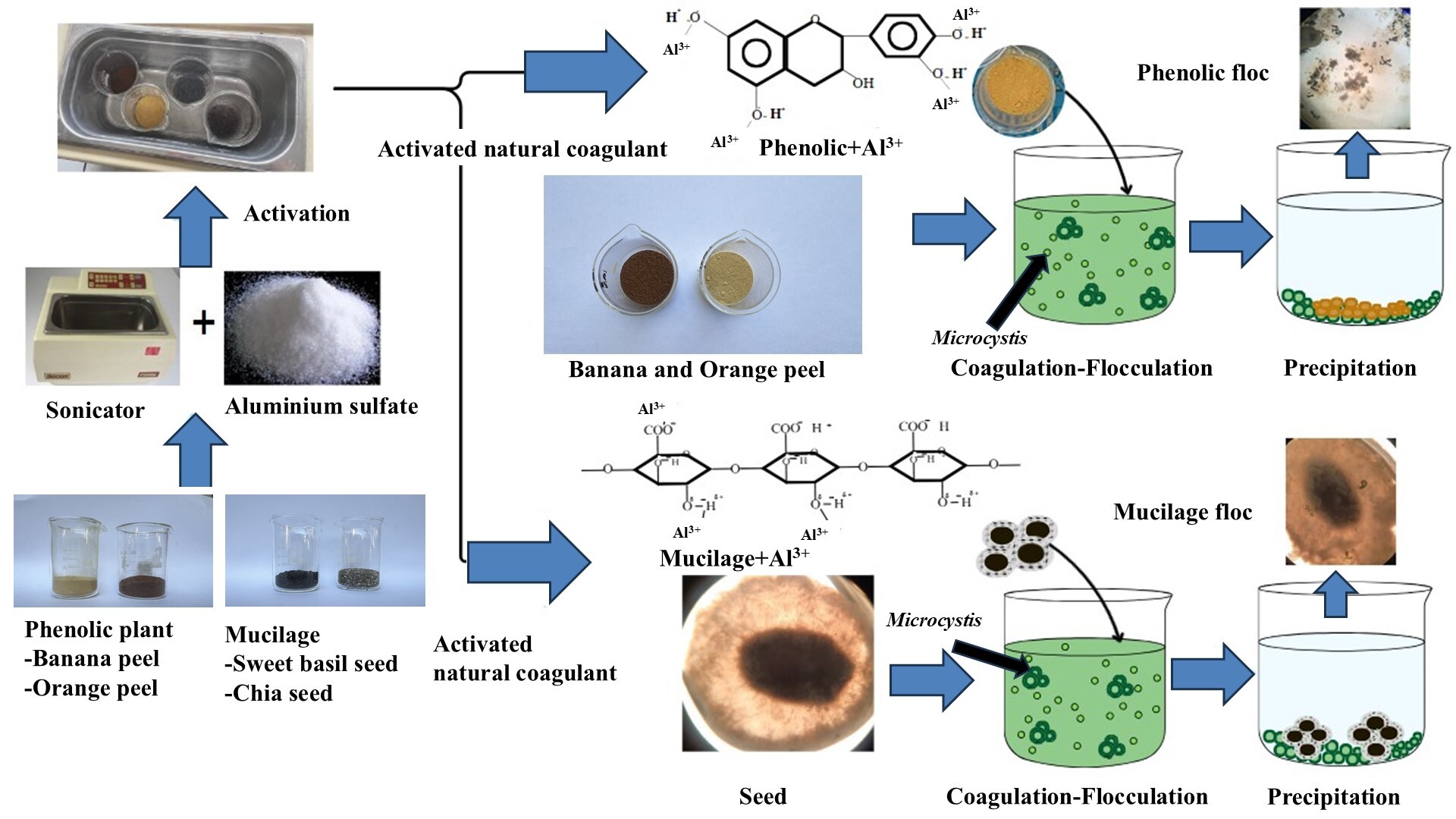
Thailand produces fruit peels and seeds rich in natural polymers, which can serve as eco-friendly coagulants to control algal blooms. In this study, banana peel (Musa spp.), orange peel (Citrus sinensis), basil seed (Ocimum basilicum) mucilage, and chia seed (Salvia hispanica) mucilage were used. These activated natural coagulants with aluminum were compared with nonactivated and commercial coagulants (ferric sulfate, ferrous sulfate, and polyaluminum chloride) for Microcystis removal. Phytochemical composition analysis, Fourier transform infrared (FTIR) spectroscopy, and oxidation–reduction potential (ORP) analysis were conducted. The results revealed that banana and orange peels contain phenolic compounds, whereas galacturonic acid was detected in basil and chia seed mucilage. Phytoplankton contain amino, carboxyl, and phosphate groups with a net negative surface charge. Compared with commercial coagulants, activated natural coagulants achieved 90% chlorophyll-a removal, whereas nonactivated forms reached 50–60% efficiency. ORP measurements and floc analysis confirmed effective precipitation. Mechanistically, phytoplankton acted as reducing agents, whereas banana and orange peels served as oxidizing agents through phenolic–aluminum interactions. Consequently, activated natural coagulants destabilize the phytoplankton, leading to flocculation. Similarly, aluminum ions in basil and chia mucilage bind to galacturonic acid, destabilizing the cells. The polymeric chains of polygalacturonic acid further facilitated interparticle bridging, thereby promoting flocculation. These mechanisms account for the high removal efficiency of activated natural coagulants.
Article Details

This work is licensed under a Creative Commons Attribution-NonCommercial 4.0 International License.
Published articles are under the copyright of the Applied Environmental Research effective when the article is accepted for publication thus granting Applied Environmental Research all rights for the work so that both parties may be protected from the consequences of unauthorized use. Partially or totally publication of an article elsewhere is possible only after the consent from the editors.
