Sustainable Approach for The Removal of Cu(II) from Aqueous Solutions Using Lotus Seedpod-alginate Composite Biosorbents
Article Sidebar
Main Article Content
Abstract
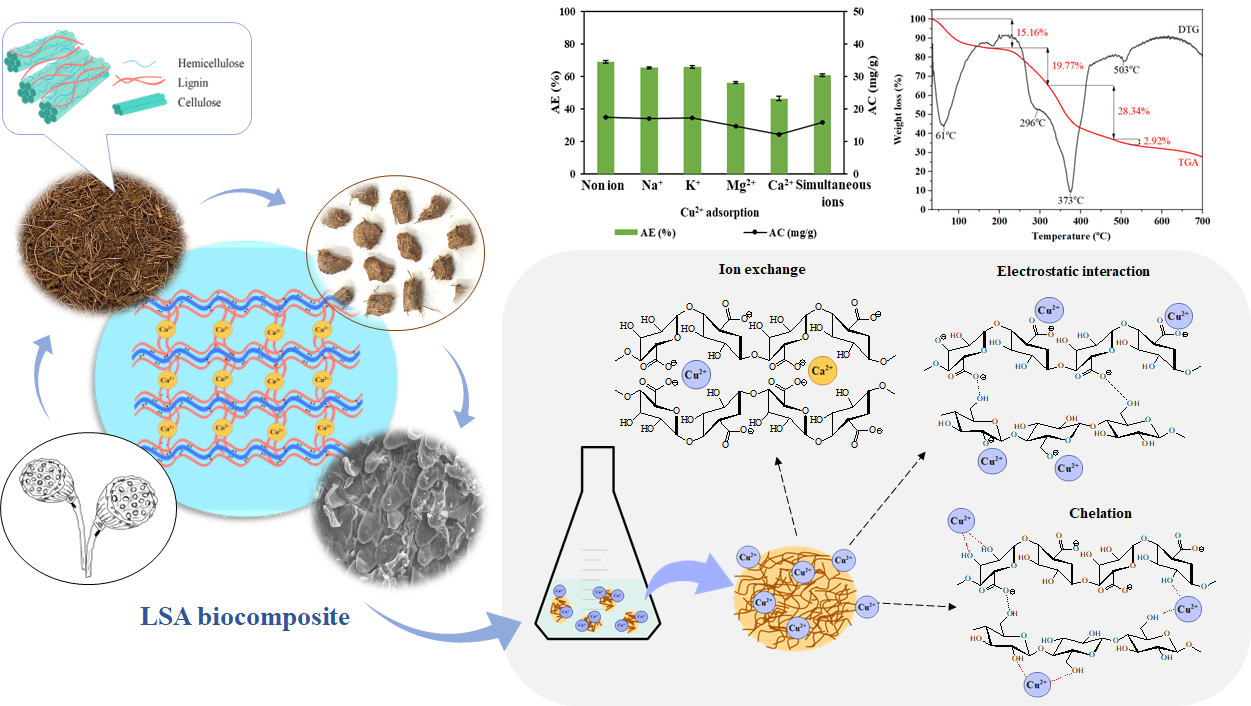
Turning waste or agricultural byproducts into valuable products has recently become a concern of scientists. In this study, the facile and cost-effective synthesis of a biocomposite derived from lotus seedpod (LS) and alginate (AG) was further applied for Cu2+ ion uptake from aqueous solutions. SEM images revealed the layered structures of the composites, which were thin and irregularly stacked sheets of a complex 3D network. The abundant functional groups on the surface of the LS-based material and its negative zeta potential value of -37.50 mV also facilitated efficient Cu2+ removal. Adsorption results revealed a Cu2+ adsorption efficiency (AE) and experimental capacity of 68.99% and 17.38 mg g-1, respectively, after 30 min. The coefficient values of the Sips isotherm (R2 = 0.952) and pseudo-second-order kinetic models (R2 = 0.995) suggest that the monolayer adsorption mechanism on a heterogeneous surface is governed primarily by physicochemical interactions. Although the AEs decreased from 68.99% to 44.81% after four cycles, LSA showed strong adsorption potential, highlighting LS as a sustainable and inexpensive material for the development of low-cost and high-efficiency biocomposites for wastewater treatment. This approach supported environmental treatment and agricultural waste valorization, while the chemical and mechanical stability of the composite further confirmed its practical applicability.
Article Details

This work is licensed under a Creative Commons Attribution-NonCommercial 4.0 International License.
Published articles are under the copyright of the Applied Environmental Research effective when the article is accepted for publication thus granting Applied Environmental Research all rights for the work so that both parties may be protected from the consequences of unauthorized use. Partially or totally publication of an article elsewhere is possible only after the consent from the editors.
