Environmental Sustainability Performance and Efficiency in Thailand’s Rajabhat Universities: A Cross-Regional Analysis of THE Impact Rankings A Cross-Regional Analysis of THE Impact Rankings
Article Sidebar
Main Article Content
Abstract
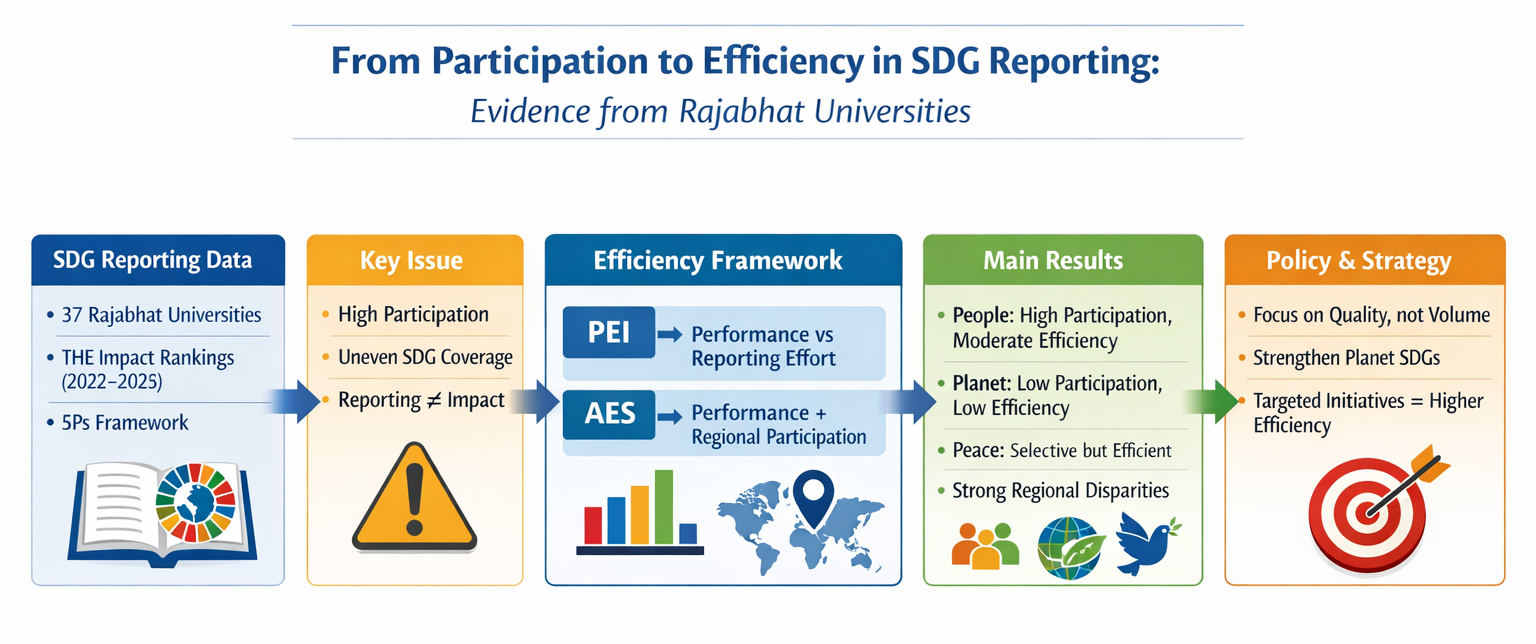
Higher education institutions (HEIs) are expected to increasingly communicate their contributions to the United Nations’ Sustainable Development Goals (SDGs), with the rise of alternative sustainability rankings serving as prominent reporting instruments for institutional transparency. In Thailand, Rajabhat Universities, a network of government HEIs historically associated with their mission of teacher training and local development, have been actively participating in the Times Higher Education (THE) Impact Rankings, presenting a unique case study to explore cross-regional sustainability efforts in relation to global benchmarks. To evaluate trends, regional disparities, and engagement performance across the sustainability pillars, this study uses a descriptive quantitative design to analyze the performance of 37 Rajabhat University between 2022 and 2025 and uses secondary data from the THE Impact Rankings. The performance was evaluated through the development of two efficiency metrics: the performance efficiency index (PEI) and the area efficiency score (AES). The findings indicate that while the People and Partnerships pillars show the highest level of engagement, efficiency varies across the pillars. Partnerships achieve the highest efficiency, while the People pillar demonstrates moderate efficiency despite extensive reporting, suggesting diminishing returns. In contrast, the planet pillar records both low participation and the lowest efficiency, whereas the peace pillar shows relatively high efficiency concentrated in a limited number of institutions. These results reveal uneven sustainability engagement across pillars, with stronger institutionalization in social domains and more selective performance in others. This study contributes to understanding how sustainability engagement is distributed across different sustainability domains within Thailand's Rajabhat university system by distinguishing between participation breadth and performance efficiency. It further demonstrates that differences in sustainability performance are associated not only with the extent of participation but also with how sustainability commitments are embedded within institutional practice.
Article Details

This work is licensed under a Creative Commons Attribution-NonCommercial 4.0 International License.
Published articles are under the copyright of the Applied Environmental Research effective when the article is accepted for publication thus granting Applied Environmental Research all rights for the work so that both parties may be protected from the consequences of unauthorized use. Partially or totally publication of an article elsewhere is possible only after the consent from the editors.
