Bioremediation Potential of Indigenous Stutzerimonas stutzeri 08TBb Isolated from Mercury-Contaminated Gold Mining Sites in Indonesia
Article Sidebar
Main Article Content
Abstract
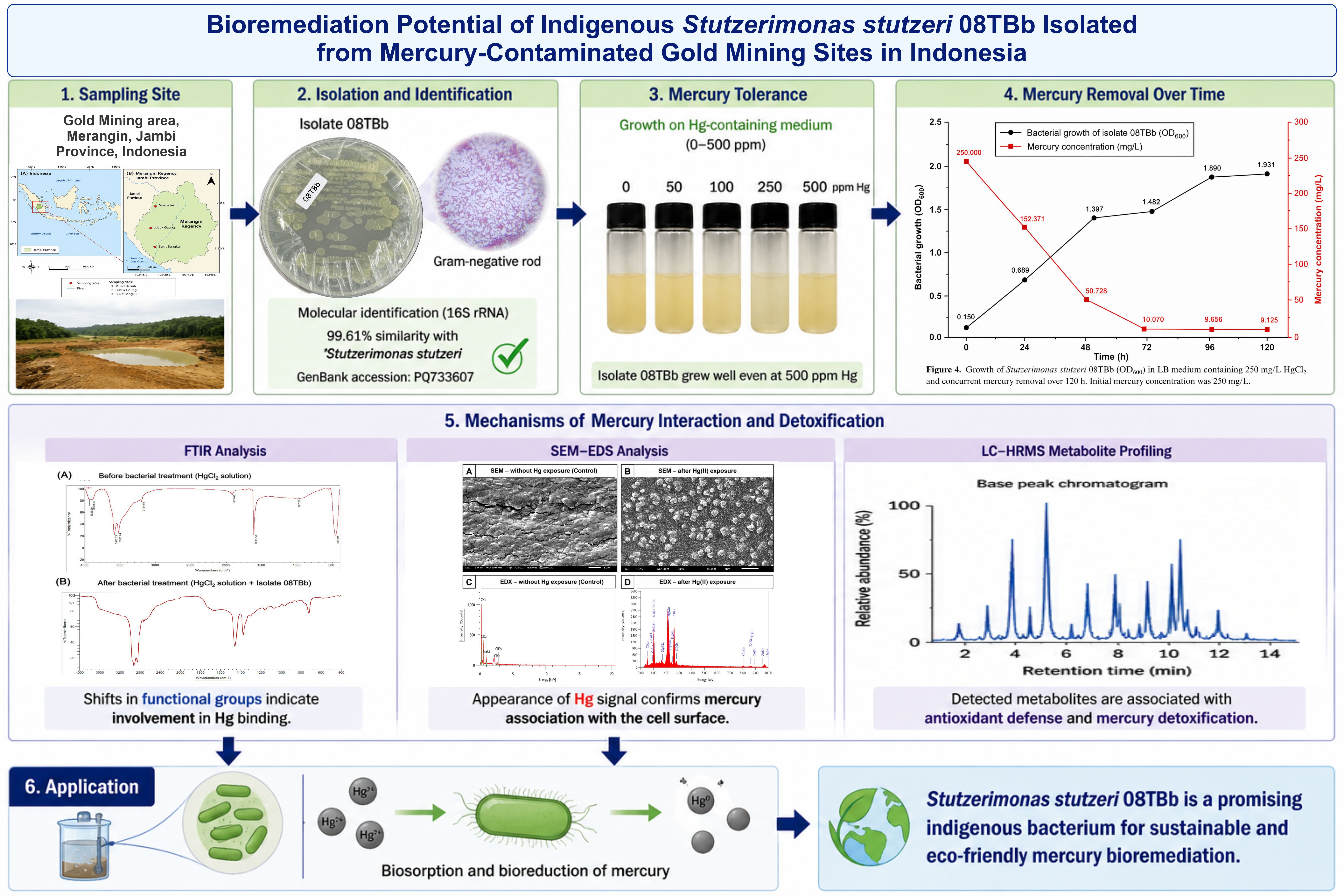
Artisanal and small-scale gold mining (ASGM) widely uses mercury (Hg) in the amalgamation process, and the resulting waste is often discharged directly into the environment, posing serious risks to ecosystems and human health because of the high toxicity of Hg. This study aimed to isolate and screen indigenous Hg-tolerant bacteria from contaminated gold mining sites in Indonesia; characterize the most effective isolate using morphological, biochemical, and molecular approaches; evaluate Hg(II) degradation performance using ICP‒OES, FTIR, and SEM analyses; and identify key metabolites involved in Hg detoxification through untargeted LC–HRMS metabolomics. A total of 51 bacterial isolates were obtained from Hg-contaminated gold mining waste, of which the five isolates showing the smallest inhibition zones at increasing Hg2+ concentrations were selected as Hg-resistant candidates. Among these, isolate 08TBb exhibited the most stable growth under high Hg concentrations and was selected for further characterization. Morphological, biochemical, and 16S rRNA gene-based molecular identification revealed that isolate 08TBb shared high similarity (≥99%) with Stutzerimonas stutzeri. ICP‒OES analysis demonstrated a significant reduction in Hg concentration during bacterial cultivation, indicating effective Hg removal. FTIR analysis revealed that bacterial treatment altered the chemical form of Hg in the medium, suggesting a transition from inorganic Hg–Cl bonds to Hg–biomolecule complexes followed by enzymatic reduction. SEM revealed distinct morphological changes in bacterial cells exposed to Hg, including surface roughening, aggregation, and granular deposits associated with Hg accumulation. Untargeted LC–HRMS metabolomic analysis revealed a distinct metabolic response dominated by sulfur-containing compounds, stress-related amino acids and peptides, osmoprotectants, nucleotides, and membrane-associated lipids, indicating coordinated mechanisms of metal binding, redox regulation, and cellular structural adaptation. Overall, the findings highlight the strong potential of Stutzerimonas stutzeri 08TBb as an effective indigenous bacterium for Hg bioremediation.
Article Details

This work is licensed under a Creative Commons Attribution-NonCommercial 4.0 International License.
Published articles are under the copyright of the Applied Environmental Research effective when the article is accepted for publication thus granting Applied Environmental Research all rights for the work so that both parties may be protected from the consequences of unauthorized use. Partially or totally publication of an article elsewhere is possible only after the consent from the editors.
