Exploring Consumers’ Intention and Behavior in the Circular Economy: Evidence from Vietnam
Article Sidebar
Main Article Content
Abstract
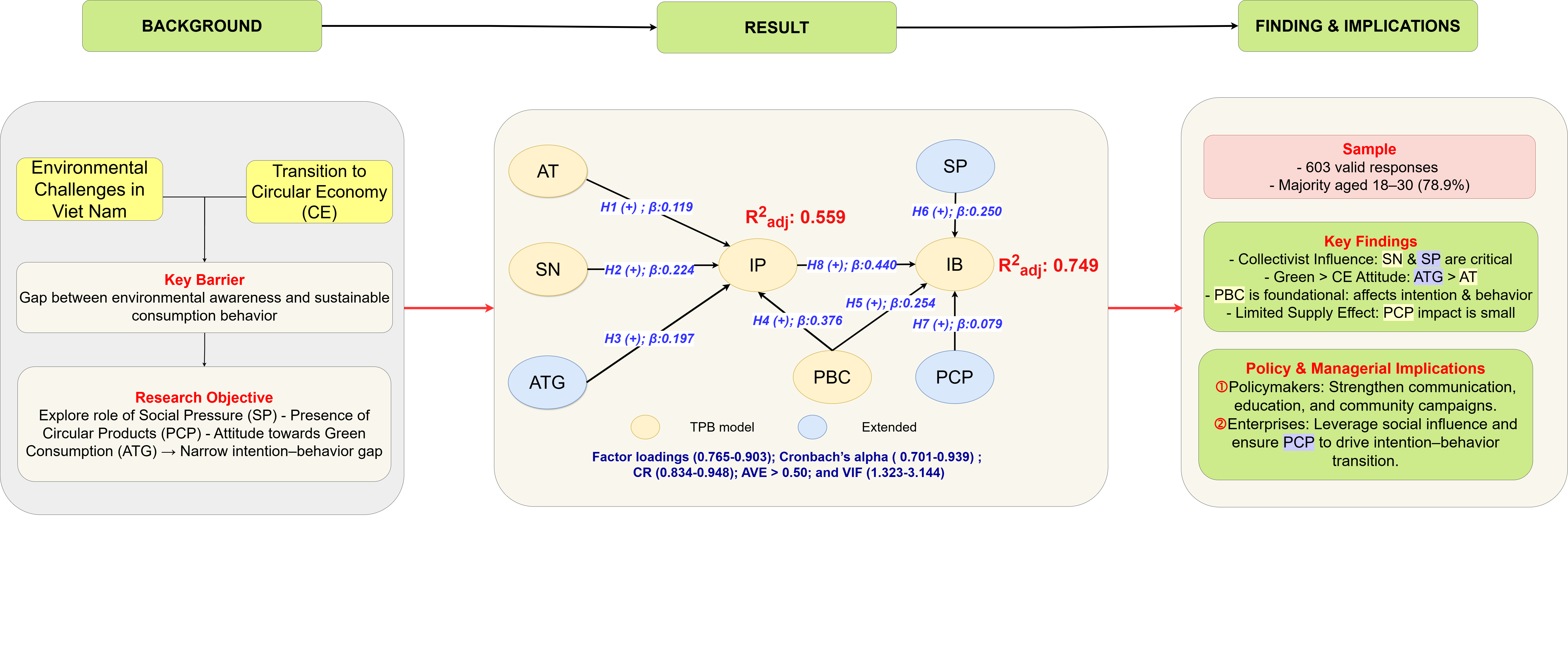
This study aims to address the key gaps in understanding the factors influencing the intention–behavior relationship of consumers in the context of the circular economy (CE). Grounded in the theory of planned behavior (TPB), this research extends the framework by integrating social pressure, attitudes toward green consumption, and the availability of CE products as crucial components that shape intention and behavior. Data were collected from 603 Vietnamese consumers and analyzed using partial least squares structural equation modeling (PLS-SEM). The results confirm the core TPB constructs, with perceived behavioral control emerging as the most influential factor. Notably, attitude toward green consumption has a greater effect on intention than does attitude toward the CE does, whereas social pressure has a stronger direct effect on behavior than subjective norms do. This research establishes the validity of an extended TPB framework within the CE context of a developing economy, providing new evidence on the psychological and sociocultural factors that shape circular consumption behavior. Finally, this study offers insights for policy makers and businesses to develop strategies for promoting CE not only for Vietnam but also for other developing countries.
Article Details

This work is licensed under a Creative Commons Attribution-NonCommercial 4.0 International License.
Published articles are under the copyright of the Applied Environmental Research effective when the article is accepted for publication thus granting Applied Environmental Research all rights for the work so that both parties may be protected from the consequences of unauthorized use. Partially or totally publication of an article elsewhere is possible only after the consent from the editors.
