Evaluating Sediment Control Strategies Using SWAT Based BMP Assessment in a Tropical Highland Watershed, Northern Thailand
Article Sidebar
Main Article Content
Abstract
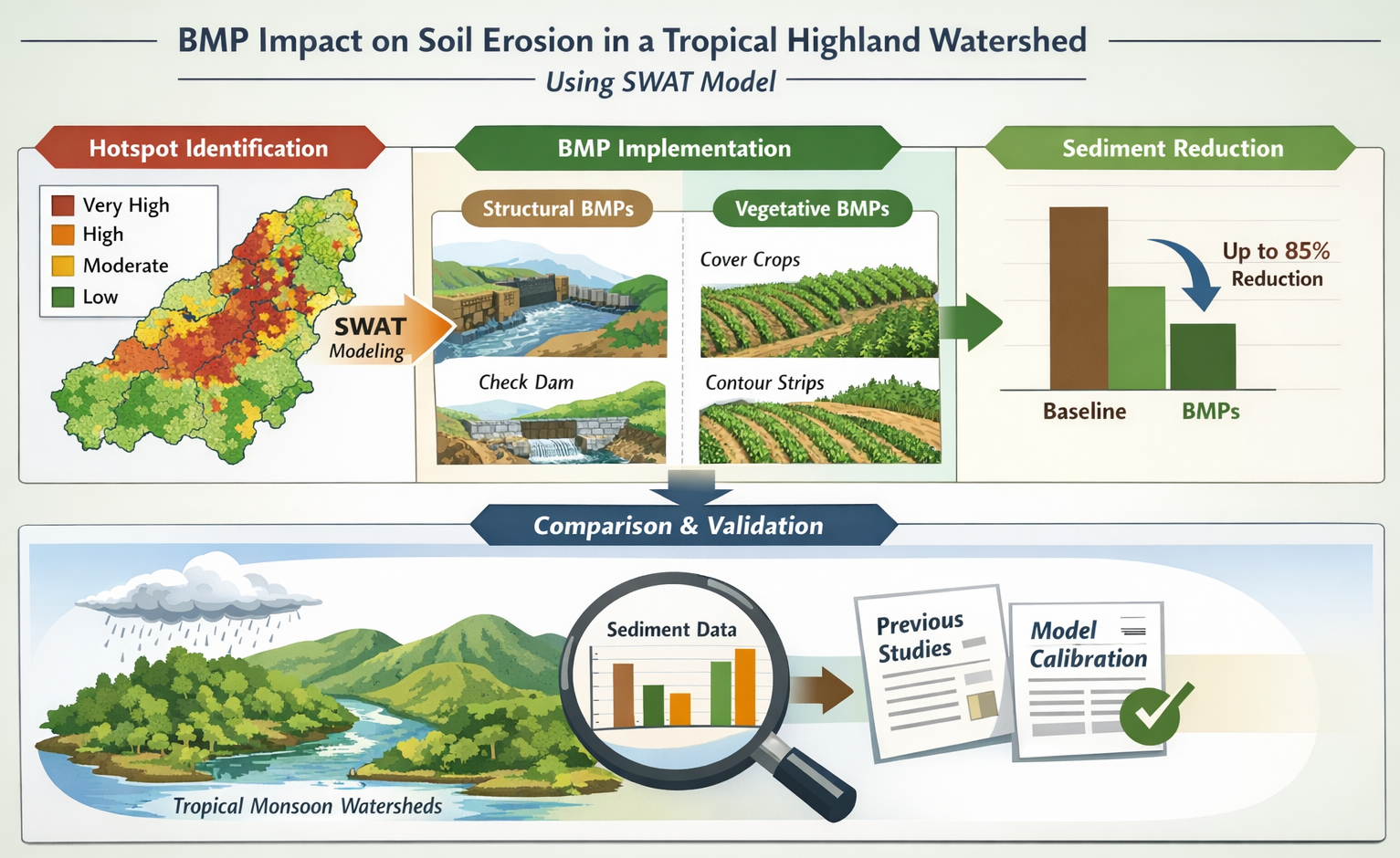
Soil erosion remains a critical environmental challenge in the tropical highland watersheds of Southeast Asia, where steep terrain, intense monsoonal rainfall, and intensive land use interact to accelerate sediment generation and downstream degradation. This study aims to quantify spatial patterns of sediment yield and to systematically evaluate the effectiveness of individual and combined best management practices (BMPs) at both the watershed and subwatershed (SWW) scales using the Soil and Water Assessment Tool (SWAT) in a tropical highland watershed in northern Thailand. Baseline simulations reveal pronounced spatial heterogeneity in erosion severity, with substantial portions of the watershed exhibiting moderate to extreme sediment yield levels. Scenario-based simulations indicate sediment reduction efficiencies ranging from 42% to 85% across watershed and SW scales, demonstrating clear performance differences among BMP categories. Structural BMPs, particularly stone/soil bunds (SSB) and terracing (TRC), achieve the greatest immediate sediment reduction by shortening the effective slope length and disrupting runoff–sediment connectivity in erosion-prone areas. Vegetative and management-based BMPs, including reforestation (RFT), filter strips (FTS), and contour farming (CTF), produce more gradual yet persistent sediment reductions, thereby enhancing long-term hydrological regulation and watershed resilience. Integrated BMP implementation further improves sediment control by coupling rapid structural interception with sustained vegetative and management effects. Spatial prioritization at the SW scale demonstrates that compared with uniform implementation, targeted BMP deployment substantially enhances sediment reduction efficiency. Overall, the integration of SWAT-based modeling, multiscale evaluation, and spatial prioritization offers a transferable and decision-relevant framework for assessing BMP effectiveness and supporting climate-resilient erosion management in tropical highland watersheds.
Article Details

This work is licensed under a Creative Commons Attribution-NonCommercial 4.0 International License.
Published articles are under the copyright of the Applied Environmental Research effective when the article is accepted for publication thus granting Applied Environmental Research all rights for the work so that both parties may be protected from the consequences of unauthorized use. Partially or totally publication of an article elsewhere is possible only after the consent from the editors.
