Seasonal Wastewater Monitoring and Quantitative Microbial Risk Assessment of Escherichia coli in a University Wastewater System, Pathum Thani, Central Thailand
Article Sidebar
Main Article Content
Abstract
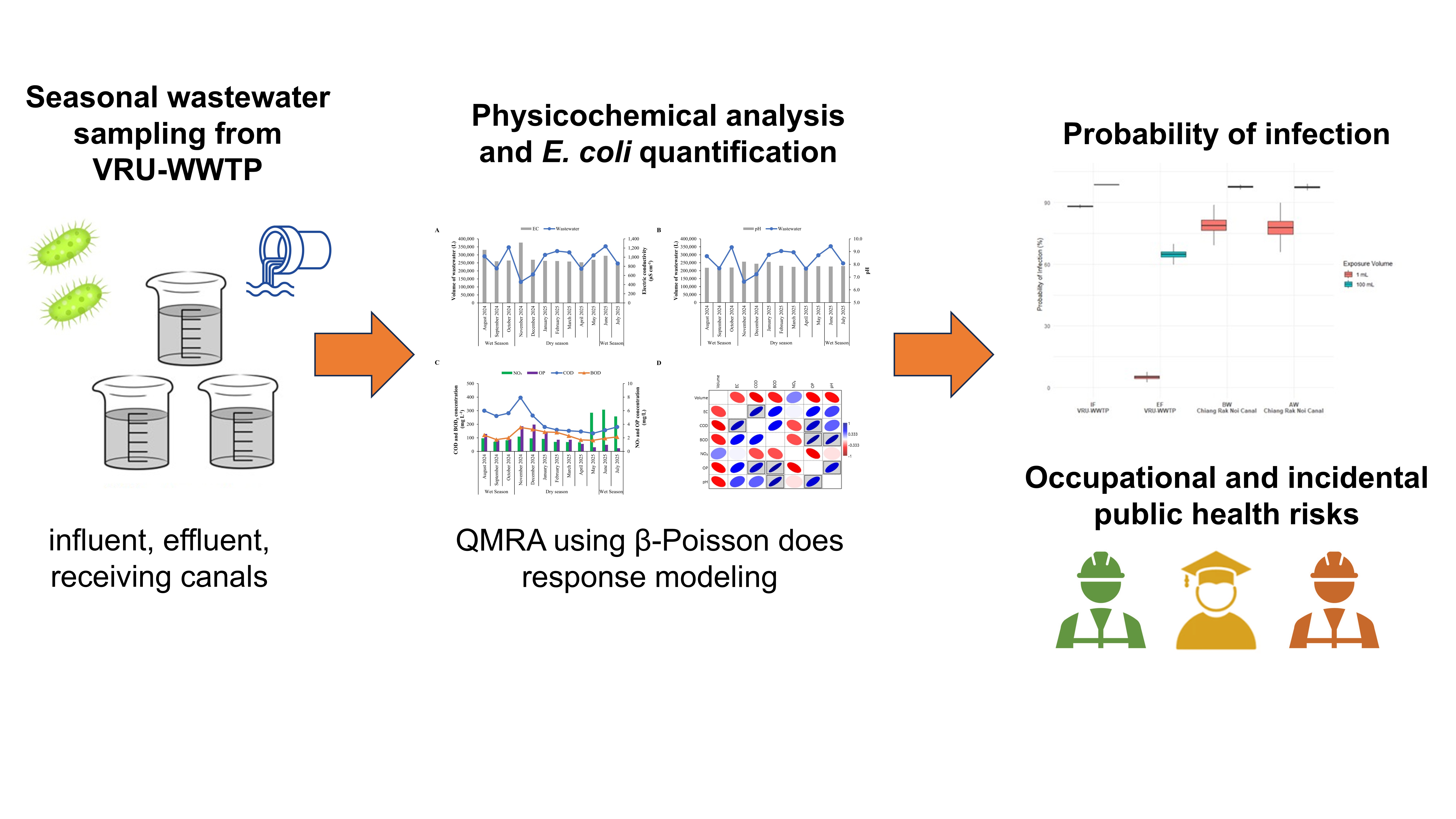
In this study, the physicochemical properties of wastewater were characterized, and a quantitative microbial risk assessment (QMRA) of E. coli was conducted in the wastewater treatment system of the Faculty of Science and Technology, Valaya Alongkorn Rajabhat University, under the Royal Patronage, Pathum Thani, Thailand (VRU-SciTech). This study was conducted because the current water-quality assessment does not include the QMRA or evaluate the occupa-tional and incidental public risk of infection. Over a one-year monitoring period, this study quantified wastewater generation (~6.09 L person-1 day-1; ~3.21 × 10³ m3 year-1) and analyzed its physicochemical parameters and E. coli concentrations. High concentrations of nitrate, orthophosphate, BOD5, and COD were observed during the summer. Using a β-Poisson dose–response model, the probability of infection from a single unintentional ingestion was quantified from the influent and effluents of VRU-WWTP and Chiang Rak Noi Canal. The QMRA exposure scenarios represent occupational exposure (e.g., wastewater operators and maintenance staff) and incidental environmental contact (e.g., students, staff, and canal users). The infection risk of the 1 mL sample ranged from 4.92 to 88.08%, and that of the 100 mL sample ranged from 64.68 to 98.65%. These results indicate significant health risks associated with repeated contact with E. coli-contaminated water. The estimated annual infection probabilities exceeded the commonly referenced tolerable risk levels proposed by the World Health Organization (WHO). There is an urgent need for improved wastewater manage-ment and microbial risk-based monitoring to reduce human health risks.
Article Details

This work is licensed under a Creative Commons Attribution-NonCommercial 4.0 International License.
Published articles are under the copyright of the Applied Environmental Research effective when the article is accepted for publication thus granting Applied Environmental Research all rights for the work so that both parties may be protected from the consequences of unauthorized use. Partially or totally publication of an article elsewhere is possible only after the consent from the editors.
