Heavy Metals and Organic Carbon in Sediments of Seagrass Sediments of Trang Province, Thailand
Article Sidebar
Main Article Content
Abstract
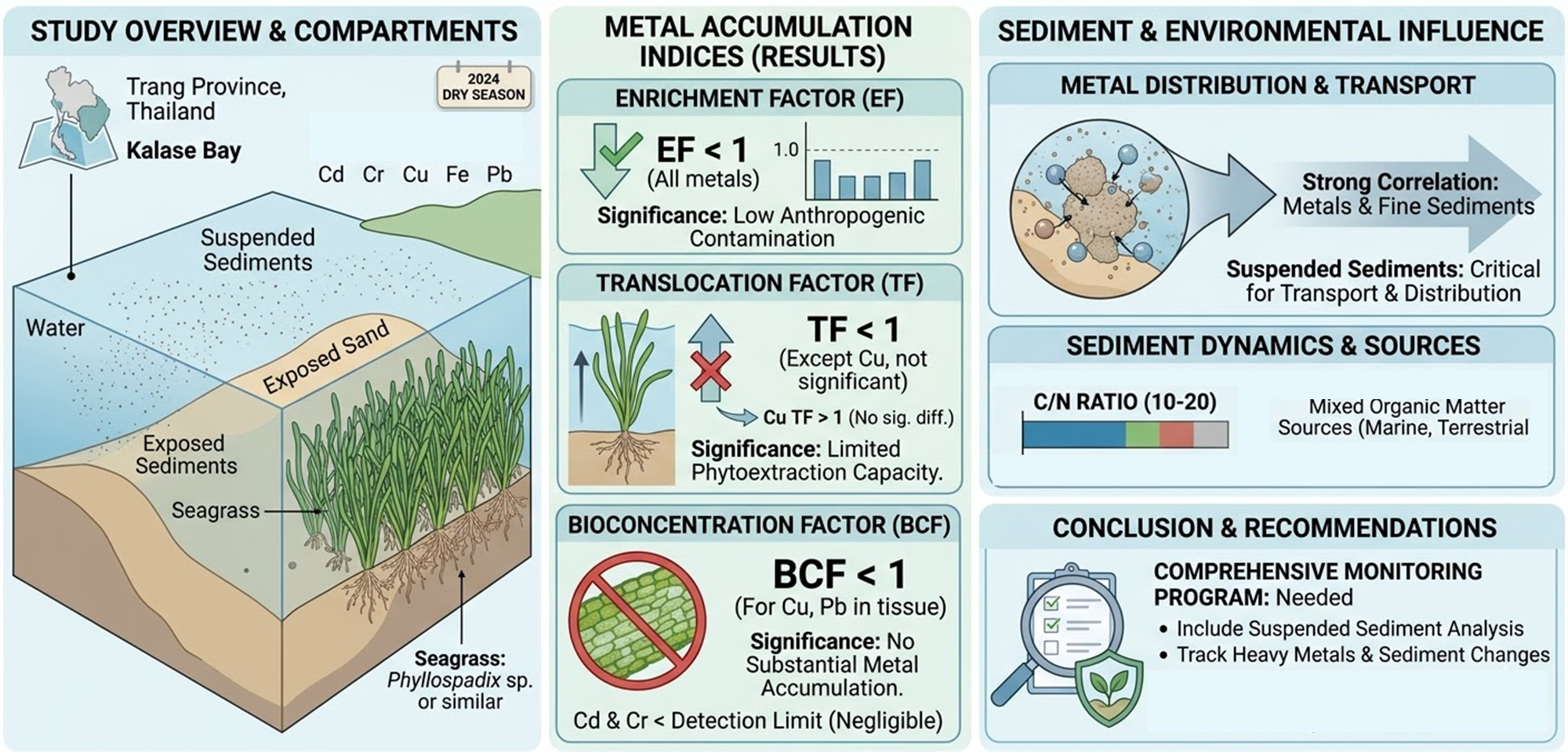
In this study, the accumulation of heavy metals (Cd, Cr, Cu, Fe, and Pb) in water, suspended sediments, sediments, and seagrass in Kalase Bay, Trang Province, Thailand, during the 2024 dry season was investigated. These findings indicate that the enrichment factor (EF) for all the metals was less than 1, suggesting that anthropogenic contamination is not a significant concern in the area. The translocation factor (TF) values were less than 1 for all the metals except Cu, whose TF was greater than 1; however, these values were not statistically significant, indicating limited phytoextraction capacity. The bioconcentration factor (BCF) values for Cu and Pb in seagrass were also less than 1, indicating no substantial accumulation of these metals in seagrass tissues. Additionally, the Cd and Cr concentrations were below the detection limits, further indicating their negligible presence. This study revealed a strong correlation between the concentrations of heavy metals and fine sediment fractions, with suspended sediments playing a critical role in the transport and distribution of these metals. The presence of sand bars and seagrass beds in the region likely influences sediment dynamics, contributing to the retention and bioavailability of metals. The sediment carbon-to-nitrogen (C/N) ratio ranged between 10 and 20, indicating that mixed organic matter sources are commonly associated with coastal sediments. This suggests that sediment organic matter originates from multiple inputs rather than from a single dominant source. These results underscore the importance of implementing a comprehensive monitoring program, including suspended sediment analysis, to track heavy metal accumulation and sediment changes, which is crucial for informed conservation and management of the unique ecosystem of Kalase Bay and its carbon storage potential.
Article Details

This work is licensed under a Creative Commons Attribution-NonCommercial 4.0 International License.
Published articles are under the copyright of the Applied Environmental Research effective when the article is accepted for publication thus granting Applied Environmental Research all rights for the work so that both parties may be protected from the consequences of unauthorized use. Partially or totally publication of an article elsewhere is possible only after the consent from the editors.
