Assessment of The Influence of Human Activities on The Occurrence of Forest Fires in Thailand via Multiple Linear Regression (MLR)
Article Sidebar
Main Article Content
Abstract
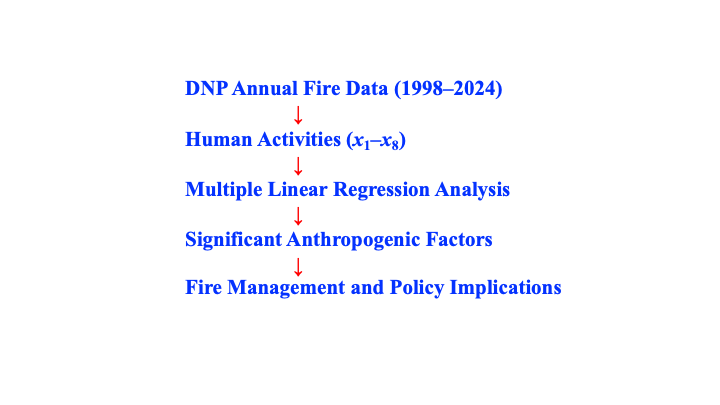
Forest fires represent one of the most critical environmental challenges in Thailand, with impacts varying depending on forest type, fuel characteristics, terrain conditions, fire intensity, and the frequency of fire occurrence on the same landscape. While forest fires can contribute to ecosystem degradation, biodiversity loss, and the depletion of natural resources, such effects are not uniformly severe across all forest ecosystems. Understanding the human-induced factors contributing to forest fire occurrence is crucial for developing effective prevention strategies and promoting sustainable forest management. This study aimed to identify the anthropogenic factors influencing forest fire areas in Thailand via multiple linear regression (MLR) analysis. Eight independent variables related to human activities, including agricultural burning, forest product gathering, hunting, livestock raising, tourism, local conflicts, illegal logging, and accidents or negligence, were analyzed via annual data from 1998--2024 obtained from governmental and environmental agencies. The analysis revealed that forest product gathering, livestock raising, tourism, local conflicts, and negligence were significantly and positively correlated with burned areas. Although agricultural burning, hunting, and illegal logging were not statistically significant in the final regression model, these activities have been reported to contribute to extensive burned areas in Thailand. The lack of statistical significance in this study may reflect limitations related to data aggregation, temporal resolution, or indirect pathways through which these activities influence fire occurrence. The final regression model demonstrated high predictive accuracy, explaining approximately 97.83% of the interannual variation in Thailand’s burned area. The findings indicate that human-related activities play a significant role in forest fire occurrence within the scope of the anthropogenic factors analyzed in this study, and the developed statistical model provides an effective tool for predicting fire-prone areas and supporting policy development for sustainable forest management and environmental protection.
Article Details

This work is licensed under a Creative Commons Attribution-NonCommercial 4.0 International License.
Published articles are under the copyright of the Applied Environmental Research effective when the article is accepted for publication thus granting Applied Environmental Research all rights for the work so that both parties may be protected from the consequences of unauthorized use. Partially or totally publication of an article elsewhere is possible only after the consent from the editors.
