Blue carbon stock assessment and climate resilience potential of mangrove forest in Hung Thang commune, Vietnam
Article Sidebar
Main Article Content
Abstract
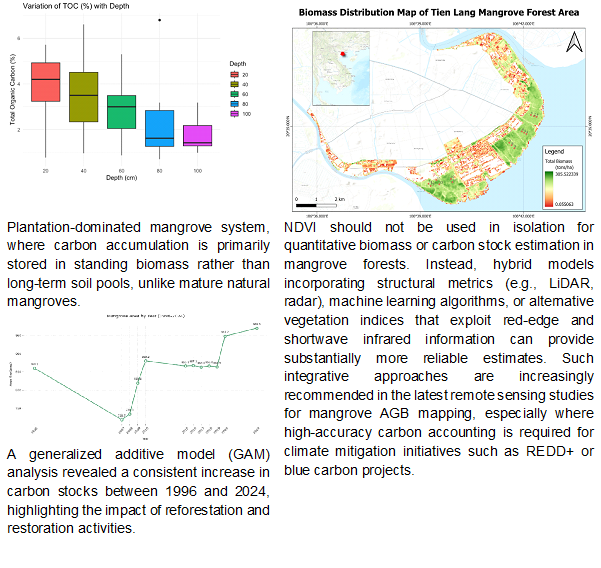
Mangrove forests are vital blue carbon sinks that contribute to climate change mitigation and coastal resilience. This study assessed the carbon stock and spatial‒temporal dynamics of a mangrove forest in Hung Thang commune, Hai Phong Province, Vietnam, via a combination of field measurements, soil organic carbon (SOC) analysis, and normalized difference vegetation index (NDVI)-based remote sensing models. The results revealed that mangroves in the Hung Thang community store an average of 87.42 tC ha-1, with SOC accounting for approximately 19% of the total carbon. A generalized additive model (GAM) analysis revealed a consistent increase in carbon stocks between 1996 and 2024, highlighting the impact of reforestation and restoration activities. This study provides critical data to strengthen measurement, reporting, and verification (MRV) systems for climate policy frameworks, including those related to REDD+ initiatives. The integration of field-based observations with remote sensing technologies highlights an approach for monitoring ecosystem-based climate mitigation. The findings emphasize the ability to integrate machine learning and AI-based tools into predictive carbon mapping and to optimize restoration planning, the role of mangroves in climate-resilient development pathways, and support evidence-based policy-making for sustainable coastal management.
Article Details

This work is licensed under a Creative Commons Attribution-NonCommercial 4.0 International License.
Published articles are under the copyright of the Applied Environmental Research effective when the article is accepted for publication thus granting Applied Environmental Research all rights for the work so that both parties may be protected from the consequences of unauthorized use. Partially or totally publication of an article elsewhere is possible only after the consent from the editors.
