Impacts of Temperature on Ammonium Migration: Simulation from An Unsanitary Landfill in Vietnam
Article Sidebar
Main Article Content
Abstract
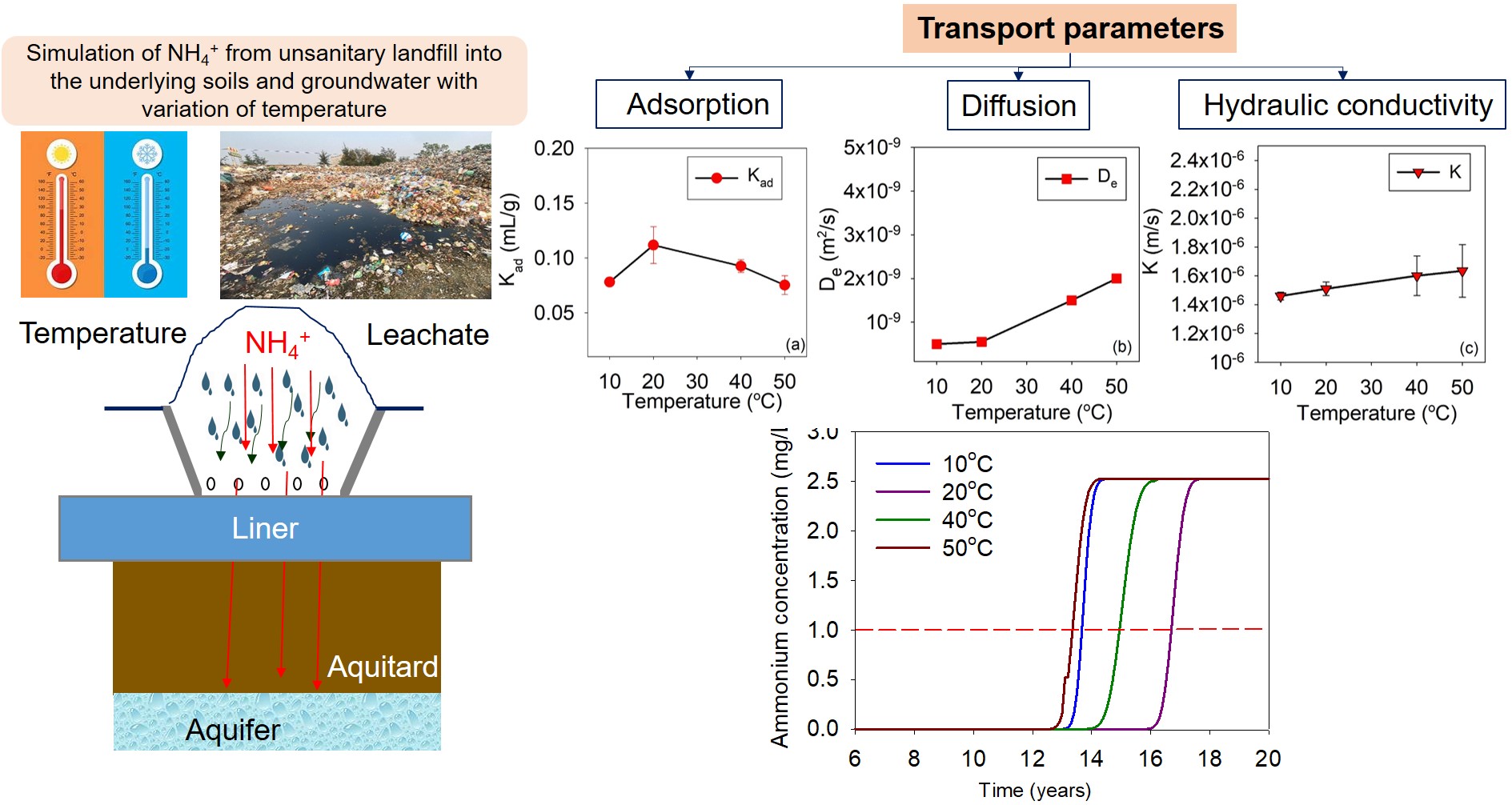
Understanding the effects of temperature variations on pollutant dynamics is crucial for enhancing the accuracy of simulations of contaminant transport under climate change scenarios and groundwater protection. This study examines how temperature influences the migration of ammonium (NH4+) through silty sandy soils at an unsanitary landfill. Laboratory tests were used to measure the adsorption, diffusion, and permeability coefficients of these soils at four temperatures: 10 °C, 20 °C, 40 °C, and 50 °C. The results indicated that the apparent distribution coefficient (Kad) peaked at 20 °C but decreased at lower (10 °C) and higher (40–50 °C) temperatures. Diffusion analysis revealed that the diffusion coefficient increased from 5.0 × 10⁻10 m2 s-1 at 10 °C to 2.0 × 10⁻9 m2 s-1 at 50 °C, indicating that the ammonium diffusivity increases rapidly with temperature. Moreover, the hydraulic conductivity of the sand increased with both temperature and ammonium concentration, with the permeability increasing slightly from 1.46 × 10⁻6 m s-1 at 10 °C to 1.63 × 10⁻6 m s-1 at 50 °C. The simulations confirmed that the relationship between temperature and break-through behavior is nonmonotonic, reflecting coupled physicochemical transport and the competing influences of advection, diffusion, and adsorption processes. These findings highlight the urgent need for technical and management solutions to minimize environmental risks.
Article Details

This work is licensed under a Creative Commons Attribution-NonCommercial 4.0 International License.
Published articles are under the copyright of the Applied Environmental Research effective when the article is accepted for publication thus granting Applied Environmental Research all rights for the work so that both parties may be protected from the consequences of unauthorized use. Partially or totally publication of an article elsewhere is possible only after the consent from the editors.
