Fabrication of Acid-modified Corn Plant By-product-based Biochar for Efficient Adsorption of Sulfamethoxazole from Aqueous Solutions
Article Sidebar
Main Article Content
Abstract
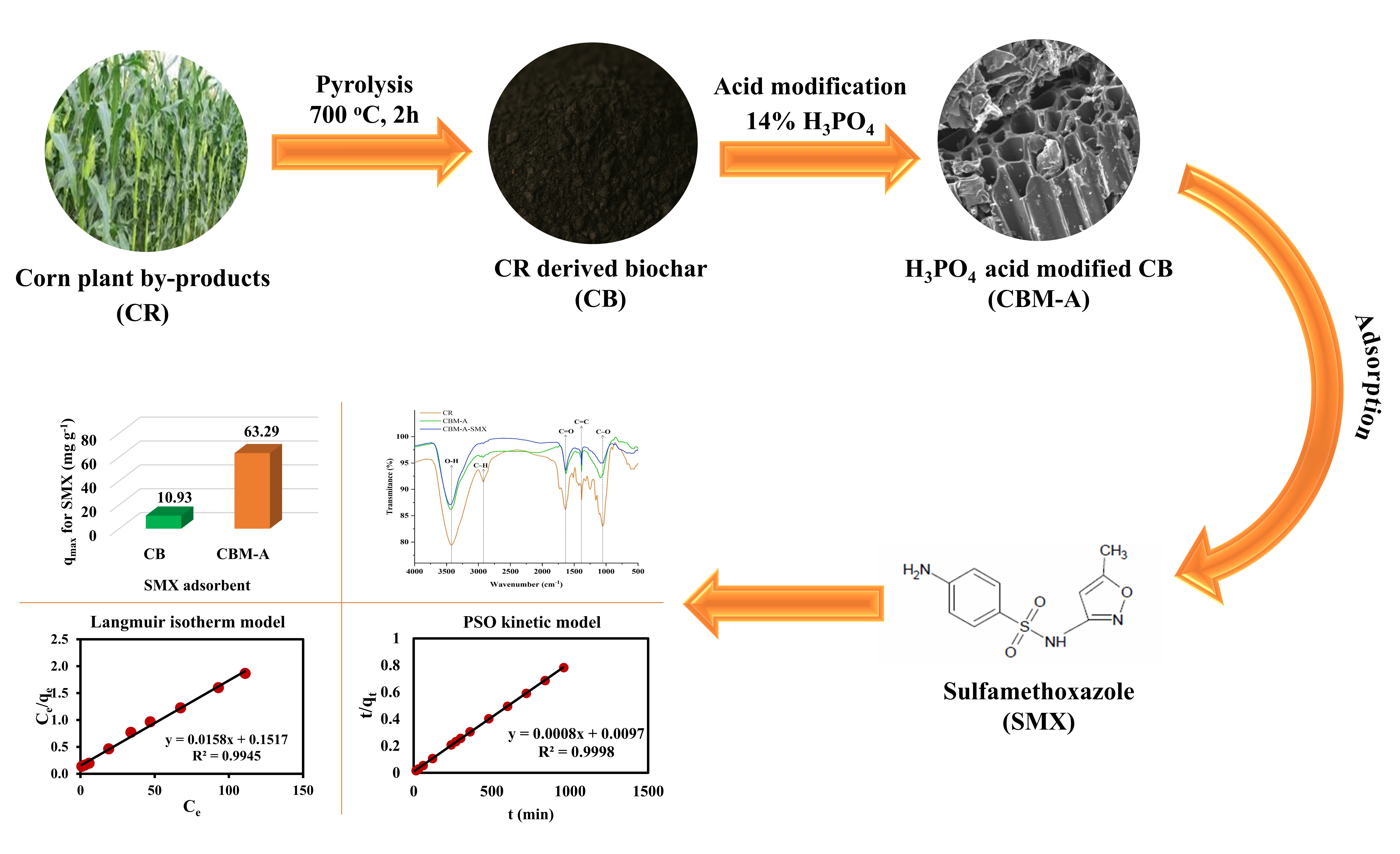
Antibiotic pollution is of great interest owing to growing concerns about antibiotic resistance worldwide. This study aims to fabricate acid-modified biochar (CBM-A) from corn plant byproducts (CRs) for sulfamethoxazole (SMX) adsorption in aqueous solutions. CBM-A was synthesized via pyrolysis at 700 °C and modified with 14% H3PO4. Kinetics, isotherms, and thermodynamics were investigated in combination with material characterization to elucidate the adsorption behaviors and mechanisms. The results showed that pyrolysis and acid modification effectively enhanced SMX adsorption by CR because of the increased number of binding groups, specific surface area, and porosity. SMX adsorption on CBM-A was optimized at a natural pH of 6.3, initial SMX concentration of 30 mg L-1, CBM-A dose of 1.5 g L-1, contact time of 2 h, and temperature of 298 K. Under the optimal conditions and initial SMX concen-tration range of 10–200 mg L-1, the maximum SMX adsorption capacity (qmax) of CBM-A was 63.29 mg g-1. The Langmuir isotherm (R2 = 0.9945) and Pseudo-second-order kinetic (R2 = 0.9928) models were appropriate for describing SMX adsorption on CBM-A. The adsorption process was favorable and endothermic. Owing to its facile preparation, high qmax value, and short equilibrium time, CBM-A is considered a promising biosorbent for eliminating SMX from aqueous solutions.
Article Details

This work is licensed under a Creative Commons Attribution-NonCommercial 4.0 International License.
Published articles are under the copyright of the Applied Environmental Research effective when the article is accepted for publication thus granting Applied Environmental Research all rights for the work so that both parties may be protected from the consequences of unauthorized use. Partially or totally publication of an article elsewhere is possible only after the consent from the editors.
References
REFERENCES
Chen, T., Luo, L., Deng, S., Shi, G., Zhang, S., Zhang, Y., Deng, O., Wang, L., Zhang, J., Wei, L. Sorption of tetracycline on H3PO4-modified biochar derived from rice straw and swine manure. Bioresource technology, 2018, 267, 431-437.
Tran, V.S., Ngo, H.H., Guo, W., Nguyen, T.H., Luong, T.M.L., Nguyen, X.H., Phan, T.L.A., Le, V.T., Nguyen, M.P., Nguyen, M.K. New chitosan-biochar composite derived from agricultural waste for removing sulfamethoxazole antibiotics in water. Bioresource Technology, 2023, 385, 129384.
Hou, J., Yu, J., Li, W., He, X., Li, X. The effects of chemical oxidation and high-temperature reduction on surface functional groups and the adsorption performance of biochar for sulfamethoxazole adsorption. Agronomy, 2022, 12(2), 510.
Ahmed, M.B., Zhou, J.L., Ngo, H.H., Guo, W., Johir, M.A.H., Belhaj, D. Competitive sorption affinity of sulfonamides and chloramphenicol antibiotics toward functionalized biochar for water and wastewater treatment. Bioresource technology, 2017, 238, 306-312.
Zhang, Y., Liu, Y., Li, Y., Cheng, H., Zhu, C., Shen, Y., Shao, S., Xue, J., Zhou, D., Cao, F. Cost-effective micro/mesoporous biochar derived from soda residue-assisted hydrocarbonization and activation of crop waste for sulfamethoxazole removal from water environments. Bioresource Technology, 2025, 133166.
Reguyal, F., Sarmah, A.K., Gao, W. Synthesis of magnetic biochar from pine sawdust via oxidative hydrolysis of FeCl2 for the removal of sulfamethoxazole from aqueous solution. Journal of Hazardous Materials, 2017, 321, 868-878.
Heo, J., Yoon, Y., Lee, G., Kim, Y., Han, J., Park, C.M. Enhanced adsorption of bisphenol A and sulfamethoxazole by a novel magnetic CuZnFe2O4–biochar composite. Bioresource technology, 2019, 281, 179-187.
Zhang, X., Gang, D.D., Zhang, J., Lei, X., Lian, Q., Holmes, W.E., Zappi, M.E., Yao, H. Insight into the activation mechanisms of biochar by boric acid and its application for the removal of sulfamethoxazole. Journal of Hazardous Materials, 2022, 424, 127333.
Choi, Y.K., Kan, E. Effects of pyrolysis temperature on the physicochemical properties of alfalfa-derived biochar for the adsorption of bisphenol A and sulfamethoxazole in water. Chemosphere, 2019, 218, 741-748.
Jang, H.M., Yoo, S., Choi, Y.K., Park, S., Kan, E. Adsorption isotherm, kinetic modeling and mechanism of tetracycline on Pinus taeda-derived activated biochar. Bioresource Technology, 2018, 259, 24-31.
Zhou, L., Deng, H., Zhang, W., Gao, Y. (2015). Photodegradation of sulfamethoxazole and photolysis active species in water under Uv-Vis light irradiation. Fresenius environmental bulletin, 2015, 24(5), 1685-1691.
Jia, Z., Zeng, W., Xu, H., Li, S., Peng, Y. Adsorption removal and reuse of phosphate from wastewater using a novel adsorbent of lanthanum-modified platanus biochar. Process Safety and Environmental Protection, 2020, 140, 221-232.
Nguyen, T.A.H., Nguyen, Q.H., Bui, T.H., Do, D.Q. Acid-Activated Shrimp Shell-Derived Hydrochar for Adsorptive Removal of Anionic Direct Blue 71 Dye from Aqueous Solutions. Journal of Water and Environment Technology, 2025, 23(1), 1-15.
Liu, S., Wang, N., Li, Y., Liang, D., He, W., Lin, N., Li, J., Feng, Y. Magnetic biochar-mediated iron reduction synergizes with microbial co-metabolism for enhanced adsorption and in-situ degradation of sulfamethoxazole. Chemical Engineering Journal, 2025, 168620.
Taheri, M.A.R., Astaraei, A.R., Lakzian, A., Emami, H. The role of biochar and sulfur-modified biochar on soil water content, biochemical properties and millet crop under saline-sodic and calcareous soil. Plant and Soil, 2024, 499(1), 221-236.
Peng, H., Gao, P., Chu, G., Pan, B., Peng, J., Xing, B. Enhanced adsorption of Cu (II) and Cd (II) by phosphoric acid-modified biochars. Environmental Pollution, 2017, 229, 846-853.
Borowska, E., Felis, E., Miksch, K. Degradation of sulfamethoxazole using UV and UV/H2O2 processes. Journal of Advanced Oxidation Technologies, 2015, 18(1), 69-77.
Zhou, Y., Liu, X., Xiang, Y., Wang, P., Zhang, J., Zhang, F., Wei, J., Luo, L., Lei, M., Tang, L. Modification of biochar derived from sawdust and its application in removal of tetracycline and copper from aqueous solution: adsorption mechanism and modelling. Bioresource technology, 2017, 245, 266-273.
Ahsan, M.A., Islam, M.T., Imam, M.A., Hyder, A.G., Jabbari, V., Dominguez, N., Noveron, J.C. Biosorption of bisphenol A and sulfamethoxazole from water using sulfonated coffee waste: Isotherm, kinetic and thermodynamic studies. Journal of Environmental Chemical Engineering, 2018, 6(5), 6602-6611.
Pandiarajan, A., Kamaraj, R., Vasudevan, S., Vasudevan, S. OPAC (orange peel activated carbon) derived from waste orange peel for the adsorption of chlorophenoxyacetic acid herbicides from water: adsorption isotherm, kinetic modelling and thermodynamic studies. Bioresource technology, 2018, 261, 329-341.
Sun, B., Lian, F., Bao, Q., Liu, Z., Song, Z., Zhu, L. Impact of low molecular weight organic acids (LMWOAs) on biochar micropores and sorption properties for sulfamethoxazole. Environmental Pollution, 2016, 214, 142-148.
Zheng, H., Wang, Z., Zhao, J., Herbert, S., Xing, B. Sorption of antibiotic sulfamethoxazole varies with biochars produced at different temperatures. Environmental Pollution, 2013, 181, 60-67.
