Fabrication of Urea with Amorphous Silica to Increase Rice Growth in Saline Soils
Article Sidebar
Main Article Content
Abstract
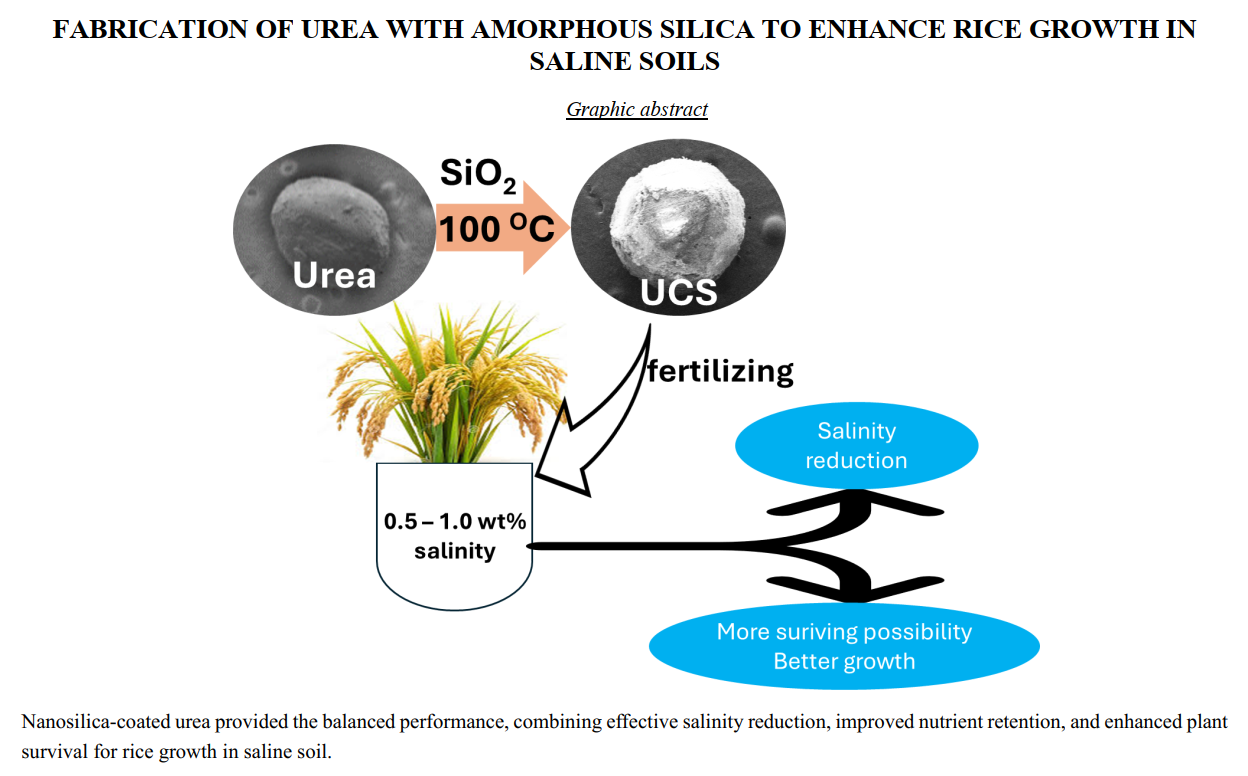
In recent decades, the decrease in rice cultivation areas in Vietnam, particularly in the Mekong River Delta, caused by climate change and soil salinization, has posed serious challenges for sustainable development. In addition to irrigation and agronomic practices, fertilizers that sustain rice growth under saline conditions play a crucial role in improving crop productivity. Amorphous silica has been reported to increase plant tolerance to drought, salinity, and heavy metal stress. In this study, nanosilica-coated urea (UCS) fertilizers were synthesized by coating urea granules with 1–5 wt% amorphous silica. The products were characterized by SEM, XRD, FTIR, TG‒DSC, and EDX to confirm their structural and chemical features. Laboratory-scale experiments on saline soils revealed that UCS reduced total dissolved salt (TDS) content by up to 40% after 30 days, increased soil organic nitrogen and silicon contents by more than 15%, and promoted stable rice growth. After 30 days, the height of the rice treated with UCS1 reached 42–44 cm, which was 124% greater on average than that with conventional urea (18–30 cm), and higher survival rates were maintained (up to 90% vs. 40%). The growth stages of rice under mild to moderate salinity conditions were evaluated throughout a 120-day cultivation period. These results highlight the strong potential of urea‒silica fertilizers for sustainable rice cultivation in saline soils (0.5%–1% NaCl).
Article Details

This work is licensed under a Creative Commons Attribution-NonCommercial 4.0 International License.
Published articles are under the copyright of the Applied Environmental Research effective when the article is accepted for publication thus granting Applied Environmental Research all rights for the work so that both parties may be protected from the consequences of unauthorized use. Partially or totally publication of an article elsewhere is possible only after the consent from the editors.
