Microwave-assisted Synthesis of Fe2O3/Mn2O3/rGO Nanocomposite for Effective Remediation of Parathion Pesticide under Visible Light Illumination
Article Sidebar
Main Article Content
Abstract
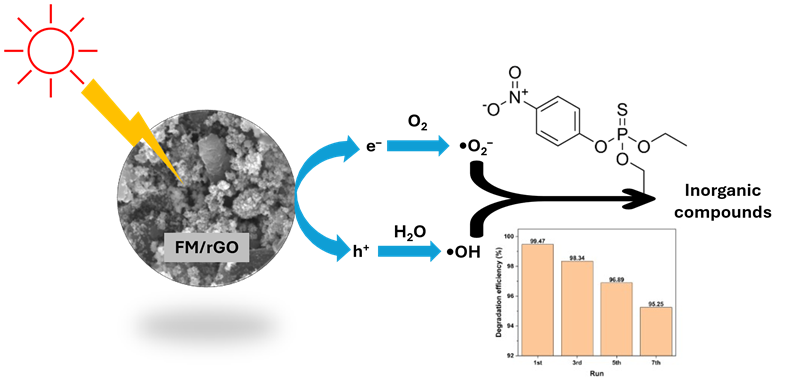
Organophosphorus compounds are effective pesticides and insecticides but are also persistent and highly hazardous. In this work, a Fe2O3/Mn2O3/reduced-graphene-oxide (FM/rGO) composite was utilized as a photocatalyst for the degradation of parathion, a typical organophosphorus pesticide. The cost-effective and environmentally friendly FM/rGO material was prepared by a coprecipitation method assisted by microwave irradiation and characterized by various techniques, including X-ray diffraction (XRD), scanning electron microscopy (SEM), transmission electron microscopy (TEM), and UV‒Vis spectroscopy. Compared with pristine Fe2O3 and Mn2O3, the immobilization of Fe2O3 and Mn2O3 on the rGO support significantly enhanced the photodegradation of parathion, primarily by reducing the recombination rate of the photogenerated electron‒hole pairs. The FM/rGO achieved approximately 100% degradation of parathion within 45 min and mineralized nearly 90% of the initial parathion after 150 min under visible light irradiation. In addition, FM/rGO exhibited outstanding durability and recyclability, with only a 5% reduction in degradation efficiency after seven consecutive cycles.
Article Details

This work is licensed under a Creative Commons Attribution-NonCommercial 4.0 International License.
Published articles are under the copyright of the Applied Environmental Research effective when the article is accepted for publication thus granting Applied Environmental Research all rights for the work so that both parties may be protected from the consequences of unauthorized use. Partially or totally publication of an article elsewhere is possible only after the consent from the editors.
