Assessment of Chromosomal Abnormalities in Hybrid Catfish in Reservoir Contaminated with Heavy Metals from Municipal Landfill
Article Sidebar
Main Article Content
Abstract
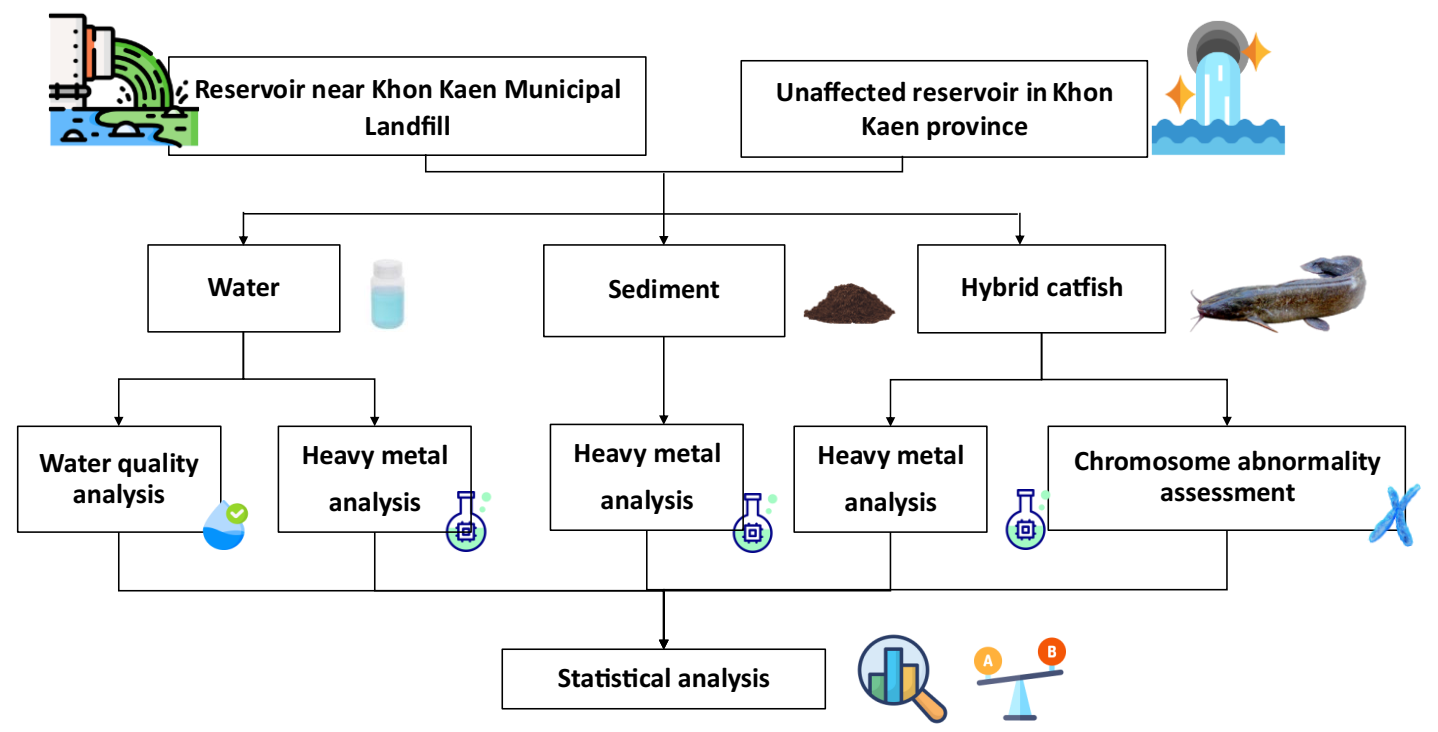
In this study, the concentrations of heavy metals (As, Cd, Cr and Pb) in water, sediment, and hybrid catfish (Clarias gariepinus x C. macrocephalus) as well as chromosomal abnormalities (CAs) from a reservoir affected by leachate from a municipal landfill were compared to those in an unaffected reservoir. Heavy metal concentrations were analyzed using inductively coupled plasma‒optical emission spectrometry (ICP‒OES). Chromosomes were prepared from kidney cells by direct methods. The As, Cd and Pb concentrations in the water and sediment from both reservoirs were within the Thailand water and soil standards. The concentrations of As and Cd in the water and the concentrations of As, Cd, Cr and Pb in the sediment and hybrid catfish significantly differed between the affected and unaffected reservoirs (p<0.05). The Pb concentration in hybrid catfish from the affected reservoir exceeded Thailand's food standard. Eight types of chromosomal abnormalities were detected in the hybrid catfish from the affected reservoir (centric fragmentation, centric gap, deletion, fragmentation, iso-chromatid break, iso-chromatid gap, single chromatid break, and single chromatid gap). The most common CA was deletion in the hybrid catfish from both reservoirs. The percentages of cells with CAs in hybrid catfish from the affected (22.00%) and unaffected reservoirs (8.60%) were significantly different (p< 0.05). These findings indicated that leachate from the municipal landfill has caused heavy metal contamination in the reservoir, leading to bioaccumulation and cytogenetic damage in hybrid catfish.
Article Details

This work is licensed under a Creative Commons Attribution-NonCommercial 4.0 International License.
Published articles are under the copyright of the Applied Environmental Research effective when the article is accepted for publication thus granting Applied Environmental Research all rights for the work so that both parties may be protected from the consequences of unauthorized use. Partially or totally publication of an article elsewhere is possible only after the consent from the editors.
