Evaluation of Soil Moisture Content, pH, and Dominant Microorganisms in Crude Oil–contaminated Soil Treated with Cow Dung, Indole-3-Acetic Acid (IAA), and Simulated Microgravity
Article Sidebar
Main Article Content
Abstract
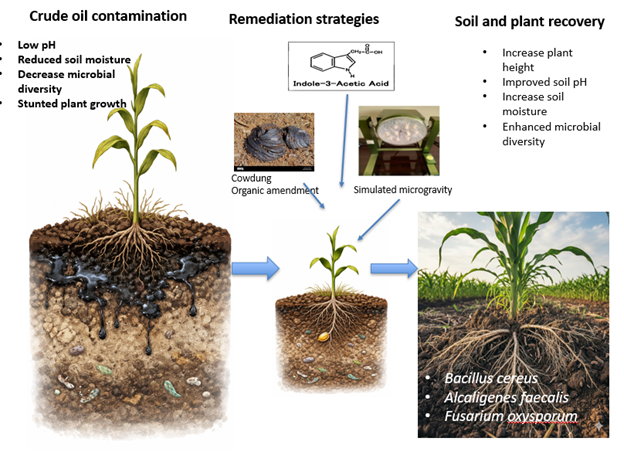
Crude oil negatively affects soil physicochemical properties and microbial activity, thereby hindering plant growth and posing notable environmental and agricultural issues. The combined effects of cow dung, indole-3-acetic acid (IAA), and simulated microgravity on the recovery of soil degraded by crude oil were explored using Zea mays as the test plant. Soil was contaminated with crude oil at different concentrations (0%, 1%, 3%, and 5% v/w), with each concentration comprising eight treatments: cow dung, Zea mays seeds exposed to microgravity, and IAA alone or in combination. Changes in plant height, soil pH, soil moisture content, and soil microbial diversity were assessed. Crude oil contamination decreased plant height and soil moisture, reduced pH, and suppressed microbial diversity. However, the various treatments significantly enhanced the soil parameters both individually and in combination. Notably, T7 (cow dung + IAA + simulated microgravity) had a plant height of 60.14±9.8 cm at 12 weeks, and the soil pH and moisture content at the 5% concentration during the 3rd month were 6.45±0.02 and 25.25±2.35%, respectively. Microbial analysis revealed the presence of the hydrocarbon-associated taxa Fusarium oxysporum, Pseudomonas aeruginosa, and Bacillus cereus and the nutrient cycling taxa Alcaligenes faecalis and Bacillus cereus. Microbial diversity was highest in T7 (3.18) and lowest in T2 (maize alone) and T5 (maize+IAA), both of which had a diversity index of 2.94. Their occurrence suggests a potential contribution to soil recovery, although their functional roles were not directly assessed in this study. This research demonstrated the synergistic potential of integrating bioremediation strategies to mitigate the negative effects of crude oil contamination and to restore the ability of soil to support plant growth. The results offer a framework for developing sustainable and effective restoration practices, with implications for enhancing soil health and agricultural productivity in crude oil-polluted areas.
Article Details

This work is licensed under a Creative Commons Attribution-NonCommercial 4.0 International License.
Published articles are under the copyright of the Applied Environmental Research effective when the article is accepted for publication thus granting Applied Environmental Research all rights for the work so that both parties may be protected from the consequences of unauthorized use. Partially or totally publication of an article elsewhere is possible only after the consent from the editors.
