Life Cycle Assessment of CO2-to-Methanol: Comparative Evaluation of Direct and Alcohol-Assisted Hydrogenation Routes
Article Sidebar
Main Article Content
Abstract
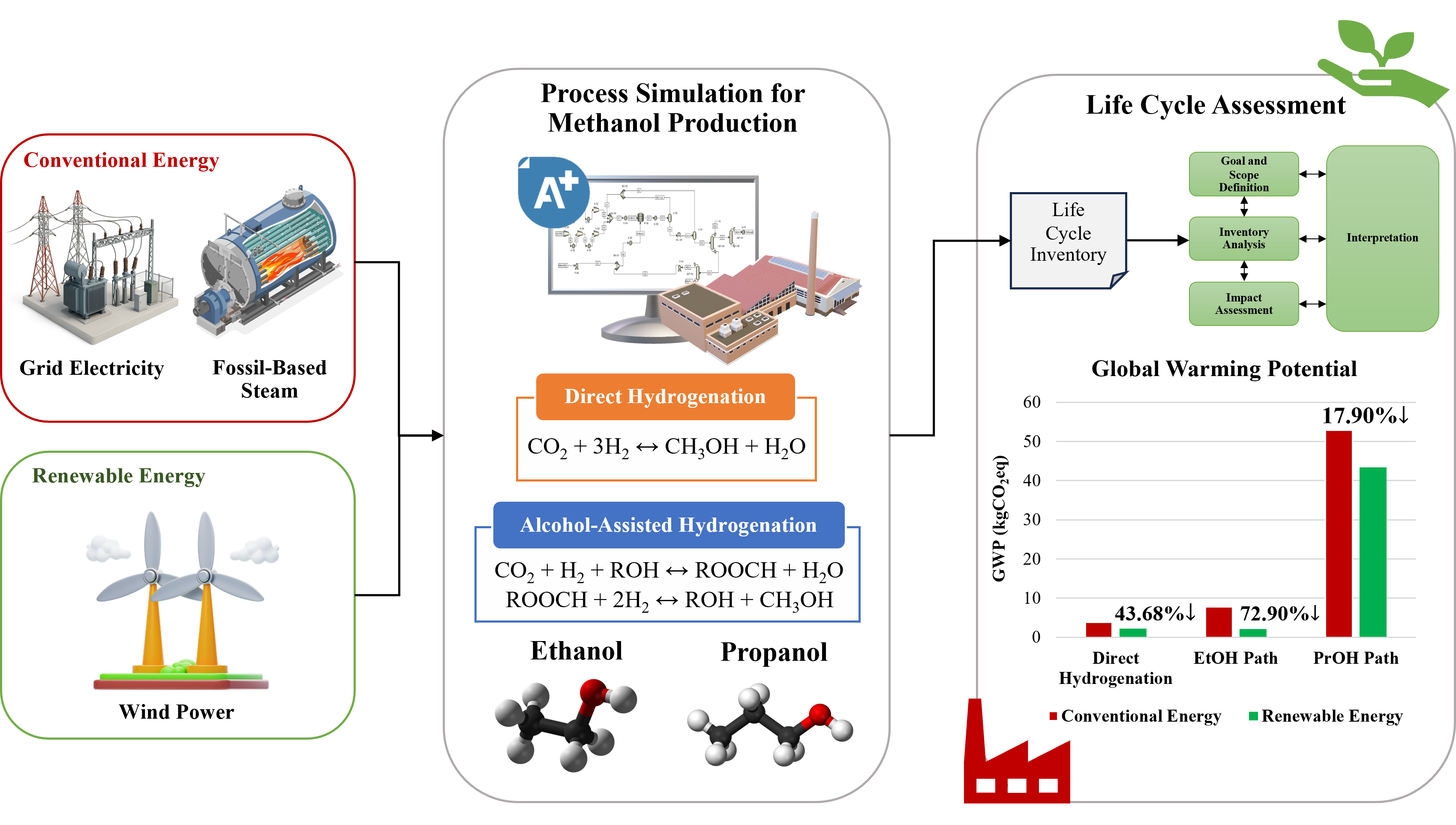
The increasing severity of global warming, primarily driven by greenhouse gas emissions, underscores the urgent need for CO2 reduction and utilization strategies. Converting CO2 into methanol presents a promising approach, as methanol serves both as a fuel and a feedstock in various industries. This study evaluates the life cycle environmental impacts of three methanol production routes: (1) direct CO2 hydrogenation, (2) ethanol-assisted CO2 hydrogenation, and (3) propanol-assisted CO2 hydrogenation. Two energy scenarios are considered: conventional energy and wind power. Process simulations were performed using Aspen Plus V.14, and inventories were analyzed through Life Cycle Assessment (LCA) using the ReCiPe 2016 (H) method under a cradle-to-gate approach for 1,000 kg of methanol. The alcohol-assisted processes operated at a lower reaction temperature (150 °C) and consumed less CO2, H2, and compression energy than the conventional process (250 °C), thereby reducing environmental impacts. However, methanol purification remained energy-intensive. Under conventional energy, the propanol-assisted process exhibited the highest global warming potential (GWP), followed by the ethanol-assisted process, while the conventional route showed the lowest. The elevated impact of the propanol route was primarily attributed to higher alcohol feedstock and energy consumption. The use of wind power significantly reduced GWP in the separation stage of alcohol-assisted routes, resulting in the lowest GWP for the ethanol-assisted process.
Article Details

This work is licensed under a Creative Commons Attribution-NonCommercial 4.0 International License.
Published articles are under the copyright of the Applied Environmental Research effective when the article is accepted for publication thus granting Applied Environmental Research all rights for the work so that both parties may be protected from the consequences of unauthorized use. Partially or totally publication of an article elsewhere is possible only after the consent from the editors.
