Development of a Deep Neural Network Model to Predict PM2.5 Concentrations Based on Key Factors Affecting Air Pollution in Bangkok
Article Sidebar
Main Article Content
Abstract
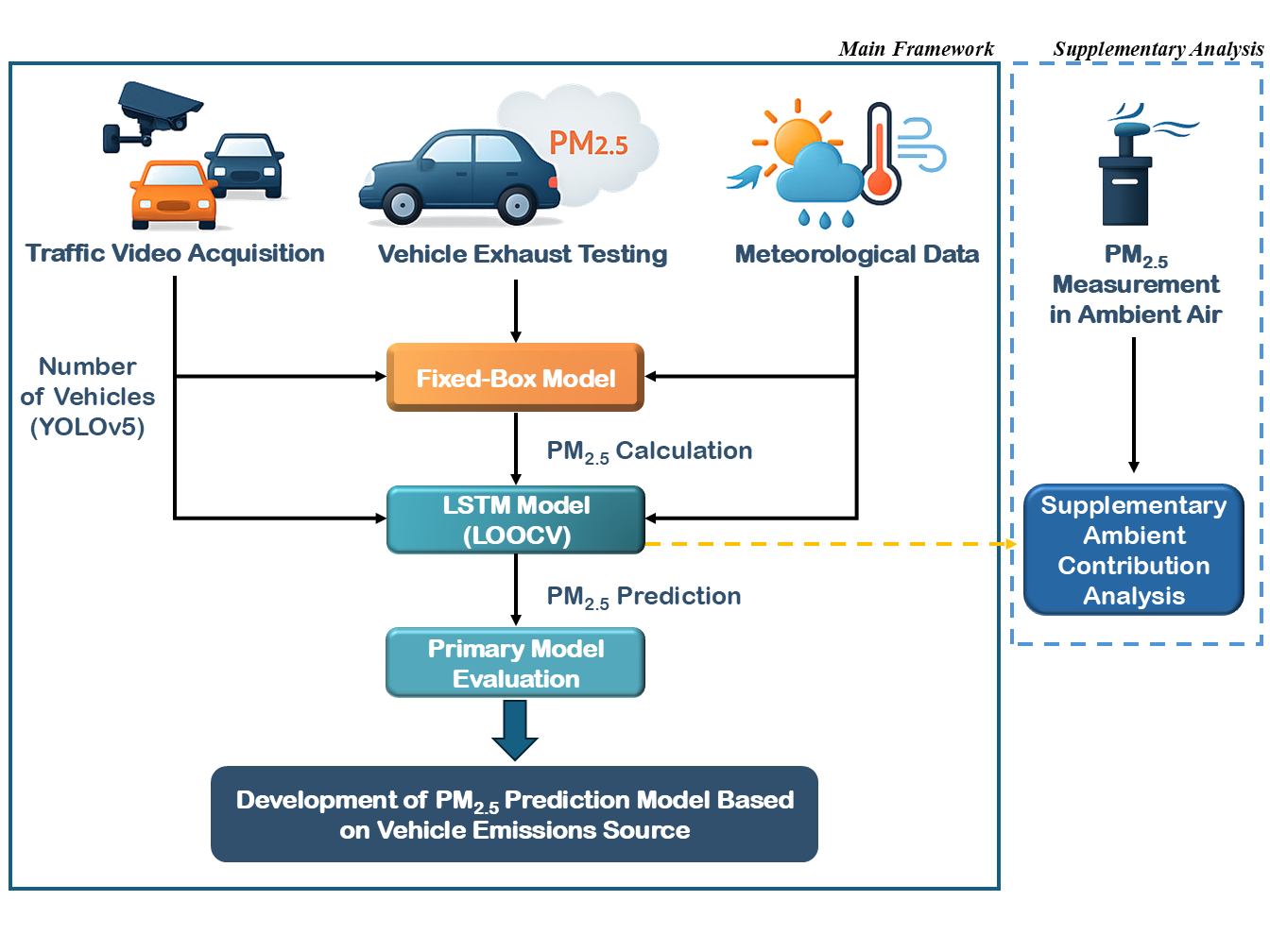
PM2.5 is a significant air pollution concern in Thailand, particularly in urban areas such as Bangkok, where the 24-hour average concentration frequently exceeds national ambient air quality standards during severe seasonal episodes. Road transportation is the primary source of PM2.5 in Bangkok, accounting for 73% of total emissions, according to the Pollution Control Department. In this study, a predictive modeling framework is developed to investigate the relationship between vehicle count and the mass concentration of PM2.5 from vehicular exhaust emissions. Convolutional neural networks (CNNs) and recurrent neural networks (RNNs) are employed for vehicle detection and counting, whereas a long short-term memory (LSTM) network is used to predict traffic-induced PM2.5 levels in urban environments. The fixed-box model was utilized as a baseline calculation, incorporating the vehicle count, meteorological parameters, and localized PM2.5 concentration. Data was collected from a monitoring station on Vibhavadi Rangsit Road, Din Daeng, Bangkok. To ensure robust evaluation on a limited dataset, a leave-one-out cross-validation (LOOCV) strategy was applied. The results indicate that the LSTM model can stably reproduce traffic-induced PM2.5 patterns without overfitting, achieving an R2 of 0.4391, an RMSE of 2.2774 µg m-3, and a MAPE of 26.63%. Furthermore, a supplementary analysis comparing these predictions to measured ambient data estimated that vehicular emissions contribute approximately 59% to the total PM2.5 pollution in the study area. This aligns with the 50–73% contribution from land transport established by prior studies. These findings demonstrate the model’s ability to reliably predict traffic-related emissions. The proposed model can be applied to identify PM2.5 sources from transportation and, alongside other models, assist in forecasting PM2.5 levels in Bangkok to support air quality management.
Article Details

This work is licensed under a Creative Commons Attribution-NonCommercial 4.0 International License.
Published articles are under the copyright of the Applied Environmental Research effective when the article is accepted for publication thus granting Applied Environmental Research all rights for the work so that both parties may be protected from the consequences of unauthorized use. Partially or totally publication of an article elsewhere is possible only after the consent from the editors.
