Seasonal Variations in CO2 Emission from Poultry Manure-amended Soils in Two Contrasting Tropical Agroecosystems
Article Sidebar
Main Article Content
Abstract
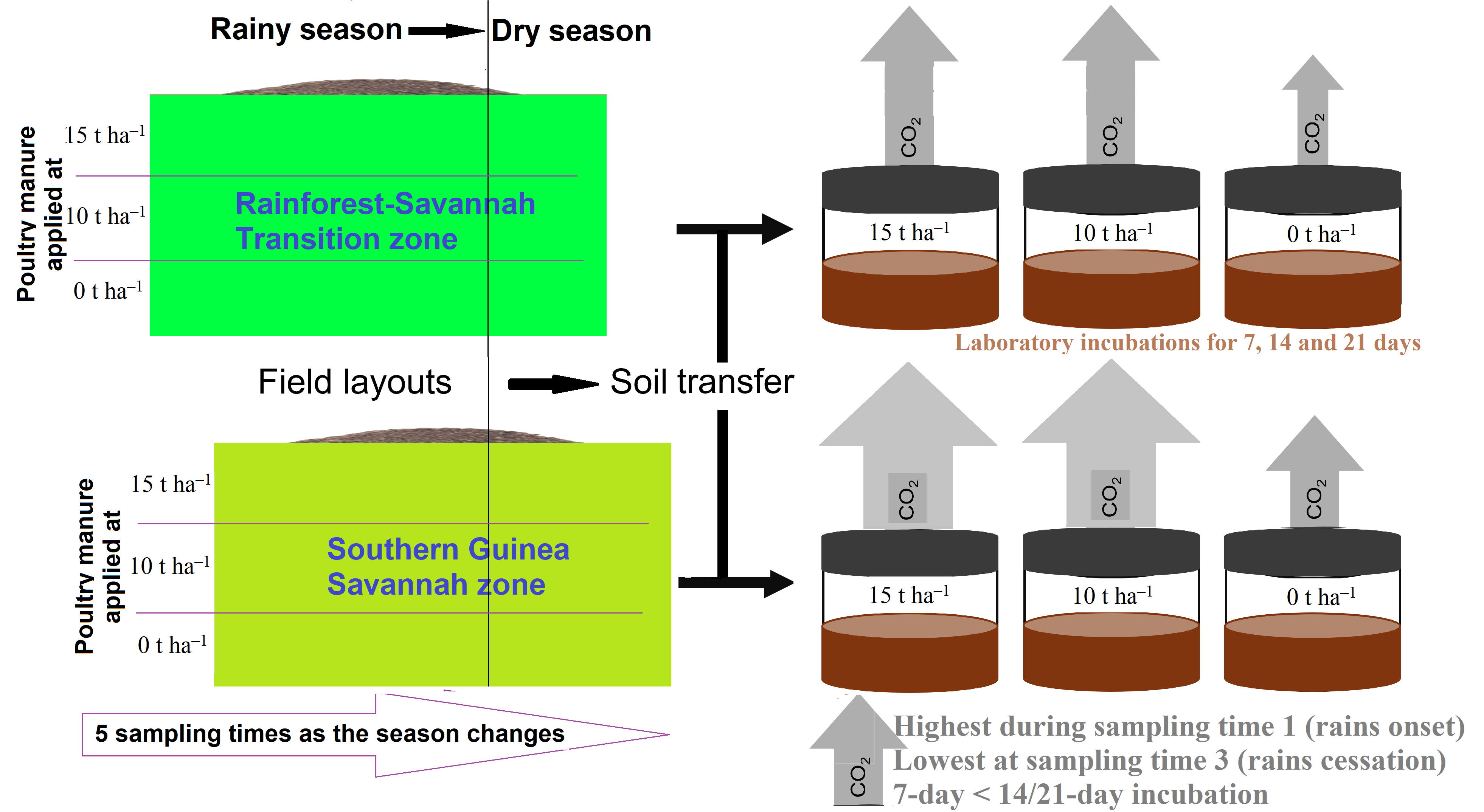
The soil remains the largest carbon sink, the capacity of which varies spatiotemporally and with anthropogenic activities, with implications for carbon dioxide (CO2) emissions and associated global warming. Despite the increasing popularity of organic amendments in the ecologically and anthropoculturally diverse farming systems of tropical Africa, manure-induced CO2 emissions in this region with high soil-carbon-sequestration potential are poorly documented. This study assessed seasonal CO2 emissions from poultry manure-amended sandy-clay-loam and sandy-loam soils in the Rainforest-Savannah and Southern Guinea Savannah zones, respectively, of Nigeria. Following manure application at 3 rates (0, 10, and 15 t ha-1), soil samples were collected during 5 periods (onset, peak and cessation of the rainy season and onset and peak of the dry season). Soil CO2 emissions were monitored after 7-, 14- and 21-day incubations. The emissions varied across manure rates, sampling periods and locations. Compared with 0 t ha-1 treatment, 15 and 10 t ha-1 treatments consistently resulted in higher emissions. These emissions were generally highest at the peaks of the rainy/dry season and lowest at the end of the rainy season, while higher at the southern Guinea Savannah than the Rainforest-Savannah zone. Overall, all three factors studied together described the emissions, which were lower for 7-day than for 14/21-day incubation. To reduce CO2 emissions, poultry manure application at rates ≥ 10 t ha-1 should be discouraged in the humid tropics, particularly locations with fairly warm climates and sandy soils. This study highlights the global warming implications of the increasing adoption of animal manures as organofertilizers and, by extension, the nonconfined rearing of poultry/livestock in tropical African agro-ecosystems. Studies involving different organic soil amendments at varying application rates and agronomic management practices are suggested, especially for coarse-textured soils of the widespread savannah, to deepen the understanding of the mechanisms regulating CO2 emissions.
Article Details

This work is licensed under a Creative Commons Attribution-NonCommercial 4.0 International License.
Published articles are under the copyright of the Applied Environmental Research effective when the article is accepted for publication thus granting Applied Environmental Research all rights for the work so that both parties may be protected from the consequences of unauthorized use. Partially or totally publication of an article elsewhere is possible only after the consent from the editors.
