Landslide Susceptibility Mapping via Dempster-Shafer, Statistical Index, and Certainty Factor Models in GIS and Their Comparison at Pidie Recency in Aceh, Indonesia
Article Sidebar
Main Article Content
Abstract
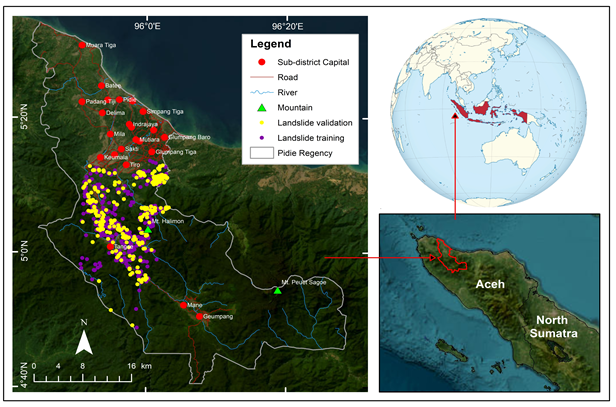
Landslides are natural disasters that are active if there is an interaction of environmental factors that are considered to control them, especially in mountainous areas. This study developed a landslide susceptibility map in Pidie Regency via the Dempster-Shafer (DS), statistical index (SI), and certainty factor (CF) models. A total of 957 landslide events were mapped, 70% of which were used for modeling, whereas the remaining events were used to validate the model output. Fourteen layers of conditioning factors were used: elevation, slope, aspect, curvature, TWI, SPI, STI, NDVI, rainfall, distance from river, distance from road, distance from fault, LULC, and lithology. To assess model performance, the model output was then compared with validation landslide data that had been separated from previous training data. Therefore, the receiver operating charac-teristic (ROC) curve was used, and the area under the curve (AUC) was calculated via the success rate and prediction rate curves. The results show that the CF model has the best performance, with success rates and prediction rates of 81.02% and 80.55%, respectively, followed by DS (80.25% and 78.70%) and SI (76.58% and 75.93%). Therefore, the CF model is more accurate than the DS and SI models. The resulting landslide susceptibility map can be used for early land use planning and hazard mitigation purposes.
Article Details

This work is licensed under a Creative Commons Attribution-NonCommercial 4.0 International License.
Published articles are under the copyright of the Applied Environmental Research effective when the article is accepted for publication thus granting Applied Environmental Research all rights for the work so that both parties may be protected from the consequences of unauthorized use. Partially or totally publication of an article elsewhere is possible only after the consent from the editors.
