Exploration of Indigeneous Biosurfactant-producing Bacillus sp. from Petroleum Hydrocarbon-contaminated Soil in Indonesia
Article Sidebar
Main Article Content
Abstract
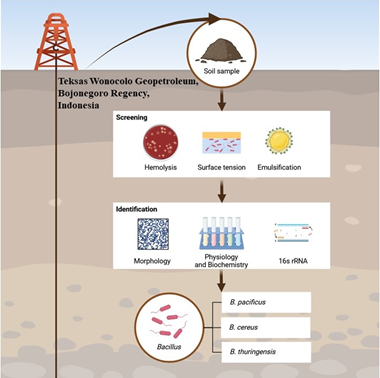
Hydrocarbonolastic bacteria are valuable for the remediation of petroleum-polluted environments. The production of biosurfactants by such bacteria significantly enhances hydrocarbon bioavailability and increases remediation efficiency. One genus of hydrocarbonolastic bacteria with the potential to produce biosurfactants is Bacillus, yet strain-level diversity and local adaptations remain underexplored.Tthis study aimed to isolate and characterize hydrocarbonolastic bacteria belonging to the Bacillus genus from soil samples collected at Geopetroleum Teksas Wonocolo, Kedewan District, Bojonegoro Regency, Indonesia, which is a historically underreported hydrocarbon site. Additionally, the capacity of Bacillus to synthesize biosurfactants was examined. Bacillus strains capable of biosur-factant production were identified via a polyphasic approach. A total of eight hydrocarbonolastic isolates from the Bacillus genus demonstrated biosurfactant-producing capabilities. The top three isolates, Bacillus sp. DIA08, Bacillus sp. DIA12, and Bacillus sp. DIA13, exhibited superior biosurfactant properties, effectively reducing the surface tension of the culture supernatant from an initial value of 72.00 mN m-1 (distilled water) to below 20 mN m-1 and achieving emulsification activity exceeding 50% when kerosene was used as the hydrophobic phase. Kerosene is used because it is a common substrate that is often used in emulsi-fication index tests so that biosurfactant evaluation can be efficient and consistent and can be compared between studies. These three selected Bacillus sp. isolates were subjected to polyphasic identification through the integration of phenotypic and genotypic characteristics. The results revealed the presence of Bacillus pacificus DIA08, Bacillus cereus DIA12, and Bacillus thuringiensis DIA13. The biosurfactants produced by these three isolates show significant potential as effective agents for remediating petroleum hydrocarbon-contaminated soils. This study is the first to report B. pacificus DIA08 and B. thuringiensis DIA13, which were isolated from Indonesian soils with high biosurfactant activity, suggesting their potential as novel bioremediation agents. These findings contribute to the expansion of microbial resources for sustainable soil restoration technologies.
Article Details

This work is licensed under a Creative Commons Attribution-NonCommercial 4.0 International License.
Published articles are under the copyright of the Applied Environmental Research effective when the article is accepted for publication thus granting Applied Environmental Research all rights for the work so that both parties may be protected from the consequences of unauthorized use. Partially or totally publication of an article elsewhere is possible only after the consent from the editors.
